
We read your photo as:
Evaluate the role of hypothesis testing in evidence-based decision-making, emphasizing the implications of Type I and Type II errors in the interpretation of results. Support your discussion with real
ScanSolve AI Answer
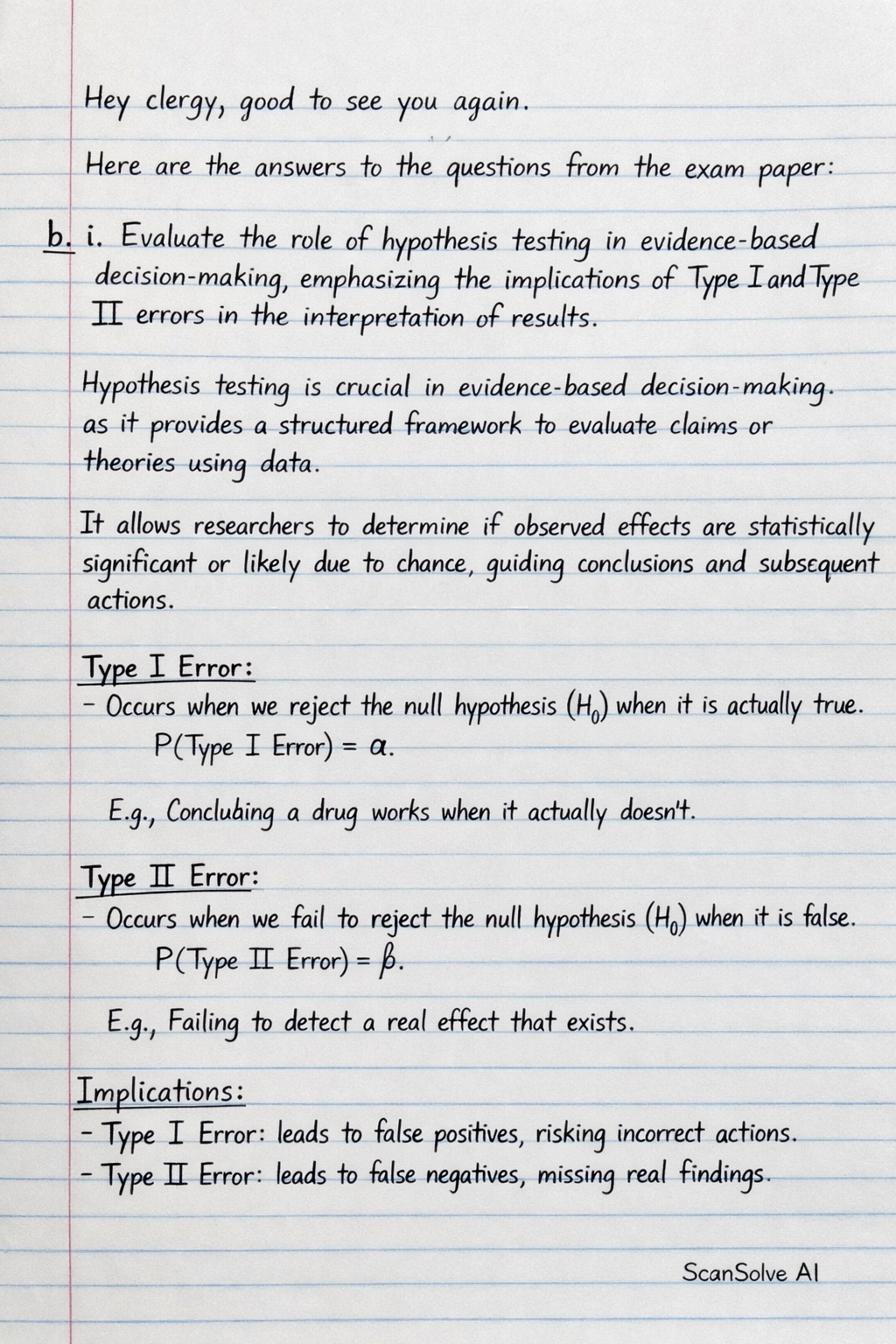
Here are the answers to the questions from the exam paper:
b. i. Evaluate the role of hypothesis testing in evidence-based decision-making, emphasizing the implications of Type I and Type II errors in the interpretation of results.
Hypothesis testing is crucial in evidence-based decision-making as it provides a structured framework to evaluate claims or theories using data. It allows researchers to determine if observed effects are statistically significant or likely due to chance, guiding conclusions and subsequent actions.
- Type I Error (False Positive): Occurs when the null hypothesis is incorrectly rejected (e.g., concluding there is an effect when there isn't one). Implications include wasting resources on ineffective interventions, adopting flawed policies, or causing unnecessary alarm.
- Type II Error (False Negative): Occurs when the null hypothesis is incorrectly accepted (e.g., failing to detect an effect when one truly exists). Implications include missing out on beneficial treatments, overlooking critical risks, or failing to identify important relationships, potentially leading to missed opportunities or continued harm.
ii. Support your discussion with real-world examples from various disciplines.
- Medicine (Type I Error): A new drug is falsely concluded to be effective (Type I error), leading to its approval and use, potentially exposing patients to side effects without benefit.
- Medicine (Type II Error): A diagnostic test for a disease is falsely concluded to be ineffective (Type II error), leading to its rejection, and patients with the disease are not diagnosed or treated.
- Law (Type I Error): A jury convicts an innocent person (Type I error), leading to wrongful imprisonment.
- Law (Type II Error): A jury acquits a guilty person (Type II error), allowing a criminal to go free.
- Engineering (Type I Error): A new material is deemed stronger than it is (Type I error), leading to structural failures in construction.
- Engineering (Type II Error): A critical flaw in a design is missed (Type II error), leading to product recalls or safety hazards.
5. a. i. Discuss the structure of semantic differential questionnaire and its application across different fields.
The semantic differential questionnaire is a scaling method used to measure the connotative meaning of objects, concepts, or people. Its structure involves a series of bipolar adjective pairs (e.g., good-bad, strong-weak, active-passive) placed at opposite ends of a numerical scale, typically 5-point or 7-point. Respondents rate a given concept by marking a point on each scale that best represents their perception.
- Applications:
- Marketing: Assessing consumer perceptions of brands, products, or advertisements.
- Psychology: Measuring attitudes towards social issues, self-concept, or personality traits.
- Sociology: Evaluating public opinion on political figures, policies, or cultural phenomena.
- Education: Gauging student attitudes towards courses, teaching methods, or learning materials.
ii. Evaluate its application in your field of study.
In the field of Immunity and Infectious Diseases and Parasite Biology and Control, the semantic differential scale can be highly valuable for:
- Assessing Public Perception: Measuring public attitudes towards vaccination campaigns (e.g., safe-dangerous, effective-ineffective, necessary-unnecessary) or acceptance of new disease control measures (e.g., acceptable-unacceptable, convenient-inconvenient).
- Evaluating Patient Experiences: Understanding patient perceptions of treatment regimens for infectious diseases (e.g., tolerable-intolerable, helpful-unhelpful) or their trust in healthcare providers.
- Community Engagement: Gauging community perceptions of vector control interventions for parasitic diseases (e.g., clean-dirty, pleasant-unpleasant, useful-useless) to inform more effective public health strategies.
- Expert Opinion: Collecting structured expert opinions on the perceived efficacy or safety of novel diagnostic tools or therapeutic agents.
iii. Evaluate its advantages and limitations in research.
-
Advantages:
- Quantifies Subjective Data: Transforms qualitative perceptions into quantifiable data, allowing for statistical analysis.
- Versatility: Applicable to a wide range of concepts and suitable for various research designs.
- Captures Nuance: Measures multiple dimensions of meaning (e.g., evaluation, potency, activity), providing a richer understanding than simple agreement scales.
- Ease of Administration: Relatively simple for respondents to understand and complete.
-
Limitations:
- Subjectivity of Adjectives: The selection of adjective pairs can be subjective and may not fully capture all relevant dimensions of a concept.
- Cultural Bias: Adjective meanings can vary across cultures, potentially affecting the validity of cross-cultural comparisons.
- Interpretation Challenges: Interpreting the "semantic space" created by multiple scales can sometimes be complex.
- Limited to Bipolar Concepts: Only suitable for concepts that can be meaningfully described by opposing adjectives.
b. How does the semantic differential scale enhance the accuracy of measuring subjective experiences compared to other scaling methods?
The semantic differential scale enhances the accuracy of measuring subjective experiences by providing a more nuanced and multi-dimensional assessment compared to simpler scaling methods like Likert scales or binary (yes/no) questions.
- Multi-Dimensional Measurement: Unlike a single Likert item that measures agreement on one statement, the semantic differential uses multiple bipolar adjective pairs to tap into different dimensions of a concept's meaning (e.g., evaluative, potency, activity). This allows researchers to understand not just if someone likes something, but how they perceive it across various attributes (e.g., good, strong, active).
- Captures Intensity and Direction: By placing adjectives on a continuum, it captures both the direction (e.g., good vs. bad) and intensity (e.g., slightly good vs. extremely good) of a feeling or perception. This provides a more granular understanding than a simple "agree/disagree" or "like/dislike" response.
- Reduces Response Bias: The use of multiple scales for the same concept can help mitigate some response biases, as respondents are less likely to give consistently extreme or neutral answers across all dimensions.
- Reveals Semantic Space: It allows for the mapping of concepts within a "semantic space," visually representing how different concepts are perceived relative to each other. This can reveal subtle differences in subjective experiences that other scales might miss. For example, two brands might both be rated "good" on a Likert scale, but a semantic differential might show one is perceived as "strong and active" while the other is "weak and passive."
Still stuck on this one?
Ask a follow-up, and the answer starts from this question.
More Economics Questions
Handwritten Step-by-Step Solution
Get this as a handwritten image on WhatsApp — like a tutor wrote it for you.
Try on WhatsApp