
We read your photo as:
Describe the roles of the three levels of the public sector in the economy, and explain the reasons for state involvement in the economy.
ScanSolve AI Answer
Step-by-step solution
7 stepshere are the answers to your questions:
Part 1
Part 1.1· 3 steps
Roles of THREE levels of public sector in the economy
Please note: As an AI, I cannot provide actual pictures or images. However, I will explain the roles clearly, as if describing what an image might depict.
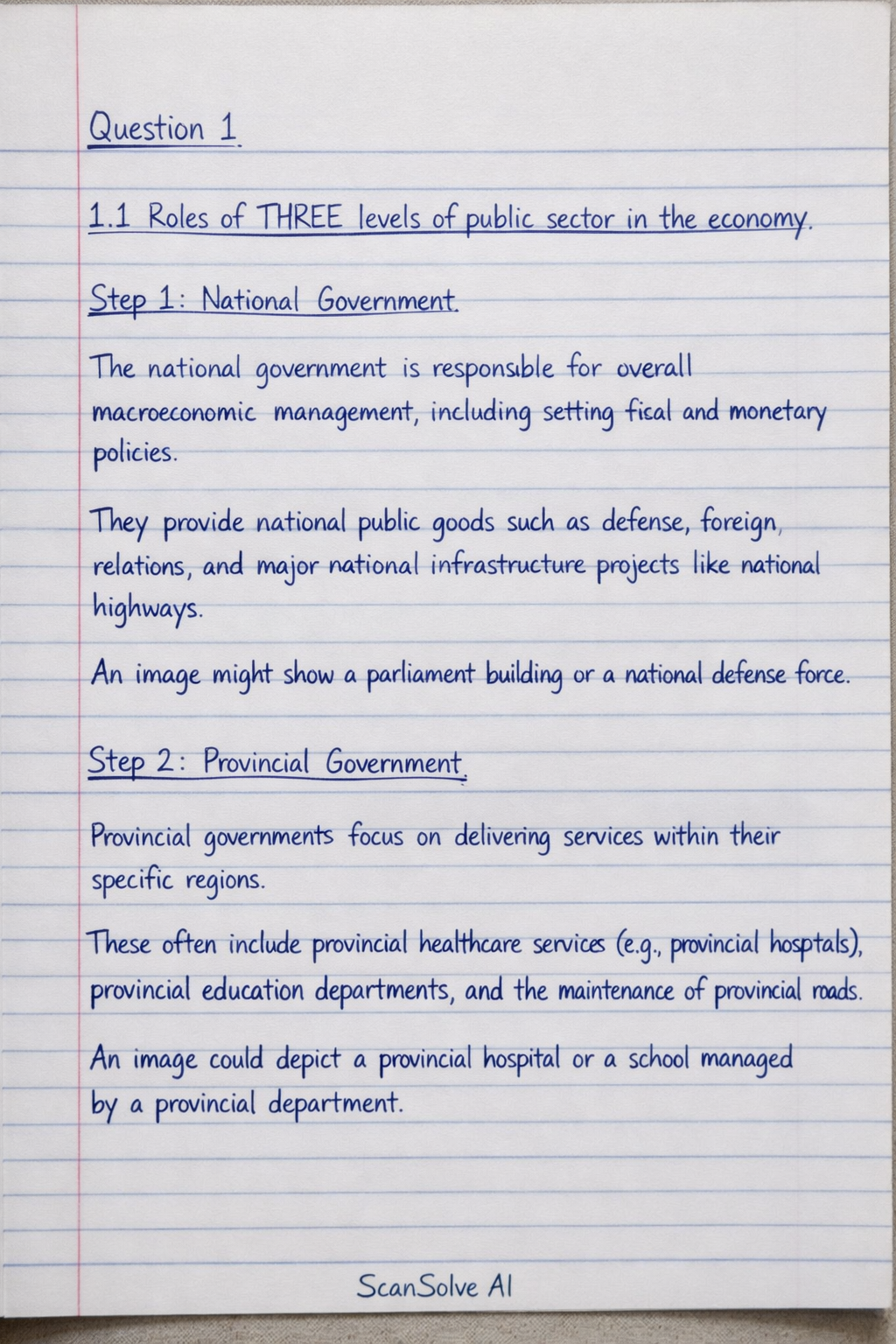
National Government
The national government is responsible for overall macroeconomic management, including setting fiscal and monetary policies. It provides national public goods such as defense, foreign relations, and major national infrastructure projects like national highways. An image might show a parliament building or a national defense force.
Provincial Government
Provincial governments focus on delivering services within their specific regions. These often include provincial healthcare services (e.g., provincial hospitals), provincial education departments, and the maintenance of provincial roads. An image could depict a provincial hospital or a school managed by a provincial department.
Local Government
Local governments (municipalities) provide essential services directly to communities. These services include water supply, sanitation, electricity distribution, waste removal, and the maintenance of local roads and public parks. An image might show a municipal water treatment plant or a local waste collection truck.
Part 1.2· 4 steps
Reasons for state involvement in the economy
Please note: As an AI, I cannot conduct an interview. However, I can provide a summary of common reasons for state involvement in the economy, as if compiled from an interview.
Addressing Market Failure
The state intervenes when free markets fail to allocate resources efficiently. For example, private companies might not provide enough public goods like streetlights or national defense because it's hard to charge individuals for them. The government steps in to provide these. Another example is controlling externalities like pollution, where the government imposes regulations or taxes to reduce negative impacts.
Income Redistribution
Governments aim to reduce income inequality and poverty. They do this through mechanisms like progressive taxation, where higher earners pay a larger percentage of their income in taxes. This revenue is then used to fund social grants (e.g., child support grants, old age pensions) and unemployment benefits, ensuring a basic safety net for vulnerable citizens.
Promoting Economic Stability and Growth
The state plays a crucial role in stabilizing the economy and fostering sustainable growth. Through fiscal policy (government spending and taxation) and monetary policy (managing interest rates and money supply), the government tries to control inflation, reduce unemployment, and prevent severe economic downturns or booms. For instance, during a recession, the government might increase spending on infrastructure projects to create jobs.
Regulation and Consumer Protection
Governments regulate various industries to ensure fair competition and protect consumers and workers. This includes setting standards for product safety (e.g., food safety regulations), enforcing anti-monopoly laws to prevent single companies from dominating markets unfairly, and establishing labor laws to ensure fair wages and safe working conditions. For example, a government agency might inspect food processing plants to ensure hygiene standards are met.
Still stuck on this one?
Ask a follow-up, and the answer starts from this question.
More Economics Questions
Handwritten Step-by-Step Solution
Get this as a handwritten image on WhatsApp — like a tutor wrote it for you.
Try on WhatsApp