
We read your photo as:
Study the graph below and answer the questions that follow: Identify the market structure depicted in the graph. Name the cost curve that represents supply in the business. Briefly describe the term shut down point. Why should marginal revenue be equal to marginal cost for profits to be maximised?
ScanSolve AI Answer
here are the answers to your questions based on the graph and economic principles:
2.3 Study the graph below and answer the questions that follow.
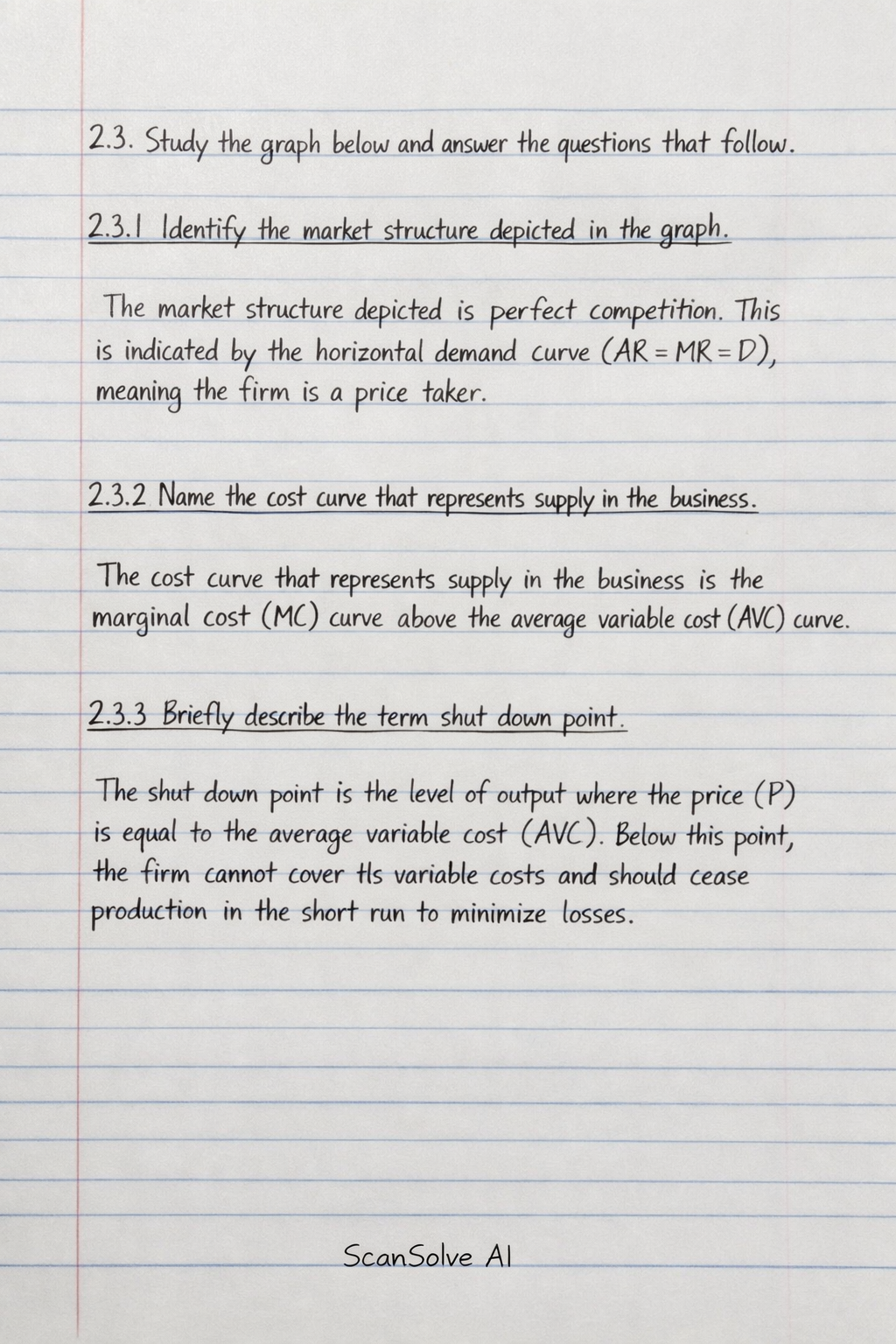
2.3.1 Identify the market structure depicted in the graph.
The market structure depicted is perfect competition. This is indicated by the horizontal demand curve (AR=MR=D), meaning the firm is a price taker.
2.3.2 Name the cost curve that represents supply in the business.
The cost curve that represents supply in the business is the marginal cost (MC) curve above the average variable cost (AVC) curve.
2.3.3 Briefly describe the term shut down point.
The shut down point is the level of output where the price (P) is equal to the average variable cost (AVC). Below this point, the firm cannot cover its variable costs and should cease production in the short run to minimize losses.
2.3.4 Why should marginal revenue be equal to marginal cost for profits to be maximised?
Profit maximization occurs where marginal revenue (MR) equals marginal cost (MC). If MR > MC, producing an additional unit adds more to revenue than to cost, increasing profit. If MR < MC, producing an additional unit adds more to cost than to revenue, decreasing profit. Therefore, profits are maximized at the output level where MR = MC.
2.3.5 How is the law of diminishing marginal returns related to the shape of the short-run marginal cost curve?
The law of diminishing marginal returns states that as more units of a variable input are added to a fixed input, the marginal product of the variable input will eventually decrease. This causes the short-run marginal cost (MC) curve to initially fall as efficiency increases, but then to rise as diminishing returns set in, leading to its characteristic U-shape.
2.4 Briefly discuss the relationship between product market and factor market.
The product market is where goods and services are bought and sold, with households as demanders and firms as suppliers. The factor market is where factors of production (land, labor, capital, entrepreneurship) are exchanged, with firms as demanders and households as suppliers. These markets are interdependent: firms demand factors in the factor market to produce goods for the product market, and households earn income from supplying factors to buy goods in the product market.
2.5 Analyse the SMART principle for setting the objectives of business.
The SMART principle is a framework for setting effective business objectives:
- Specific: Objectives should be clear and well-defined, stating exactly what needs to be achieved.
- Measurable: Objectives must have quantifiable criteria to track progress and determine when the objective has been met.
- Achievable: Objectives should be realistic and attainable given the available resources and constraints.
- Relevant: Objectives should align with the overall business goals and strategy.
- Time-bound: Objectives must have a defined start and end date, creating a sense of urgency and a clear deadline for completion.
This framework helps businesses create actionable and trackable goals, improving their chances of success.
Still stuck on this one?
Ask a follow-up, and the answer starts from this question.
More Economics Questions
Handwritten Step-by-Step Solution
Get this as a handwritten image on WhatsApp — like a tutor wrote it for you.
Try on WhatsApp