
We read your photo as:
Study the table and answer the questions about wages, labour categories, and labour demand in South Africa.
ScanSolve AI Answer
Answer
here are the answers to the next set of questions:
2.3 Study the table below and answer the questions that follow.
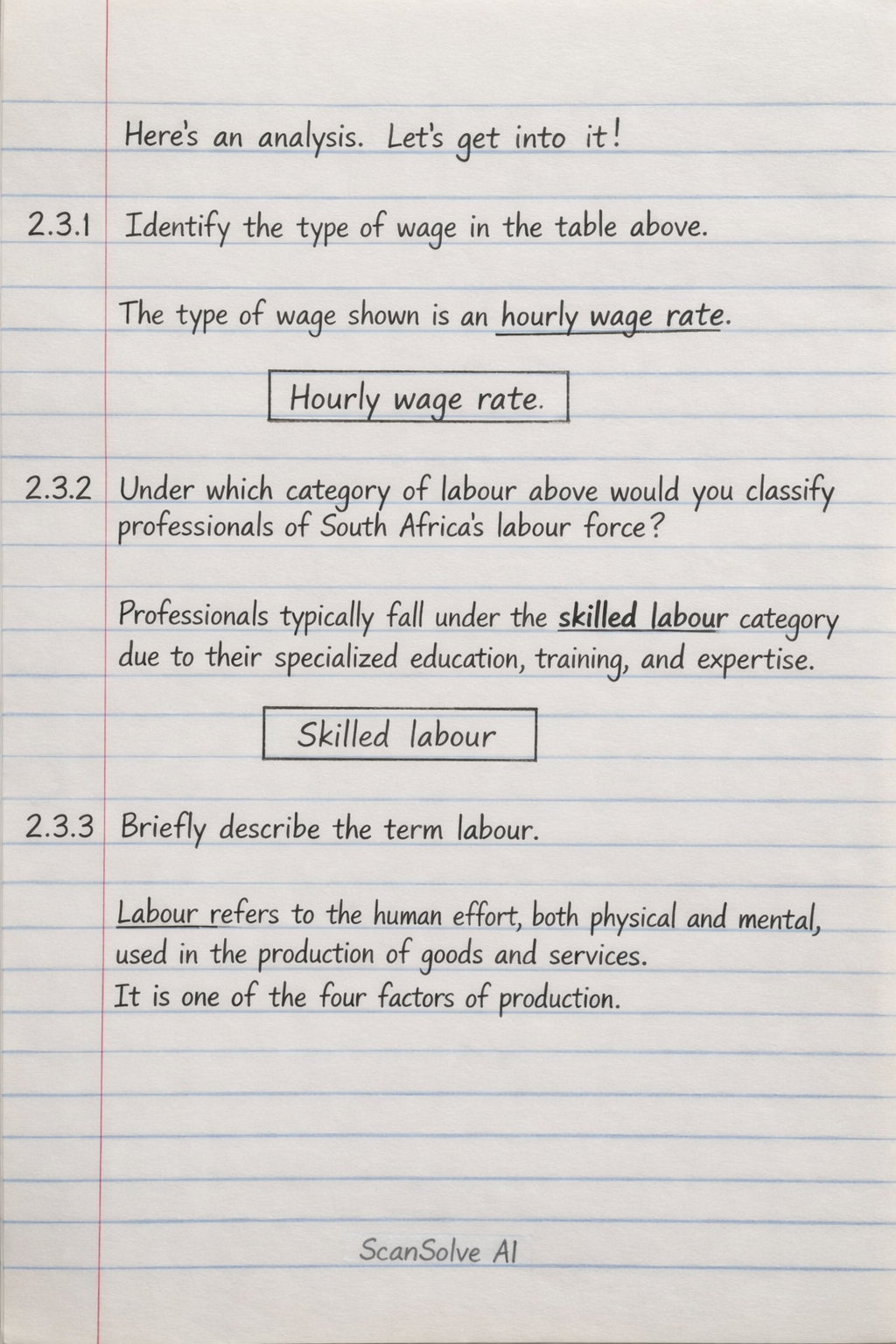
2.3.1 Identify the type of wage in the table above.
The type of wage shown is an hourly wage rate.
2.3.2 Under which category of labour above would you classify professionals of South Africa's labour force?
Professionals typically fall under the skilled labour category due to their specialized education, training, and expertise.
2.3.3 Briefly describe the term labour.
Labour refers to the human effort, both physical and mental, used in the production of goods and services. It is one of the four factors of production.
2.3.4 Explain the impact of a change in demand for a good or service on the demand for labour.
A change in demand for a good or service directly impacts the demand for labour because labour is a derived demand. If the demand for a good or service increases, businesses will need to produce more, leading to an increased demand for labour. Conversely, a decrease in demand for a good or service will lead to a decreased demand for labour.
2.3.5 How can the quality of labour be improved in South Africa?
The quality of labour in South Africa can be improved through:
- Investing in education and training: Providing access to quality schooling, vocational training, and higher education.
- Skills development programs: Implementing initiatives to upskill and reskill the workforce to meet industry demands.
- Healthcare and nutrition: Improving public health services and ensuring adequate nutrition to enhance worker productivity and reduce absenteeism.
- Workplace experience and mentorship: Offering internships, apprenticeships, and mentorship programs to develop practical skills and experience.
2.4 Discuss functional classification and economic classification of government expenditure.
- Functional classification categorizes government expenditure based on the purpose for which the money is spent. This shows what the government is trying to achieve. Examples include spending on education, health, defense, social protection, and general public services. It helps in understanding the government's priorities and the allocation of resources to different sectors.
- Economic classification categorizes government expenditure based on the type of transaction or the economic nature of the spending. This shows how the money is spent and its impact on the economy. Examples include current expenditure (e.g., salaries, goods and services for consumption), capital expenditure (e.g., infrastructure, machinery), and transfer payments (e.g., social grants, subsidies). It helps in analyzing the economic effects of government spending, such as its impact on aggregate demand, investment, and income distribution.
2.5 Examine the contribution of the businesses to the economy.
Businesses are crucial contributors to the economy in several ways:
- Production of goods and services: They produce the vast majority of goods and services consumed by households and other businesses, satisfying needs and wants.
- Job creation: Businesses are the primary source of employment, providing income for individuals and reducing unemployment rates.
- Innovation and technological advancement: They invest in research and development, leading to new products, processes, and technologies that drive economic progress and improve living standards.
- Economic growth: Through investment in capital, expansion, and increased production, businesses contribute to the overall growth of the Gross Domestic Product (GDP).
- Tax revenue: Businesses pay various taxes (e.g., corporate income tax, VAT, payroll taxes), which fund government services and public infrastructure.
- Exports: Many businesses produce goods and services for export, earning foreign exchange and improving a country's balance of payments.
- Development of infrastructure: Their operations often necessitate and contribute to the development of supporting infrastructure like roads, utilities, and communication networks.
Try one yourself
A new problem that tests the same skill.
Still stuck on this one?
Ask a follow-up, and the answer starts from this question.
More Economics Questions
Handwritten Step-by-Step Solution
Get this as a handwritten image on WhatsApp — like a tutor wrote it for you.
Try on WhatsApp