
How to calculate tariff
Economics
ScanSolve AI Answer
Step-by-step solution
5 stepsTo calculate a tariff, you generally need to know the base price of a good or service and the tariff rate. The tariff is usually a percentage of the base price.
Identify the base price of the good or service.
Determine the tariff rate, which is often expressed as a percentage.
Convert the tariff rate percentage to a decimal by dividing by 100.
For example, a 10% tariff becomes .
Multiply the base price by the decimal tariff rate to find the tariff amount.
Tariff Amount = Base Price (Tariff Rate / 100)
Add the tariff amount to the base price to get the final price including the tariff.
Final Price = Base Price + Tariff Amount
For example, if a product costs 100 \times (20/100) = 100 + $20 = 120
Was this helpful?
Still stuck on this one?
Ask a follow-up, and the answer starts from this question.
Got a different question?Ask your own question
More Economics Questions
QCalculate the cost of units in the first tariff block.QExplain what a tariff is in this context and calculate the total units of electricity purchased…QExplain the term tariff (2.1)QA tariff is a schedule of rates or charges for a service, such as electricity, water, or…Q1.1. Define the basic charge in the given context. 1.1.2. Show how the tariff of R38,62 during…
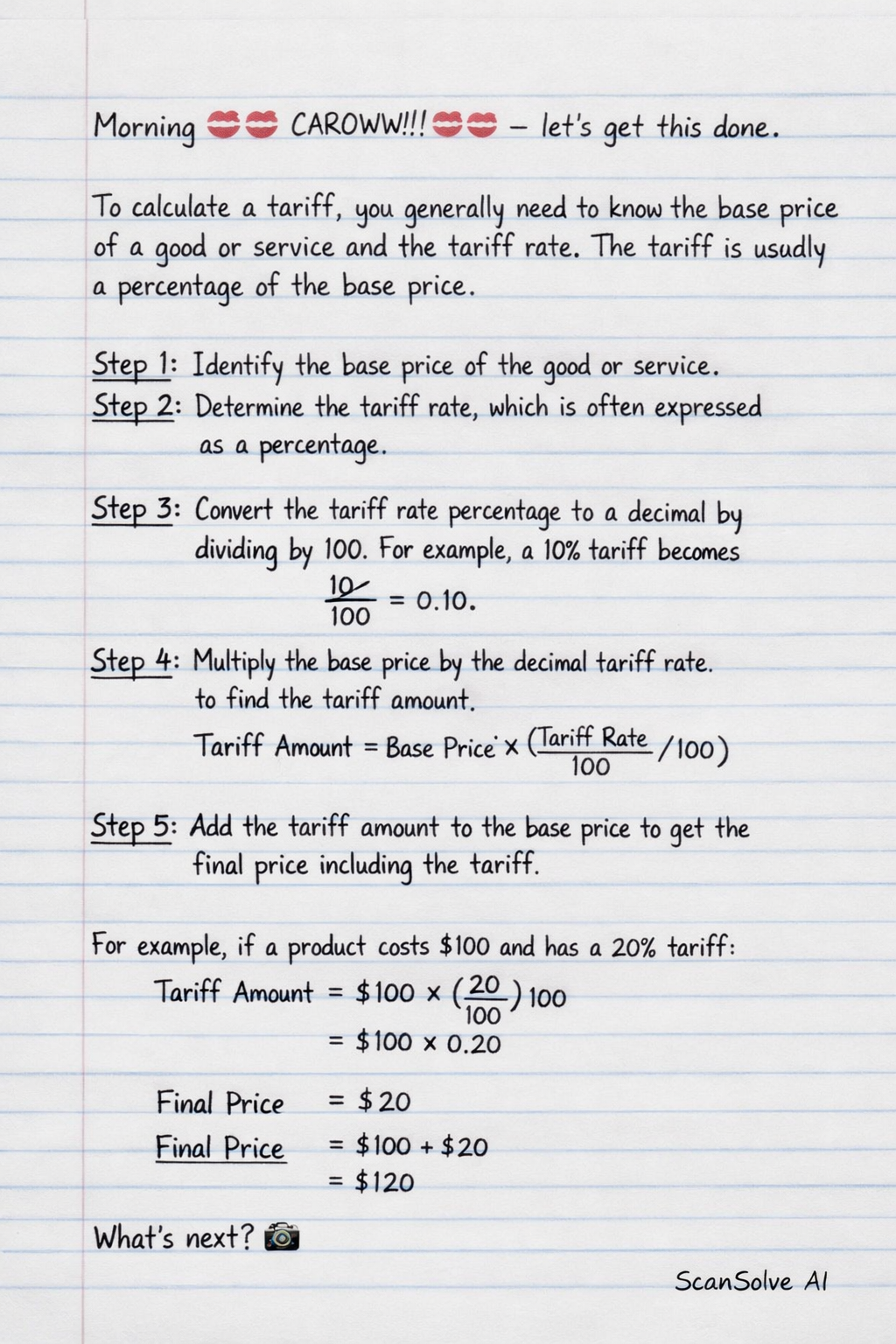
Handwritten Step-by-Step Solution
Get this as a handwritten image on WhatsApp — like a tutor wrote it for you.
Try on WhatsApp