
We read your photo as:
What is the central concept of neoclassical welfare economics and what does Pareto efficiency imply?
ScanSolve AI Answer
Answer
Step-by-step solution
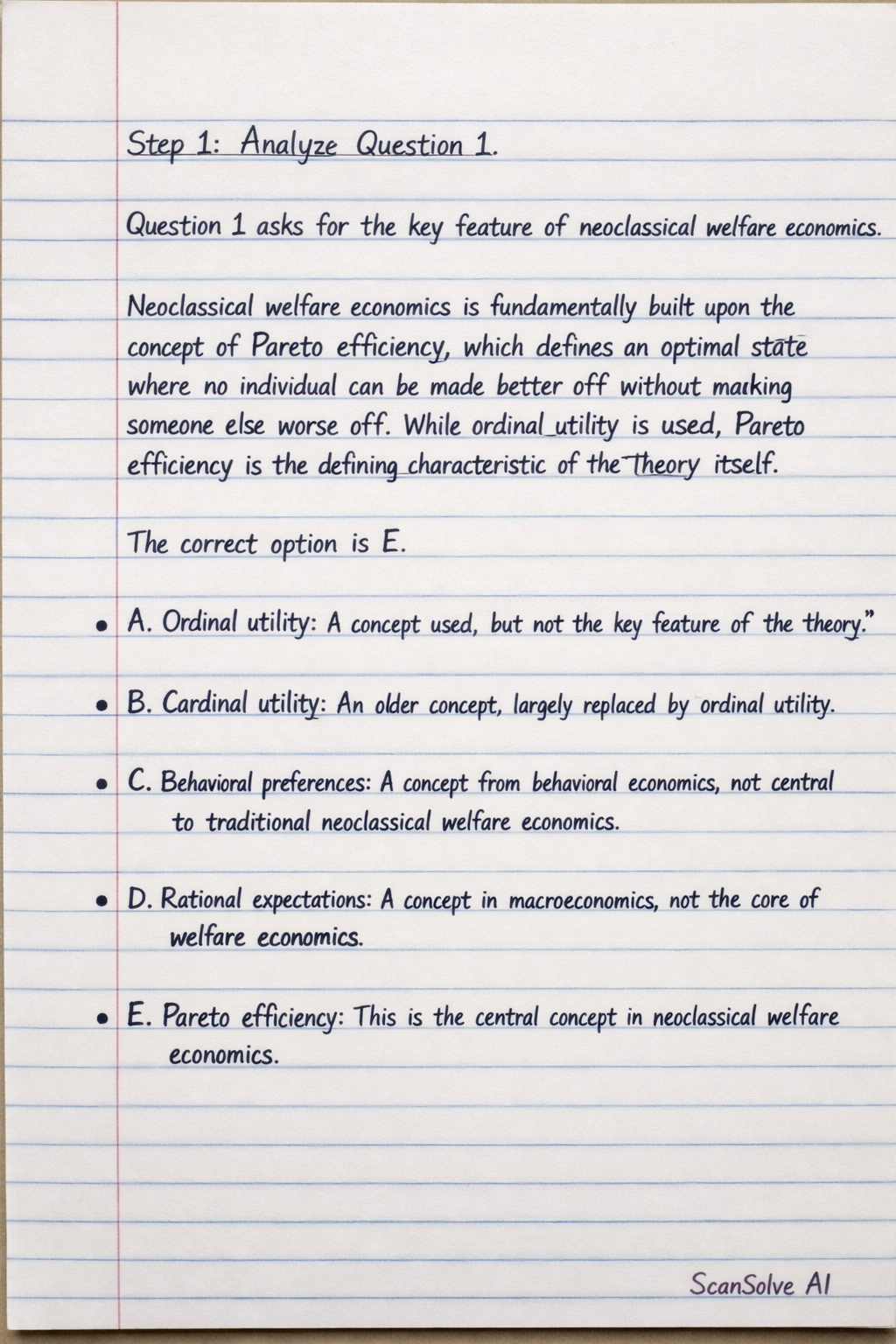
4 stepsAnalyze Question 1.
Question 1 asks for the key feature of neoclassical welfare economics. Neoclassical welfare economics is fundamentally built upon the concept of Pareto efficiency, which defines an optimal state where no individual can be made better off without making someone else worse off. While ordinal utility is used, Pareto efficiency is the defining characteristic of the theory itself.
The correct option is E.
- A. Ordinal utility: A concept used, but not the key feature of the theory.
- B. Cardinal utility: An older concept, largely replaced by ordinal utility.
- C. Behavioral preferences: A concept from behavioral economics, not central to traditional neoclassical welfare economics.
- D. Rational expectations: A concept in macroeconomics, not the core of welfare economics.
- E. Pareto efficiency: This is the central concept in neoclassical welfare economics.
Analyze Question 2.
Question 2 asks what Pareto efficiency implies. Pareto efficiency is a state where resources are allocated in such a way that it is impossible to make any one individual better off without making at least one individual worse off.
The correct option is B.
- A. Income is equally distributed: Pareto efficiency does not guarantee equity or equal distribution of income.
- B. No one can be made better off without harming another: This is the definition of Pareto efficiency.
- C. Government intervention is necessary: The First Welfare Theorem suggests competitive markets can achieve Pareto efficiency without intervention under certain conditions.
- D. Markets fail always: This is incorrect; markets can achieve efficiency.
Analyze Question 3.
Question 3 asks for the condition that ensures efficiency in exchange (also known as consumption efficiency). Efficiency in exchange occurs when the goods are distributed among consumers such that no further reallocations can make one consumer better off without making another worse off. This condition is met when the marginal rate of substitution (MRS) between any two goods is the same for all consumers.
The correct option is C.
- A. : This relates to overall efficiency (production and consumption), not solely exchange. (Marginal Rate of Technical Substitution) is for production.
- B. equal across firms: This is a condition for production efficiency.
- C. equal across consumers: This is the condition for efficiency in exchange.
- D. Prices equal wages: This relates to factor markets.
- E. Factor-price efficiency requires: This relates to production efficiency.
Analyze Question 4.
Question 4 asks what the First Welfare Theorem states. The First Welfare Theorem is a fundamental result in welfare economics, stating that under certain ideal conditions (such as perfect competition, complete markets, and no externalities), a competitive equilibrium will lead to a Pareto efficient allocation of resources.
The correct option is B.
- A. All equilibrium are equitable: The theorem does not address equity.
- B. Competitive equilibrium is Pareto efficient: This is the core statement of the First Welfare Theorem.
- C. Government improves efficiency: The theorem suggests efficiency can be achieved without government intervention in ideal competitive markets.
- D. Markets fail always: This contradicts the theorem.
Here are the answers:
-
The key feature of the theory neoclassical welfare economics is: E. Pareto efficiency
-
Pareto efficiency implies that: B. No one can be made better off without harming another
-
Which condition ensures efficiency in exchange? C. equal across consumers
-
The First Welfare Theorem states that: B. Competitive equilibrium is Pareto efficient
Try one yourself
A new problem that tests the same skill.
Still stuck on this one?
Ask a follow-up, and the answer starts from this question.
More Economics Questions
Handwritten Step-by-Step Solution
Get this as a handwritten image on WhatsApp — like a tutor wrote it for you.
Try on WhatsApp