
We read your photo as:
What are the correct answers and explanations for the following multiple-choice questions about the circular flow of income and GDP calculation?
ScanSolve AI Answer
Answer
Step-by-step solution
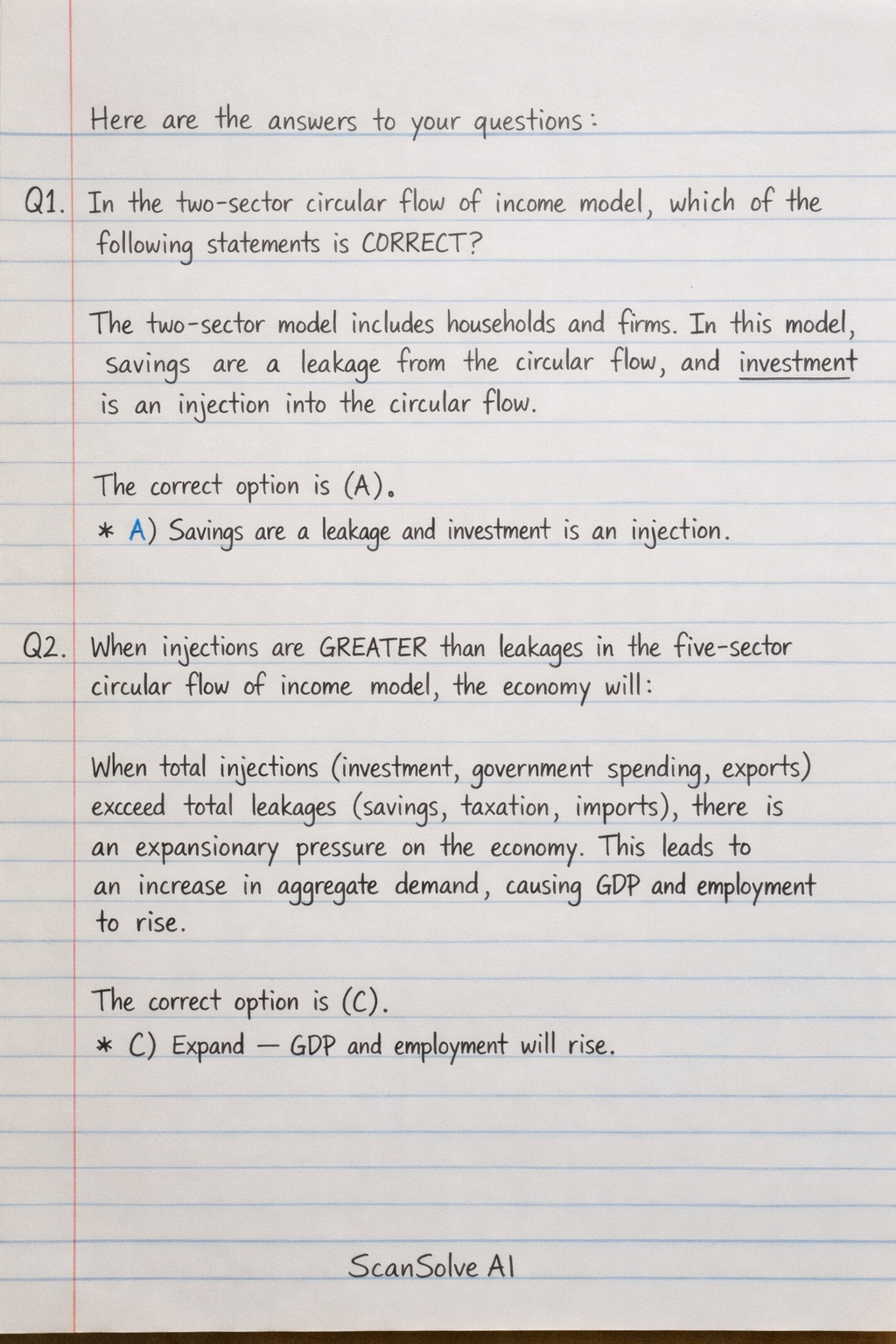
2 stepsHere are the answers to your questions:
Q1. In the two-sector circular flow of income model, which of the following statements is CORRECT?
The two-sector model includes households and firms. In this model, savings are a leakage from the circular flow, and investment is an injection into the circular flow.
The correct option is (A).
- A) Savings are a leakage and investment is an injection
Q2. When injections are GREATER than leakages in the five-sector circular flow of income model, the economy will:
When total injections (investment, government spending, exports) exceed total leakages (savings, taxation, imports), there is an expansionary pressure on the economy. This leads to an increase in aggregate demand, causing GDP and employment to rise.
The correct option is (C).
- C) Expand — GDP and employment will rise
Q3. Using the expenditure method, GDP is calculated as:
The expenditure method calculates GDP by summing up all spending on final goods and services in an economy. The formula is:
The correct option is (C).
- C) GDP = C + I + G + (X - M)
Q4. Which of the following correctly lists ALL the leakages in the five-sector circular flow of income model?
In the five-sector model (households, firms, financial sector, government, foreign sector), leakages are withdrawals from the circular flow. These are Savings (S), Taxation (T), and Imports (M).
The correct option is (B).
- B) Savings, Taxation, Imports
Q5. PNG's GDP = K20 billion; overseas income earned by PNG residents = K2 billion; income earned in PNG by foreign residents = K3 billion. What is PNG's GNP?
GNP (Gross National Product) is calculated as GDP plus Net Factor Income from Abroad.
Net Factor Income from Abroad = Income earned by domestic residents from abroad - Income earned by foreign residents domestically.
Calculate Net Factor Income from Abroad.
Calculate GNP.
The correct option is (C).
- C) K19 billion
Q6. Philip's Curve demonstrates a trade-off between:
The Phillips Curve illustrates an inverse relationship between the rate of unemployment and the rate of inflation in an economy.
The correct option is (C).- C) The rate of inflation and the rate of unemployment
Q7. Which of the following BEST describes 'stagflation'?
Stagflation is an economic condition characterized by a combination of slow economic growth (stagnation), high unemployment, and rising prices (inflation).
The correct option is (C).- C) A period of simultaneously high inflation AND high unemployment
Try one yourself
A new problem that tests the same skill.
Still stuck on this one?
Ask a follow-up, and the answer starts from this question.
More Economics Questions
Handwritten Step-by-Step Solution
Get this as a handwritten image on WhatsApp — like a tutor wrote it for you.
Try on WhatsApp