
We read your photo as:
What are the five canons of effective government expenditure and five reasons influencing a company to market imported goods direct to consumers?
ScanSolve AI Answer
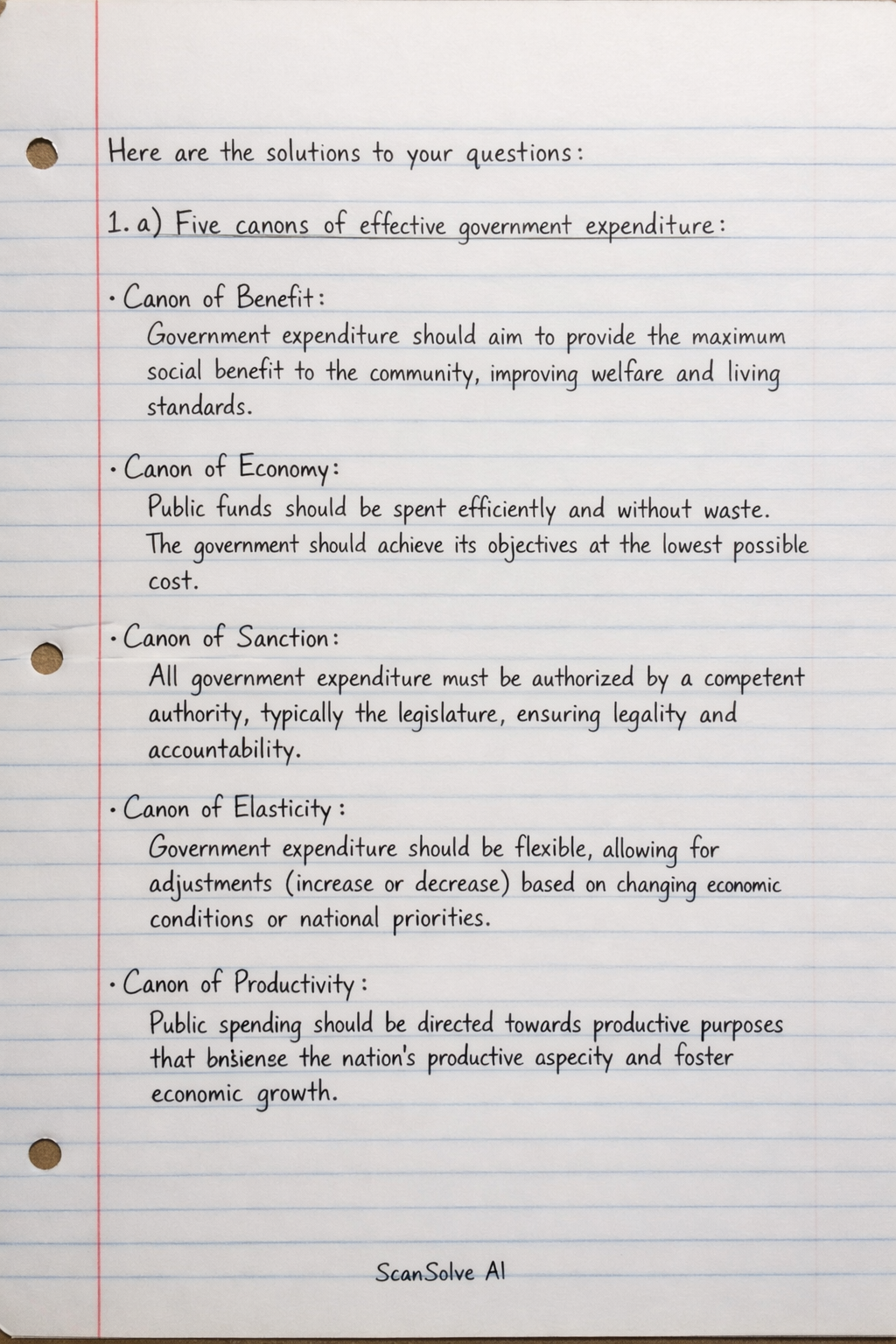
Here are the solutions to your questions:
1. a) Five canons of effective government expenditure:
- Canon of Benefit: Government expenditure should aim to provide the maximum social benefit to the community, improving welfare and living standards.
- Canon of Economy: Public funds should be spent efficiently and without waste. The government should achieve its objectives at the lowest possible cost.
- Canon of Sanction: All government expenditure must be authorized by a competent authority, typically the legislature, ensuring legality and accountability.
- Canon of Elasticity: Government expenditure should be flexible, allowing for adjustments (increase or decrease) based on changing economic conditions or national priorities.
- Canon of Productivity: Public spending should be directed towards productive purposes that enhance the nation's productive capacity and foster economic growth.
1. b) Five reasons influencing Uzima Juice Enterprises to market imported goods direct to consumers:
- Increased Profit Margins: By cutting out intermediaries (wholesalers, retailers), Uzima can retain a larger share of the profit margin.
- Greater Control Over Marketing and Branding: Direct selling allows Uzima to fully control how its products are presented, priced, and promoted, ensuring brand consistency.
- Direct Customer Feedback: Selling directly provides immediate and unfiltered feedback from consumers, which can be used to improve products and services.
- Stronger Customer Relationships: Direct interaction helps build loyalty and trust, fostering long-term relationships with customers.
- Market Penetration and Niche Targeting: Direct marketing can be effective for reaching specific customer segments or penetrating new markets where traditional distribution channels might be less efficient or unavailable.
2. a) Four features of direct production:
- Production for Self-Consumption: Goods and services are produced primarily to satisfy the needs of the producer and their family, not for sale in the market.
- Limited Scale of Production: Production is typically small-scale, often at a household or community level, due to limited resources and technology.
- Use of Simple Technology: Producers often rely on basic tools and traditional methods, with little use of advanced machinery or industrial processes.
- Lack of Specialization: Individuals or families are often involved in various production activities (e.g., farming, crafting) rather than specializing in a single task.
2. b) Recording transactions for Tumaini Traders:
Books of Original Entry (Journals):
General Journal
| Date | Particulars | Folio | Debit (Shs.) | Credit (Shs.) |
|---|---|---|---|---|
| 2010 July 15 | Office Equipment Account | 200,000 | ||
| To Seals Stationary Account | 200,000 | |||
| (Being purchase of office printer on credit) |
Sales Returns Journal
| Date | Particulars | Credit Note No. | Folio | Amount (Shs.) |
|---|---|---|---|---|
| 2010 July 15 | Ouma Traders | cr.56 | 5,000 | |
| (Being goods returned by Ouma Traders) |
Sales Journal
| Date | Particulars | Invoice No. | Folio | Amount (Shs.) |
|---|---|---|---|---|
| 2010 July 15 | Sargar Traders | 78 | 500,000 | |
| (Being goods sold on credit to Sargar Traders) |
Cash Book (Two-Column)
| Date | Particulars | Receipt No. | Folio | Cash (Shs.) | Bank (Shs.) | Date | Particulars | Cheque No. | Folio | Cash (Shs.) | Bank (Shs.) |
|---|---|---|---|---|---|---|---|---|---|---|---|
| 2010 July 15 | Sales (Mugo) | 210 | 900,000 | 2010 July 15 | Salaries Expense | 589 | 50,000 | ||||
| Total Receipts | 900,000 | 0 | Total Payments | 0 | 50,000 |
Ledger Accounts:
Office Equipment Account
| Date | Particulars | Folio | Amount (Shs.) | Date | Particulars | Folio | Amount (Shs.) |
|---|---|---|---|---|---|---|---|
| 2010 July 15 | Seals Stationary | G.J. | 200,000 | 2010 July 15 | Balance c/d | 200,000 | |
| Total | 200,000 | Total | 200,000 | ||||
| 2010 July 16 | Balance b/d | 200,000 |
Seals Stationary Account
| Date | Particulars | Folio | Amount (Shs.) | Date | Particulars | Folio | Amount (Shs.) |
|---|---|---|---|---|---|---|---|
| 2010 July 15 | Balance c/d | 200,000 | 2010 July 15 | Office Equipment | G.J. | 200,000 | |
| Total | 200,000 | Total | 200,000 | ||||
| 2010 July 16 | Balance b/d | 200,000 |
Sales Returns Account
| Date | Particulars | Folio | Amount (Shs.) | Date | Particulars | Folio | Amount (Shs.) |
|---|---|---|---|---|---|---|---|
| 2010 July 15 | Ouma Traders | S.R.J | 5,000 | 2010 July 15 | Balance c/d | 5,000 | |
| Total | 5,000 | Total | 5,000 | ||||
| 2010 July 16 | Balance b/d | 5,000 |
Ouma Traders Account
| Date | Particulars | Folio | Amount (Shs.) | Date | Particulars | Folio | Amount (Shs.) |
|---|---|---|---|---|---|---|---|
| 2010 July 15 | Balance c/d | 5,000 | 2010 July 15 | Sales Returns | S.R.J | 5,000 | |
| Total | 5,000 | Total | 5,000 | ||||
| 2010 July 16 | Balance b/d | 5,000 |
Sargar Traders Account
| Date | Particulars | Folio | Amount (Shs.) | Date | Particulars | Folio | Amount (Shs.) |
|---|---|---|---|---|---|---|---|
| 2010 July 15 | Sales | S.J. | 500,000 | 2010 July 15 | Balance c/d | 500,000 | |
| Total | 500,000 | Total | 500,000 | ||||
| 2010 July 16 | Balance b/d | 500,000 |
Sales Account
| Date | Particulars | Folio | Amount (Shs.) | Date | Particulars | Folio | Amount (Shs.) |
|---|---|---|---|---|---|---|---|
| 2010 July 15 | Balance c/d | 1,400,000 | 2010 July 15 | Sargar Traders | S.J. | 500,000 | |
| 2010 July 15 | Cash (Mugo) | C.B. | 900,000 | ||||
| Total | 1,400,000 | Total | 1,400,000 | ||||
| 2010 July 16 | Balance b/d | 1,400,000 |
Cash Account
| Date | Particulars | Folio | Amount (Shs.) | Date | Particulars | Folio | Amount (Shs.) |
|---|---|---|---|---|---|---|---|
| 2010 July 15 | Sales | C.B. | 900,000 | 2010 July 15 | Balance c/d | 900,000 | |
| Total | 900,000 | Total | 900,000 | ||||
| 2010 July 16 | Balance b/d | 900,000 |
Bank Account
| Date | Particulars | Folio | Amount (Shs.) | Date | Particulars | Folio | Amount (Shs.) |
|---|---|---|---|---|---|---|---|
| 2010 July 15 | Balance c/d | 50,000 | 2010 July 15 | Salaries Expense | C.B. | 50,000 | |
Still stuck on this one?
Ask a follow-up, and the answer starts from this question.
More Economics Questions
Handwritten Step-by-Step Solution
Get this as a handwritten image on WhatsApp — like a tutor wrote it for you.
Try on WhatsApp