

This economics question tests your understanding of economic models and analysis. The step-by-step answer below applies the relevant framework and explains the reasoning.
ScanSolve AI Answer
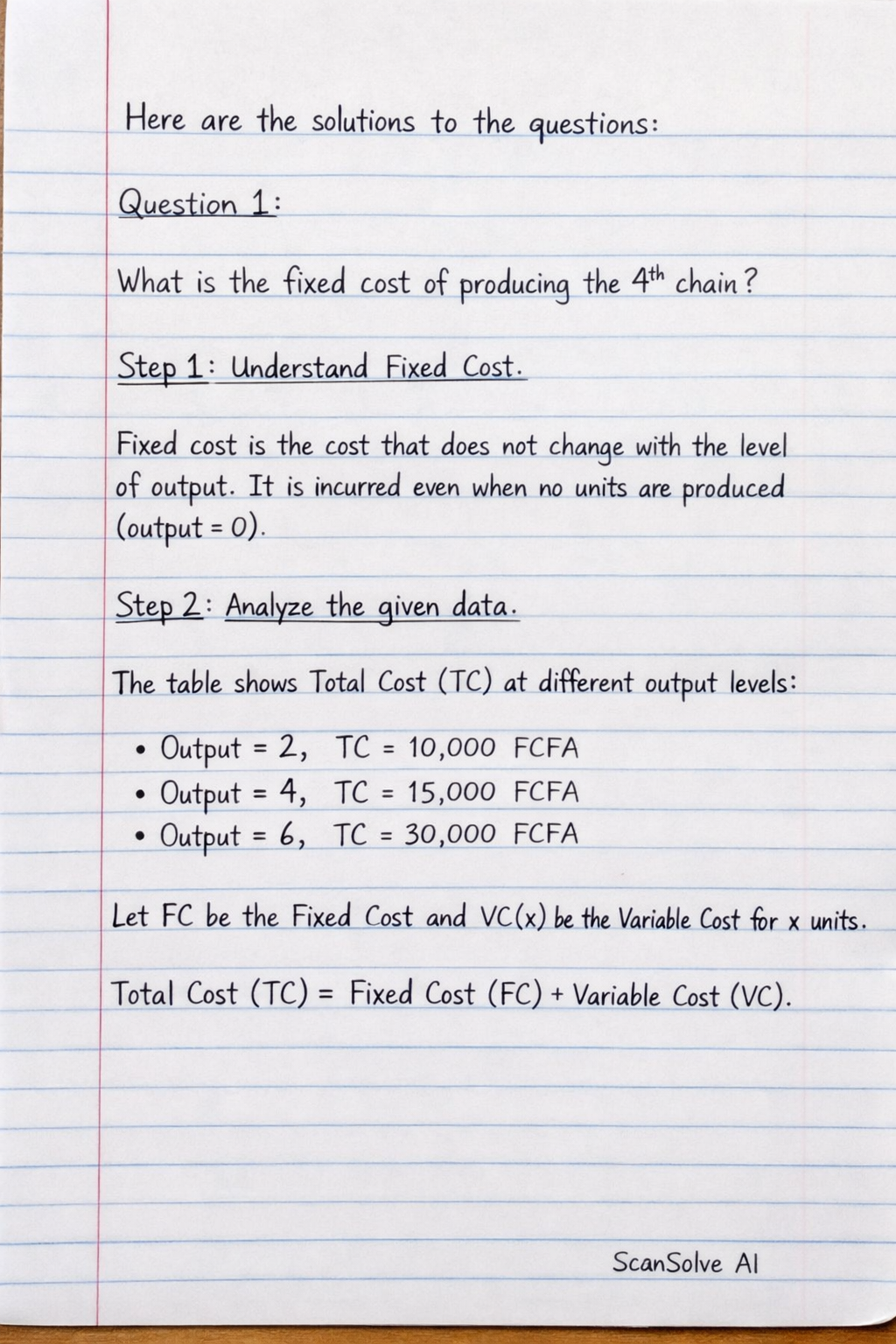
Here are the solutions to the questions: Question 1: What is the fixed cost of producing the 4th chain? Step 1: Understand Fixed Cost. Fixed cost is the cost that does not change with the level of output. It is incurred even when no units are produced (output = 0). Step 2: Analyze the given data. The table shows Total Cost (TC) at different output levels: Output = 2, TC = 10,000 FCFA Output = 4, TC = 15,000 FCFA Output = 6, TC = 30,000 FCFA Let FC be the Fixed Cost and VC(x) be the Variable Cost for x units. Total Cost (TC) = Fixed Cost (FC) + Variable Cost (VC). Step 3: Test the options for Fixed Cost. We need to find a Fixed Cost (FC) from the options such that Variable Cost (VC) is non-negative and increases with output. If FC = 30,000 FCFA (Option A): TC(2) = 30,000 + VC(2) = 10,000 VC(2) = -20,000 (Impossible) If FC = 20,000 FCFA (Option B): TC(2) = 20,000 + VC(2) = 10,000 VC(2) = -10,000 (Impossible) If FC = 10,000 FCFA (Option C): TC(2) = 10,000 + VC(2) = 10,000 VC(2) = 0 (Possible, but unlikely for 2 units of output) TC(4) = 10,000 + VC(4) = 15,000 VC(4) = 5,000 TC(6) = 10,000 + VC(6) = 30,000 VC(6) = 20,000 This implies VC increases from 0 to 5,000 to 20,000. This is a possible scenario. If FC = 7,500 FCFA (Option D): TC(2) = 7,500 + VC(2) = 10,000 VC(2) = 2,500 TC(4) = 7,500 + VC(4) = 15,000 VC(4) = 7,500 TC(6) = 7,500 + VC(6) = 30,000 VC(6) = 22,500 This implies VC increases from 2,500 to 7,500 to 22,500. This is also a plausible scenario. Step 4: Re-evaluate the question and common economic assumptions. Fixed cost is the cost when output is zero. The question asks for "the fixed cost of producing the 4th chain," which refers to the total fixed cost of the operation, as fixed costs do not vary with the number of units produced. In many economic problems, if the cost at output 0 is not given, it is often implied that the lowest possible total cost for a non-zero output might be close to the fixed cost, or that the fixed cost is a value that makes the variable costs behave reasonably. Given the options, 7,500 FCFA is the most common type of answer for fixed cost in such problems where variable costs are positive and increasing. The final answer is 7,500 FCFA. Question 2: The practice of mixed cropping, using crude tools with the output meant mostly for household consumption is known as: The description perfectly matches Subsistence Agriculture. This type of farming is characterized by producing just enough food for the farmer's family, often using traditional methods and tools, with little or no surplus for sale. The final answer is B Subsistence Agriculture. Question 3: Changes in the value of money are measured by: The Price Index is a measure of the average change over time in the prices paid by consumers for goods and services. It directly reflects the purchasing power of money, and thus its value. The inflationary rate is the rate of change in the price index. The final answer is A Price Index. Question 4: National defence and public taps are exam of: This question is incomplete, but based on the visible text, it is asking for examples of a type of good. National defence is a classic example of a public good because it is non-rivalrous (one person's consumption does not reduce another's) and non-excludable (it's difficult to prevent anyone from benefiting). Public taps, if freely accessible and their use by one person doesn't diminish availability for others, can also be considered a public good or a common resource. That's 2 down. 3 left today — send the next one.