
We read your photo as:
What is the LGS ratio in the balance sheet above? If the Liquid Asset ratio were 25%, what would be the new liquid asset? new lending amount? credit creation multiplier? What would be the final increase in money after the full credit creation process?
ScanSolve AI Answer
Step-by-step solution
2 stepsPart 14
Part a· 1 step
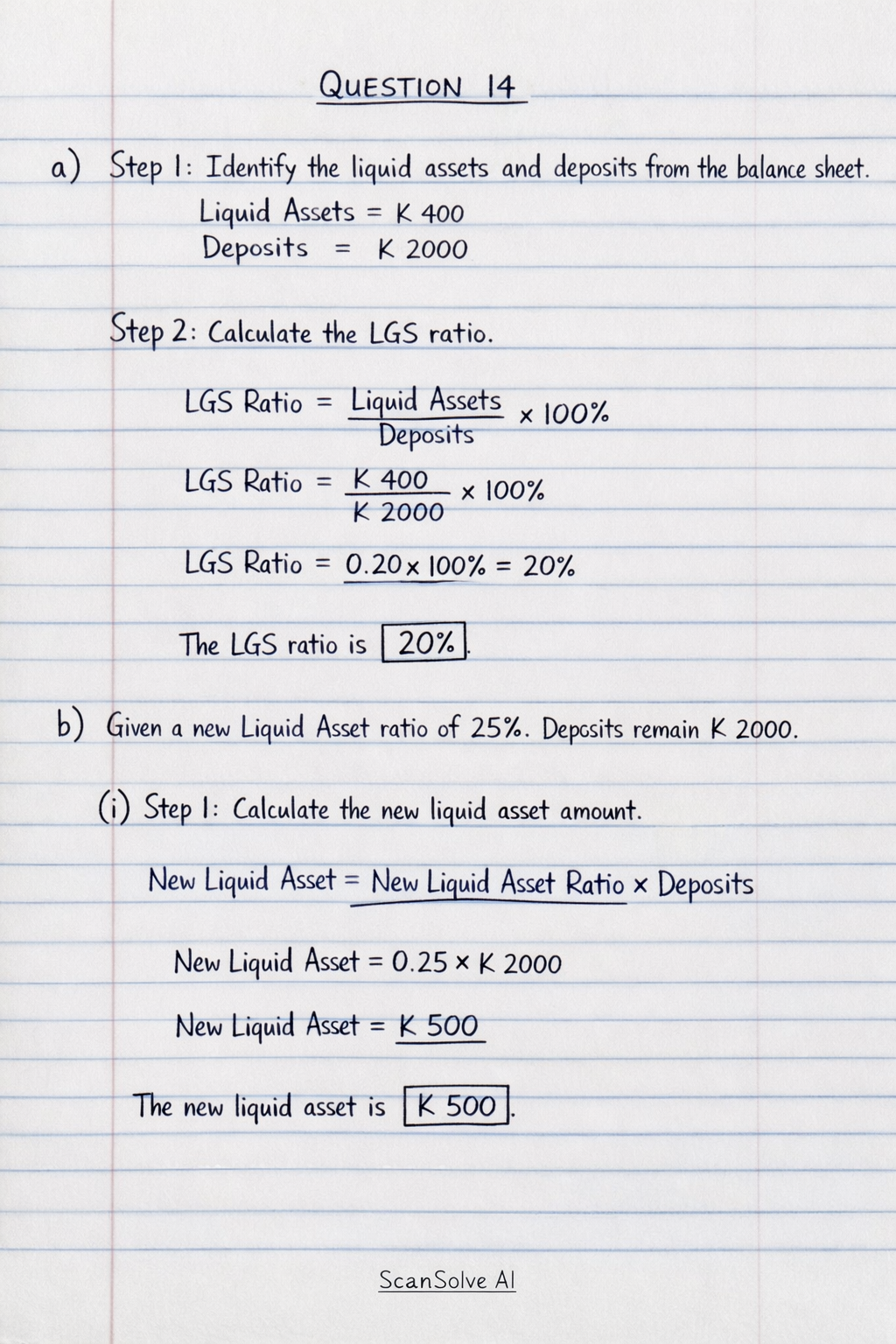
Step 1: Identify the liquid assets and deposits from the balance sheet.
Liquid Assets = K 400
Deposits = K 2000
Calculate the LGS ratio.
The LGS ratio is .
Part b(i)
Step 1: Calculate the new liquid asset amount.
Given a new Liquid Asset ratio of . Deposits remain K 2000.
The new liquid asset is .
Part b(ii)
Step 1: Calculate the new lending amount.
Total Assets = Deposits = K 2000 (since Assets must equal Liabilities)
The new lending amount is .
Part b(iii)
Step 1: Calculate the credit creation multiplier.
The credit creation multiplier is .
Part c· 1 step
Step 1: Identify the initial deposit and the credit creation multiplier.
Initial Deposit = K 2000
Credit Creation Multiplier = 4 (from part b(iii))
Calculate the final increase in money.
The final increase in money is .
Still stuck on this one?
Ask a follow-up, and the answer starts from this question.
More Economics Questions
Handwritten Step-by-Step Solution
Get this as a handwritten image on WhatsApp — like a tutor wrote it for you.
Try on WhatsApp