
Help me with the question paper
ScanSolve AI Answer
Here are the solutions to the remaining questions:
4.3 Define the term price elasticity of demand.
Price elasticity of demand measures the responsiveness of the quantity demanded of a good or service to a change in its price.
4.4 Study the graph below and answer the questions that follow.
-
4.4.1 Identify the equilibrium price and quantity before the shift in the supply curve. Before the shift, the equilibrium is at the intersection of the demand curve (D) and the initial supply curve (S).
- Equilibrium price: R10
- Equilibrium quantity: 20 units
-
4.4.2 What is the new equilibrium price and quantity after the shift in the supply curve? After the shift, the new equilibrium is at the intersection of the demand curve (D) and the new supply curve (S1).
- New equilibrium price: R15
- New equilibrium quantity: 15 units
-
4.4.3 Explain the shift from S to S1. The shift from S to S1 represents a decrease in supply. This could be caused by factors such as an increase in the cost of production (e.g., higher wages or raw material prices), a decrease in the number of producers, or an increase in taxes on the product.
4.5 Briefly discuss any TWO factors that influence the supply of a product.
- Cost of production: An increase in the cost of inputs like labor, raw materials, or energy will make production more expensive, reducing the profit margin for producers. This leads to a decrease in the quantity supplied at each price level.
- Technology: Improvements in technology can make production more efficient, reducing the cost per unit and allowing producers to supply more at each price. Conversely, outdated technology can limit supply.
Still stuck on this one?
Ask a follow-up, and the answer starts from this question.
More Economics Questions
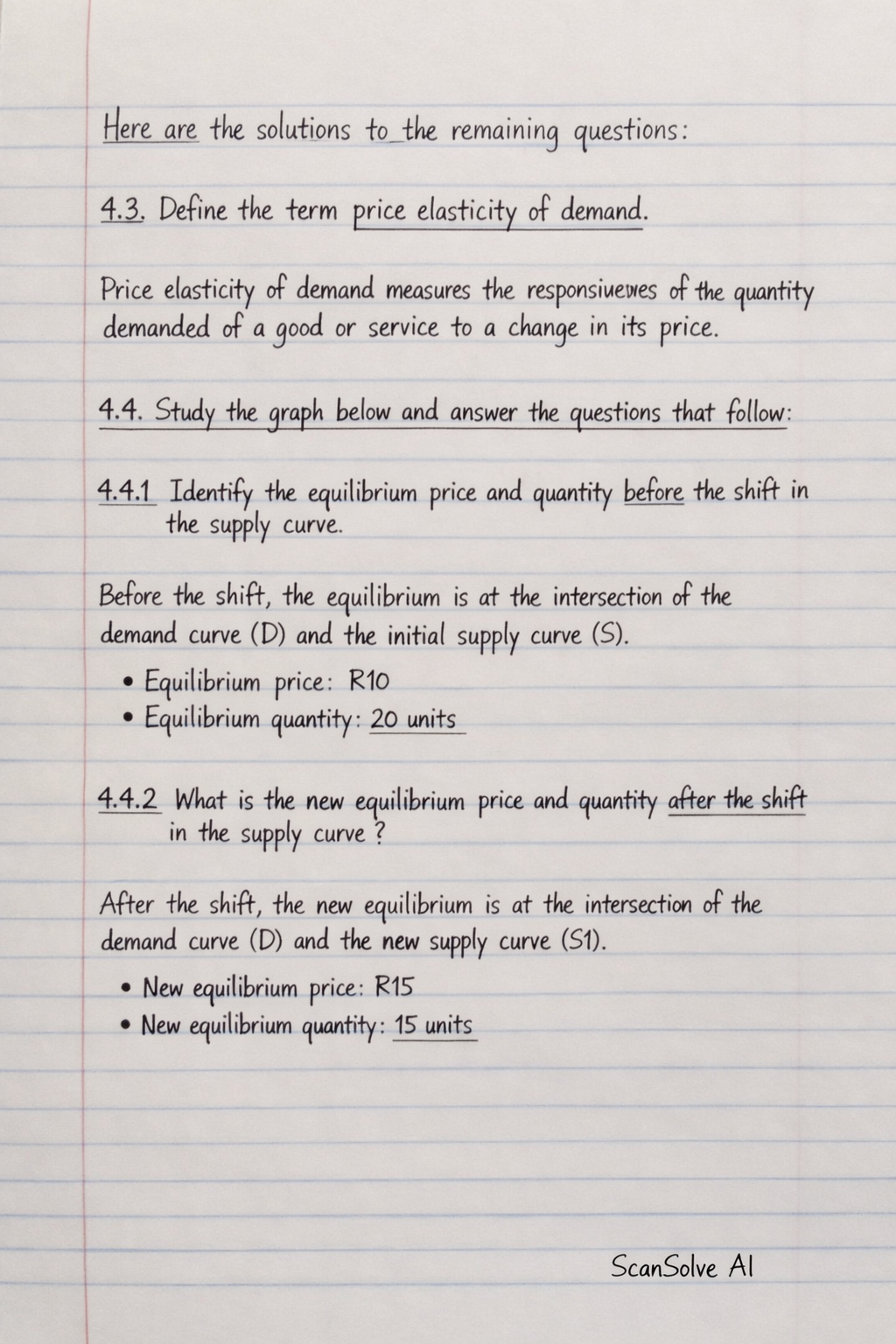
Handwritten Step-by-Step Solution
Get this as a handwritten image on WhatsApp — like a tutor wrote it for you.
Try on WhatsApp