
We read your photo as:
The question states that Good X has a price elasticity of demand (PED) of 0.25.
ScanSolve AI Answer
Step-by-step solution
4 stepsThe question states that Good X has a price elasticity of demand (PED) of 0.25.
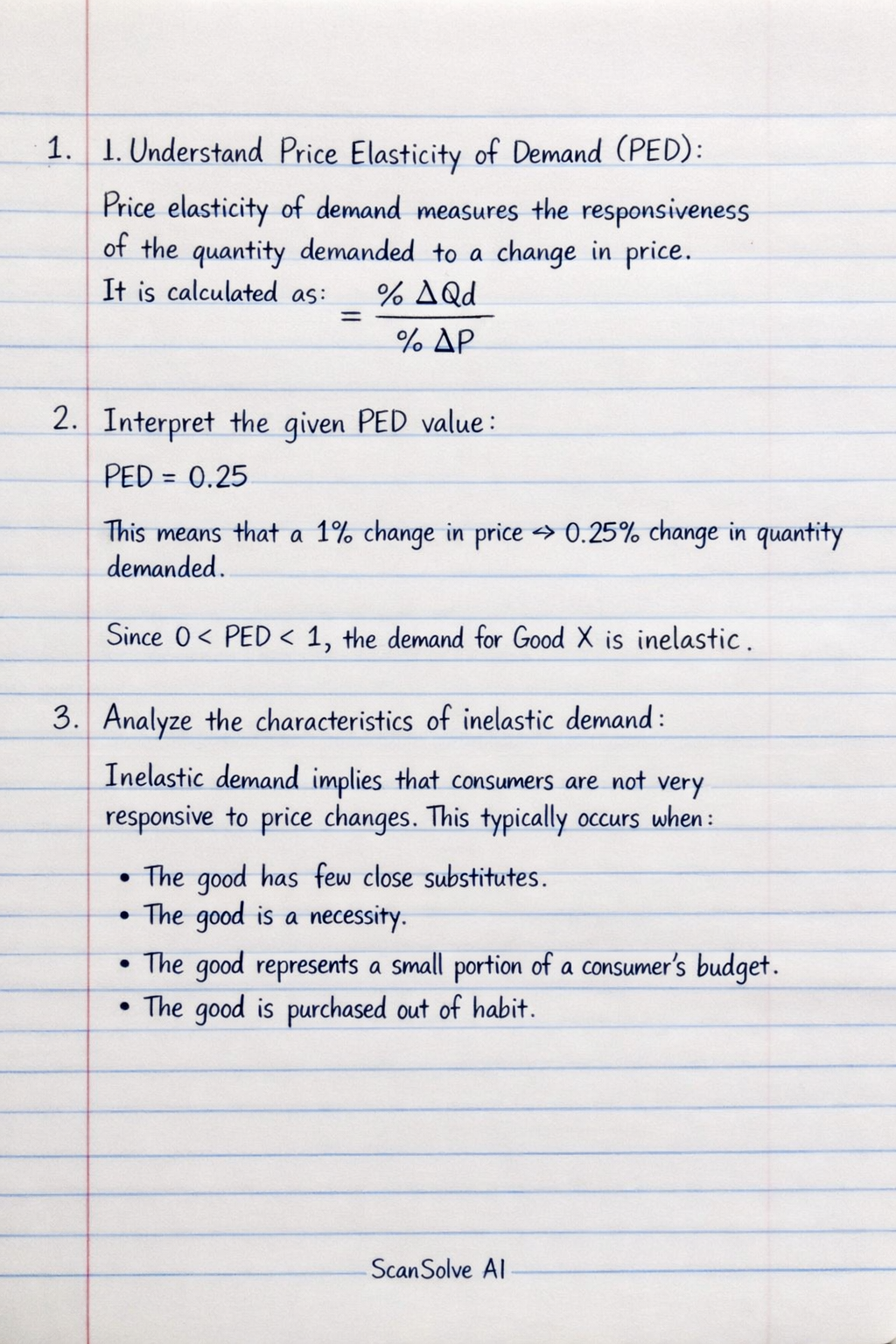
Understand Price Elasticity of Demand (PED).
Price elasticity of demand measures the responsiveness of the quantity demanded of a good to a change in its price. It is calculated as the percentage change in quantity demanded divided by the percentage change in price.
Interpret the given PED value.
A PED value of 0.25 means that for every 1% change in price, the quantity demanded changes by 0.25%. Since , the demand for Good X is inelastic.
Analyze the characteristics of inelastic demand.
Inelastic demand implies that consumers are not very responsive to price changes. This typically occurs when:
- The good has few close substitutes.
- The good is a necessity.
- The good represents a small portion of a consumer's budget.
- The good is purchased out of habit.
Evaluate the given options.
- A. has many close substitutes: If a good has many close substitutes, consumers can easily switch to alternatives when its price changes, leading to elastic demand (PED > 1). This contradicts the given PED of 0.25.
- B. has few substitutes: If a good has few substitutes, consumers have fewer alternatives, making them less responsive to price changes. This leads to inelastic demand (PED < 1). This is consistent with the given PED of 0.25.
- C. is not purchased out of habit: Goods purchased out of habit often have inelastic demand because consumers continue to buy them regardless of price changes. If it's not purchased out of habit, it might imply more elastic demand. This option is generally inconsistent with inelastic demand.
- D. is a luxury good: Luxury goods are typically non-essential and often have elastic demand (PED > 1) because consumers can easily forgo them if prices rise. This contradicts the given PED of 0.25.
Based on the analysis, a good with a price elasticity of demand of 0.25 (inelastic demand) is characterized by having few substitutes.
The final answer is .
Still stuck on this one?
Ask a follow-up, and the answer starts from this question.
More Economics Questions
Handwritten Step-by-Step Solution
Get this as a handwritten image on WhatsApp — like a tutor wrote it for you.
Try on WhatsApp