
We read your photo as:
The statement from "The Limits to Growth, 1972" presents a stark warning about the consequences of unchecked growth in population, industrialization, pollution, food production, and resource depletion
ScanSolve AI Answer
Step-by-step solution
3 stepsThe statement from "The Limits to Growth, 1972" presents a stark warning about the consequences of unchecked growth in population, industrialization, pollution, food production, and resource depletion. Your chosen option, f), offers a perspective that acknowledges the severity of the situation while expressing a deep-seated skepticism about viable solutions.
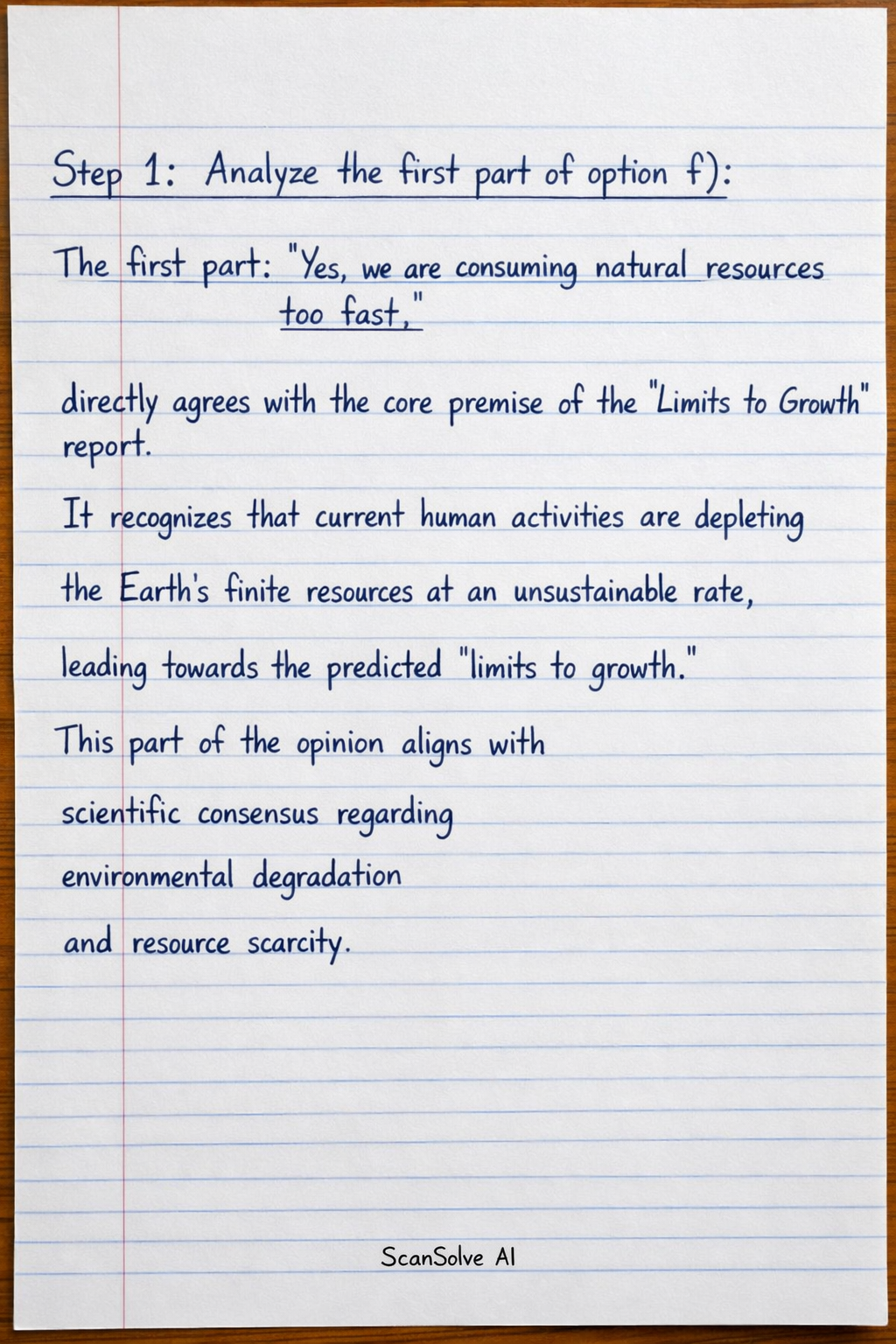
Analyze the first part of option f).
The first part, "Yes we are consuming natural resources too fast," directly agrees with the core premise of the "Limits to Growth" report. It recognizes that current human activities are depleting the Earth's finite resources at an unsustainable rate, leading towards the predicted "limits to growth." This part of the opinion aligns with scientific consensus regarding environmental degradation and resource scarcity.
Analyze the second part of option f).
The second part, "And frankly I don't see any solution because increasing consumption is the basis of our economic growth," articulates a critical and often pessimistic view on the feasibility of addressing this problem. Modern global economies are largely structured around the principle of continuous growth, which is typically measured by Gross Domestic Product (GDP). GDP growth is often driven by increased production and, consequently, increased consumption of goods and services. From this perspective, reducing resource consumption significantly would imply a contraction of economic activity, potentially leading to recession, job losses, and a decline in living standards as currently defined.
Explain the implications of this viewpoint.
This opinion highlights a fundamental dilemma: how can societies continue to pursue economic growth, which historically relies on ever-increasing resource use, while simultaneously addressing the finite nature of planetary resources? The perceived lack of a solution stems from the belief that our current economic paradigm is inherently incompatible with environmental sustainability. It suggests that any meaningful solution would require a radical transformation of economic systems, moving away from a consumption-driven model, which is seen as an insurmountable challenge given entrenched economic interests and societal expectations. This viewpoint, while perhaps pessimistic, reflects a realistic assessment of the deep structural changes required to avert the predicted decline.
The most appropriate personal opinion is f).
Still stuck on this one?
Ask a follow-up, and the answer starts from this question.
More Economics Questions
Handwritten Step-by-Step Solution
Get this as a handwritten image on WhatsApp — like a tutor wrote it for you.
Try on WhatsApp