
We read your photo as:
What is the total utility of consuming the 3rd loaf of bread?
ScanSolve AI Answer
Answer
Step-by-step solution
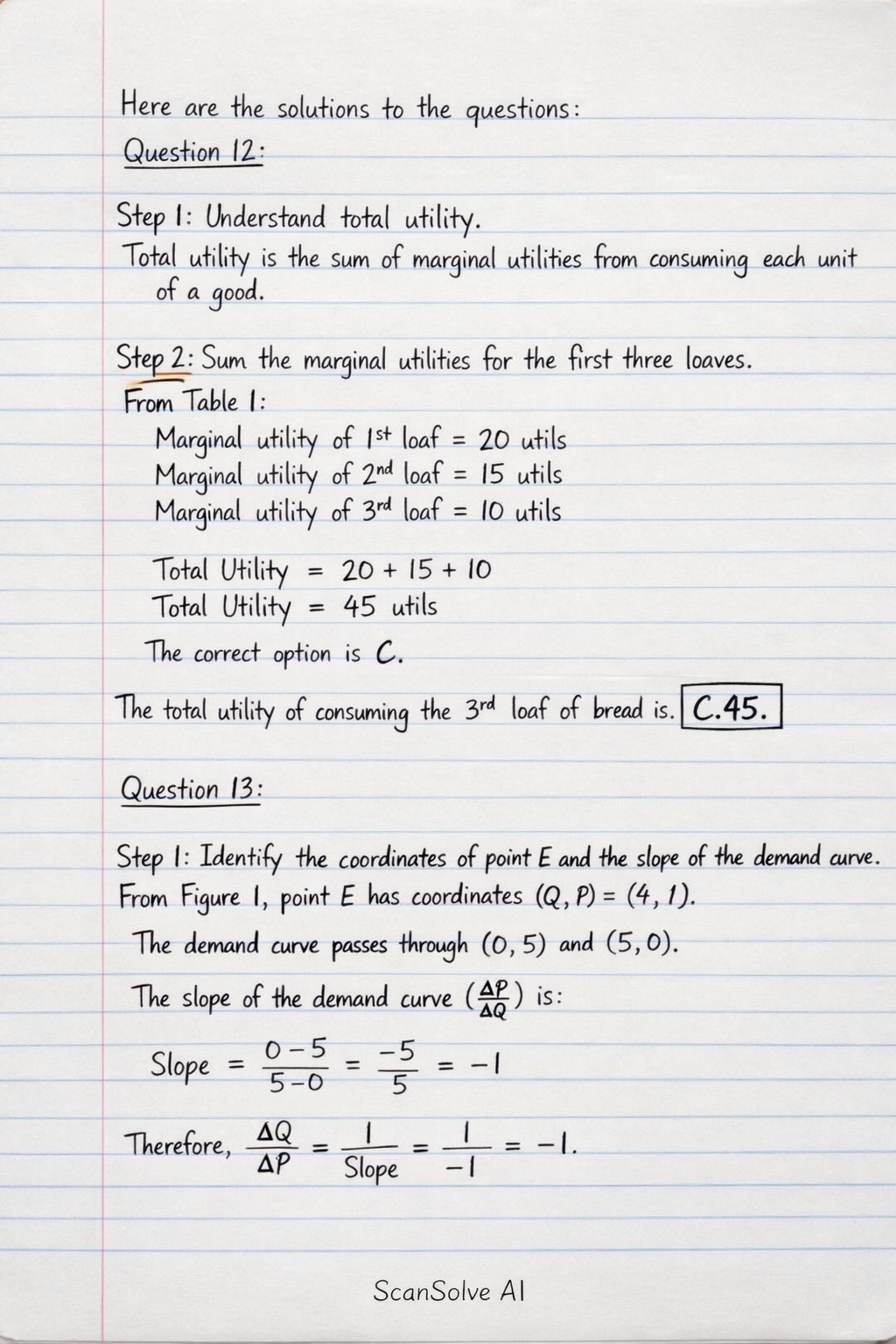
8 stepsHere are the solutions to the questions:
Part 12· 2 steps
Understand total utility.
Total utility is the sum of marginal utilities from consuming each unit of a good.
Sum the marginal utilities for the first three loaves.
From Table 1:
Marginal utility of 1st loaf = 20 utils
Marginal utility of 2nd loaf = 15 utils
Marginal utility of 3rd loaf = 10 utilsThe correct option is C.
The total utility of consuming the 3rd loaf of bread is .
Part 13· 2 steps
Identify the coordinates of point E and the slope of the demand curve.
From Figure 1, point E has coordinates .
The demand curve passes through and .
The slope of the demand curve () is:Therefore, .
Calculate the price elasticity of demand (PED) at point E.
The formula for price elasticity of demand is:
Substitute the values for point E (, ) and the calculated :
The coefficient of price elasticity of demand is usually reported as an absolute value.
Since , demand at point E is inelastic.
The coefficient of price elasticity of demand at point E is most likely to be .
Part 15· 2 steps
Analyze the definition provided.
The question describes a price P1 set by the government "below which it becomes illegal to sell". This means P1 is the lowest legal price.
Match the definition to the economic terms.
- A minimum price (also known as a price floor) is a government-imposed lower limit on the price at which a good can be sold. Selling below this price is illegal.
- A maximum price (or price ceiling) is an upper limit, making it illegal to sell above it.
- A black market price is a price set in an illegal market, not a government-imposed limit. The description perfectly matches the definition of a minimum price. The correct option is A. The technical term is .
Part 16· 2 steps
Identify the given supply equation and the quantity.
The supply equation is .
The quantity the producer will sell is units.Substitute the quantity into the equation to find the price.
The correct option is D.
The producer will sell 20 units at a price of .
Try one yourself
A new problem that tests the same skill.
Still stuck on this one?
Ask a follow-up, and the answer starts from this question.
More Economics Questions
Handwritten Step-by-Step Solution
Get this as a handwritten image on WhatsApp — like a tutor wrote it for you.
Try on WhatsApp