
We read your photo as:
What are the two reasons for trade?
ScanSolve AI Answer
Here are the answers to your questions:
Question 12:
The two main reasons for trade are:
- Differences in resource endowments: Countries possess varying amounts of natural resources, labor, and capital, leading to different production capabilities.
- Differences in comparative advantage: Countries specialize in producing goods and services where they have a lower opportunity cost, allowing for more efficient global production.
Question 13:
- Absolute advantage refers to a country's ability to produce more of a good or service using the same amount of resources, or the same amount using fewer resources, compared to another country. It's about being more productive in absolute terms.
- Comparative advantage refers to a country's ability to produce a good or service at a lower opportunity cost than another country. It's about specializing in what a country does relatively best, even if it doesn't have an absolute advantage in any good.
Question 14:
Given the production data:
| Product | Papua New Guinea | Australia |
|---|---|---|
| Wheat | 200 | 400 |
| Rice | 400 | 800 |
-
a. To determine which country has an absolute advantage in producing rice, we compare their production figures. Australia produces 800 units of rice, while Papua New Guinea produces 400 units.
- Australia produces more rice.
- The country with an absolute advantage in producing rice is Australia.
-
b. To determine comparative advantage, we calculate the opportunity cost for each country for each product.
- Papua New Guinea (PNG):
- Opportunity cost of 1 unit of Wheat = units of Rice
- Opportunity cost of 1 unit of Rice = units of Wheat
- Australia:
- Opportunity cost of 1 unit of Wheat = units of Rice
- Opportunity cost of 1 unit of Rice = units of Wheat
Since the opportunity costs for both wheat and rice are identical for both countries, neither Papua New Guinea nor Australia has a comparative advantage over the other in either product based on these figures.
- PNG has comparative advantage in neither product.
- Papua New Guinea (PNG):
Question 15:
The benefits of free trade on:
- a. Price: Decrease (due to increased competition and efficiency).
- b. Supply: Increase (due to access to a wider range of international producers).
- c. Level of employment: Increase (in export-oriented industries and overall due to economic growth, though some sectors may experience job losses).
Question 16:
The effects after a tariff is imposed:
- a. Price of goods and services in the domestic market: Increase (tariffs raise the cost of imported goods, which can also lead to higher prices for domestic substitutes).
- b. Supply of locally produced goods and services: Increase (domestic producers face less competition from imports, encouraging more local production).
- c. Demand for goods and services in the domestic market: Decrease (higher prices reduce consumers' purchasing power and overall quantity demanded).
- d. Supply of imported goods and services: Decrease (tariffs make imports more expensive and less attractive, reducing their supply).
- e. General level of consumption in the economy: Decrease (higher prices and reduced real income lead to a lower overall level of consumption).
Still stuck on this one?
Ask a follow-up, and the answer starts from this question.
More Economics Questions
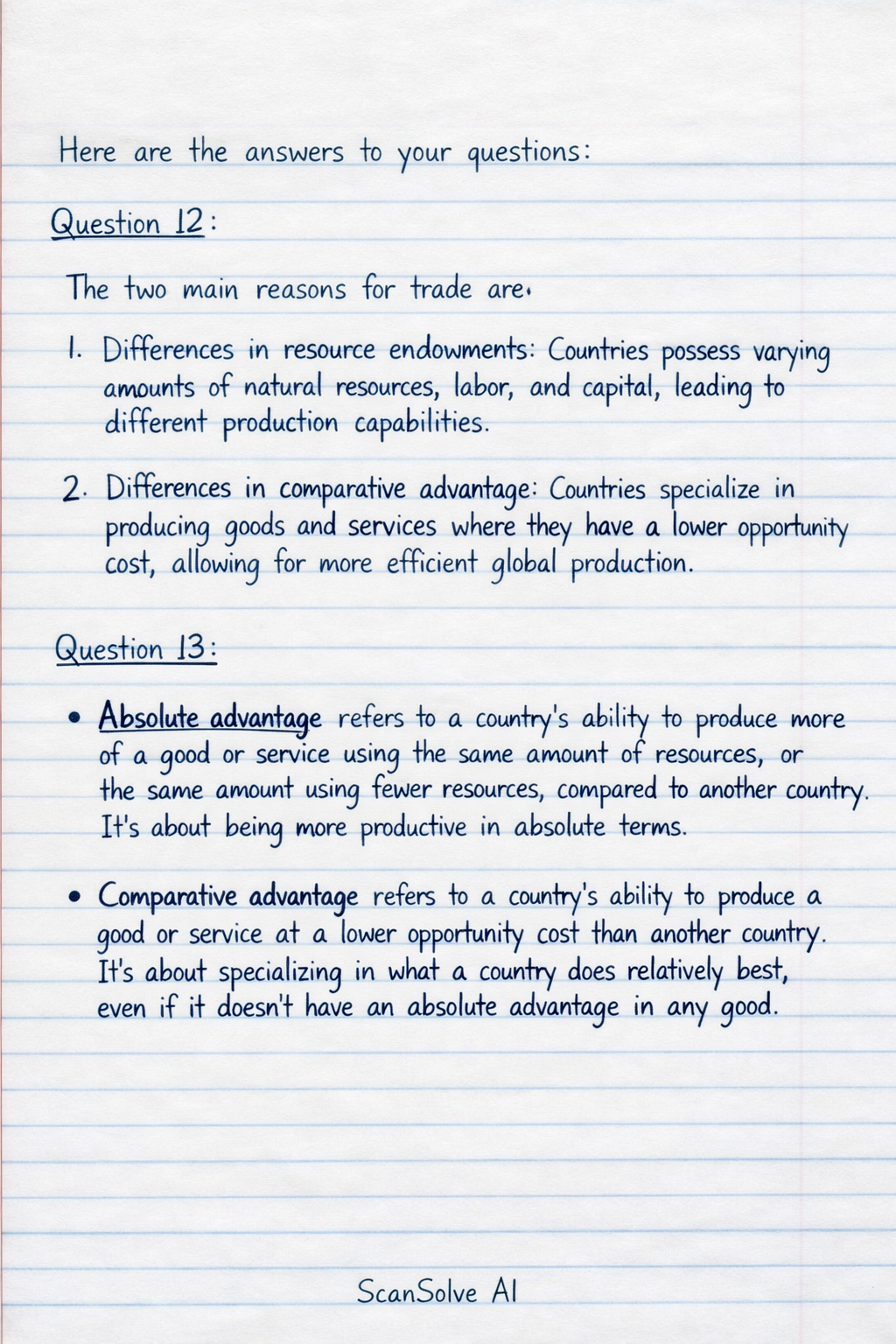
Handwritten Step-by-Step Solution
Get this as a handwritten image on WhatsApp — like a tutor wrote it for you.
Try on WhatsApp