
We read your photo as:
What is the Value of Mu when Tu reaches the Maximum? How Can the Law of diminishing Marginal utility be used to explain the slope of the normal demand Law. List and discuss the types of utility. What is Consumer Behavior? State the Law of diminishing marginal utility.
ScanSolve AI Answer
Here are the solutions to your questions:
1. What is the Value of MU when TU reaches the Maximum?
When Total Utility (TU) reaches its maximum point, the Marginal Utility (MU) is zero. This is because at this point, consuming an additional unit of the good provides no extra satisfaction.
3. How Can the Law of diminishing marginal utility be used to explain the slope of the normal demand Law.
The Law of Diminishing Marginal Utility explains the downward slope of the demand curve because as a consumer acquires more units of a good, the additional satisfaction (marginal utility) from each subsequent unit decreases. Consequently, consumers are only willing to purchase additional units if the price decreases, reflecting the lower value they place on these extra units. This inverse relationship between price and quantity demanded forms the basis of the downward-sloping demand curve.
4. List and discuss the Types of utility.
There are four main types of utility:
- Form Utility: This refers to the value added to a product by changing its form or shape to make it more useful to the consumer. For example, converting raw timber into furniture.
- Place Utility: This is the value added by making a product available at a convenient location for the consumer. For instance, having a store in an easily accessible area or delivering goods to a customer's home.
- Time Utility: This refers to the value added by making a product available at a convenient time for the consumer. An example is a store being open late or providing seasonal products when they are in demand.
- Possession Utility: This is the value added by allowing the consumer to take ownership of a product, enabling them to use or consume it. This is typically achieved through sales or transfers of ownership.
5. What is Consumer Behavior?
Consumer behavior is the study of how individuals, groups, or organizations select, buy, use, and dispose of ideas, goods, and services to satisfy their needs and wants. It involves analyzing the decision-making processes that consumers go through before, during, and after purchasing a product or service.
6. State the Law of diminishing marginal utility.
The Law of Diminishing Marginal Utility states that as a consumer consumes more and more units of a specific good, holding all other factors constant, the additional satisfaction or utility (marginal utility) derived from each successive unit of that good tends to decrease.
Still stuck on this one?
Ask a follow-up, and the answer starts from this question.
More Economics Questions
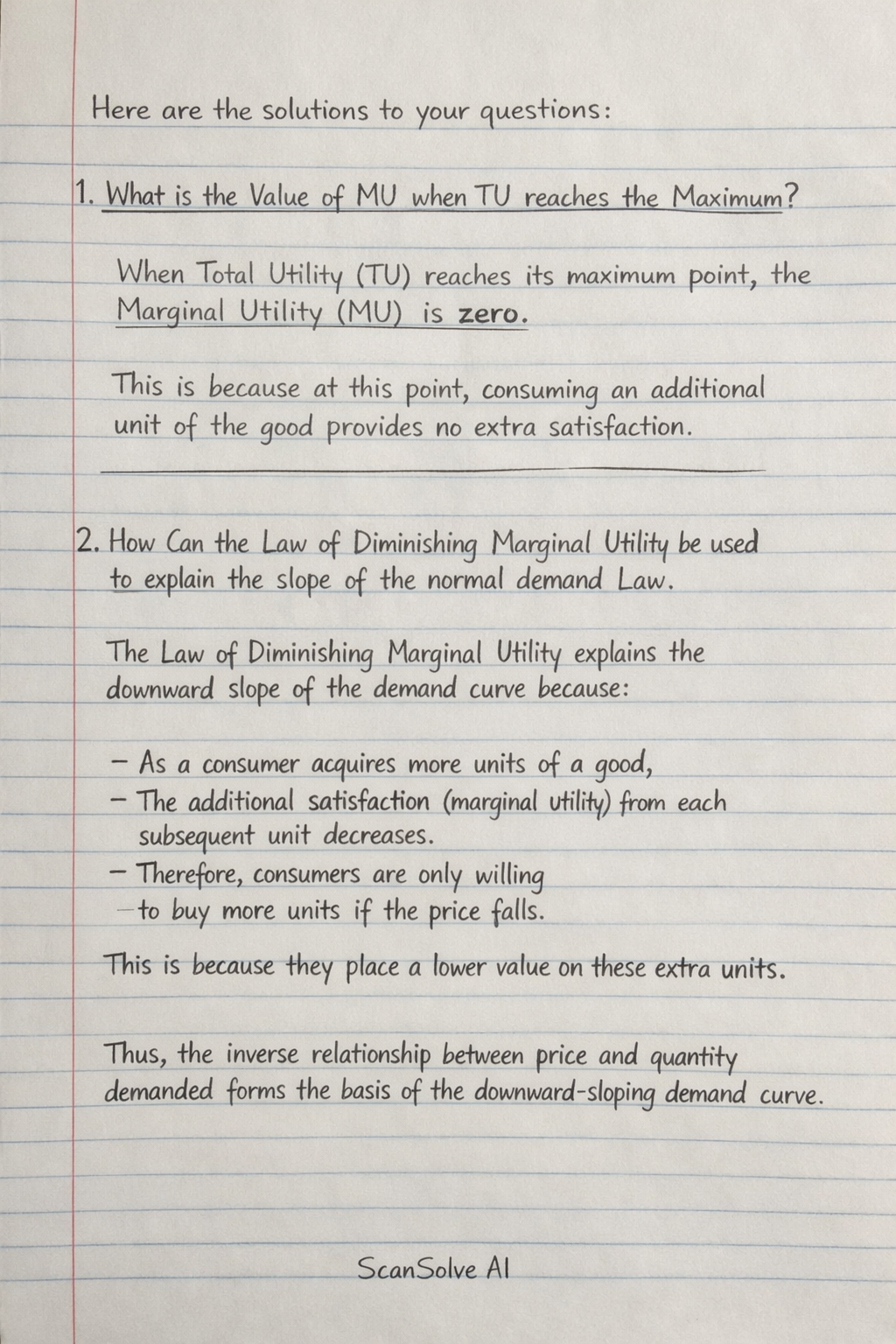
Handwritten Step-by-Step Solution
Get this as a handwritten image on WhatsApp — like a tutor wrote it for you.
Try on WhatsApp