

This economics question tests your understanding of economic models and analysis. The step-by-step answer below applies the relevant framework and explains the reasoning.
ScanSolve AI Answer
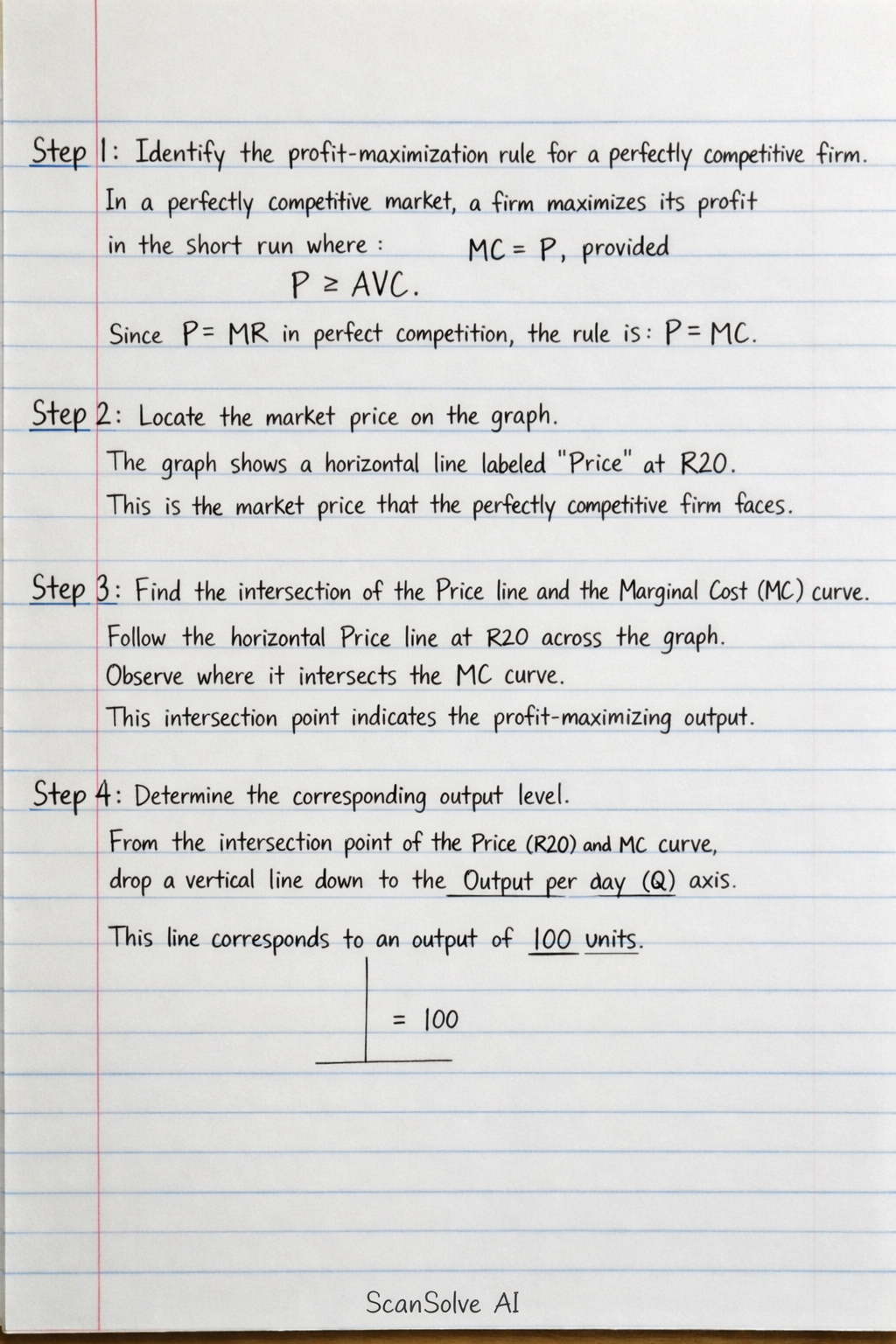
Step 1: Identify the profit-maximization rule for a perfectly competitive firm. In a perfectly competitive market, a firm maximizes its profit in the short run by producing at the output level where its Marginal Cost (MC) equals the market Price (P), provided that the price is greater than or equal to the Average Variable Cost (AVC). In perfect competition, Price (P) is also equal to Marginal Revenue (MR). So, the rule is P = MC. Step 2: Locate the market price on the graph. The graph shows a horizontal line labeled "Price" at R20. This is the market price that the perfectly competitive firm faces. Step 3: Find the intersection of the Price line and the Marginal Cost (MC) curve. Follow the horizontal Price line at R20 across the graph. Observe where it intersects the MC curve. This intersection point indicates the profit-maximizing output. Step 4: Determine the corresponding output level. From the intersection point of the Price (R20) and MC curve, drop a vertical line down to the "Output per day" (Q) axis. This line corresponds to an output of 100 units. Step 5: Verify the shutdown condition. At an output of 100 units, the Price (R20) is above the Average Variable Cost (AVC) curve and also above the Average Cost (AC) curve. This means the firm is covering its variable costs and even making a profit, so it should continue to produce. Therefore, the firm's profit-maximizing daily output is 100 units. The final answer is a). 3 done, 2 left today. You're making progress.