
We read your photo as:
Using the provided graph and formulas, calculate the firm's variable cost at output levels 2, 4, and 6, and its average total cost at output levels 5 and 7.
Economics
ScanSolve AI Answer
Step-by-step solution
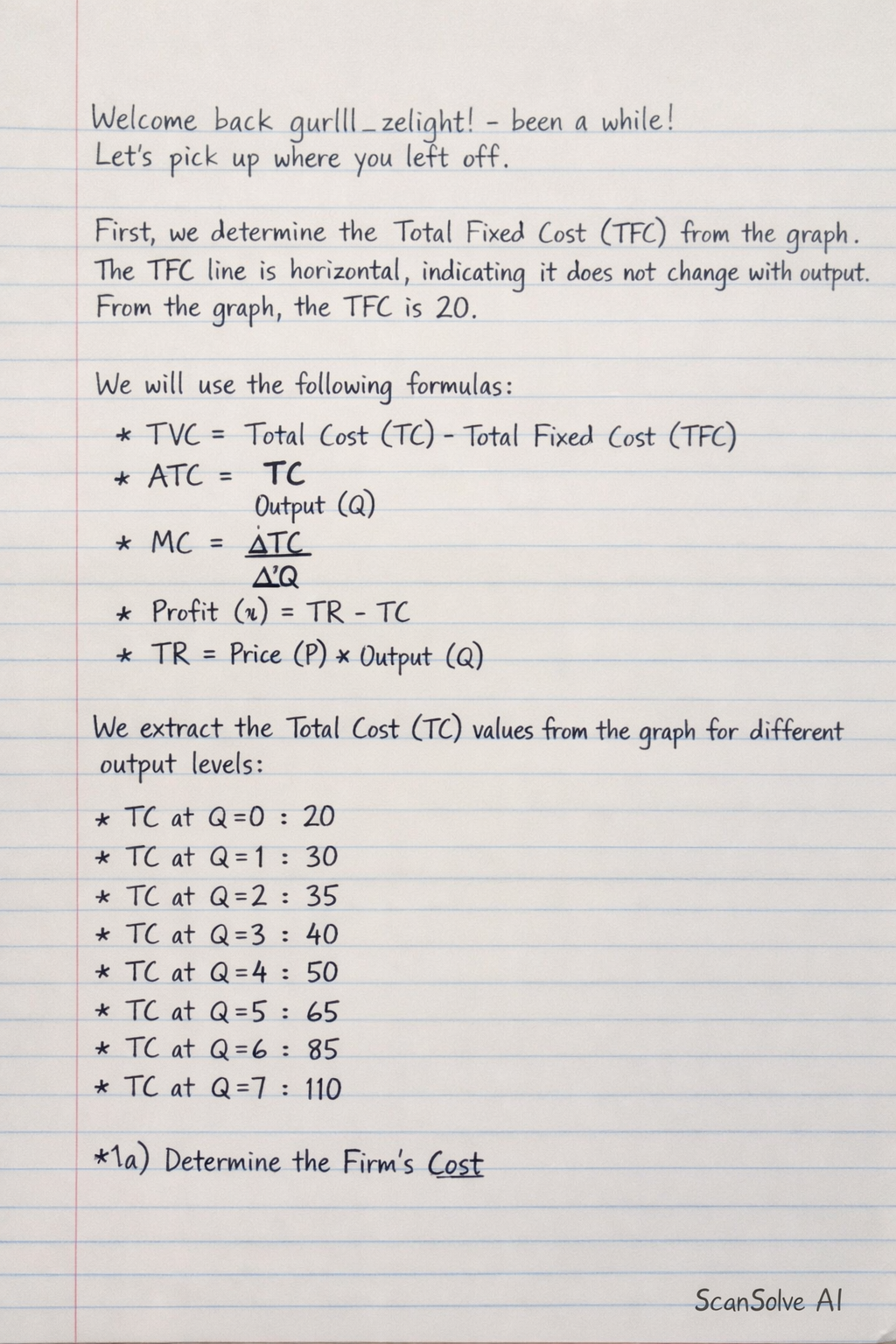
6 stepsFirst, we determine the Total Fixed Cost (TFC) from the graph. The TFC line is horizontal, indicating it does not change with output.
From the graph, the TFC is 20.
We will use the following formulas:
- Total Variable Cost (TVC) = Total Cost (TC) - Total Fixed Cost (TFC)
- Average Total Cost (ATC) =
- Marginal Cost (MC) =
- Profit () = Total Revenue (TR) - Total Cost (TC)
- Total Revenue (TR) = Price (P) Output (Q)
We extract the Total Cost (TC) values from the graph for different output levels:
- TC at Q=0: 20
- TC at Q=1: 30
- TC at Q=2: 35
- TC at Q=3: 40
- TC at Q=4: 50
- TC at Q=5: 65
- TC at Q=6: 85
- TC at Q=7: 110
Part a· 3 steps
Determine the Firm's Cost
Calculate Variable Cost (TVC) at output levels 2, 4, and 6.
- At Q = 2:
- At Q = 4:
- At Q = 6:
- i) Variable Cost at output levels 2, 4, 6:
- Q=2:
\boxed{\text{\15}}$ - Q=4:
\boxed{\text{\30}}$ - Q=6:
\boxed{\text{\65}}$
- Q=2:
Calculate Average Cost (ATC) at output levels 5 and 7.
- At Q = 5:
- At Q = 7:
- ii) Average Cost at output levels 5 and 7:
- Q=5:
\boxed{\text{\13}}$ - Q=7:
\boxed{\text{\15.71}}$
- Q=5:
Calculate Marginal Cost (MC) at output levels 4 and 6.
- At Q = 4:
- At Q = 6:
- iii) Marginal Cost at output levels 4 and 6:
- Q=4:
\boxed{\text{\10}}$ - Q=6:
\boxed{\text{\20}}$
- Q=4:
Part b· 3 steps
If the firm's revenue per unit is $40, calculate the firm's profit at the following units of production
Calculate profit at 3 units of production.
Given Price (P) = $40.
From the graph, TC(3) = 40.
- i) Profit at 3 units:
\boxed{\text{\80}}$
- i) Profit at 3 units:
Calculate profit at 5 units of production.
From the graph, TC(5) = 65.
- ii) Profit at 5 units:
\boxed{\text{\135}}$
- ii) Profit at 5 units:
Calculate profit at 7 units of production.
From the graph, TC(7) = 110.
- iii) Profit at 7 units:
\boxed{\text{\170}}$
- iii) Profit at 7 units:
Was this helpful?
Still stuck on this one?
Ask a follow-up, and the answer starts from this question.
Got a different question?Ask your own question
More Economics Questions
QComplete the table showing the relationship between Total Cost, Total Variable Cost, Average…QAs the level of output increases, what happens to the average fixed cost of a firm?QComplete the table using the economic relationships for Marginal Product, Total Variable Cost, and…QGiven the following data points for a quadratic average cost function, determine the coefficients…QCalculate the fixed and variable elements of the above mixed factory overhead using: i. The high and…
Browse by topic:Microeconomics
Handwritten Step-by-Step Solution
Get this as a handwritten image on WhatsApp — like a tutor wrote it for you.
Try on WhatsApp