
We read your photo as:
Explain what a tariff system is, provide examples, and differentiate between fixed and variable tariffs.
ScanSolve AI Answer
Step-by-step solution
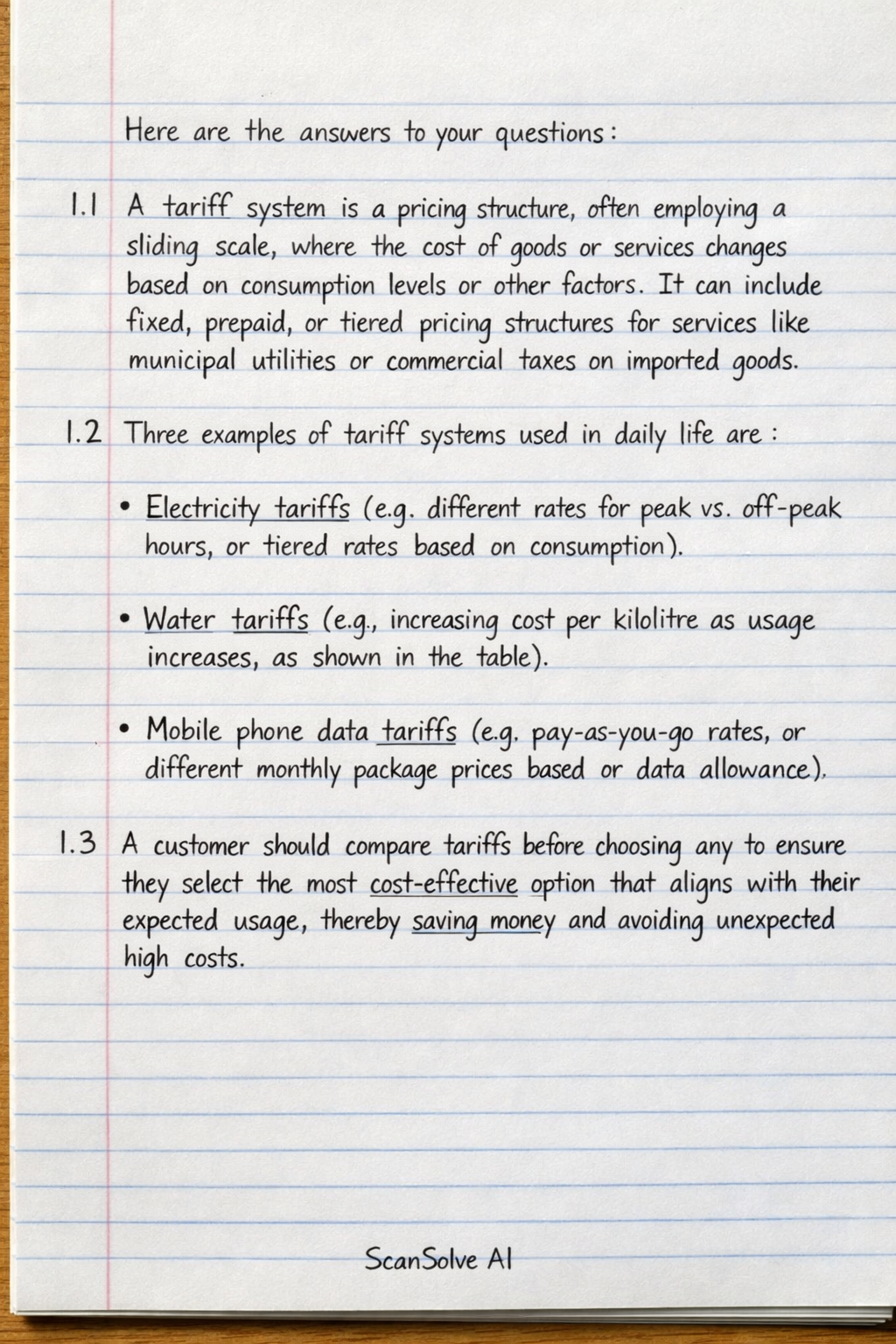
4 stepsHere are the answers to your questions:
1.1 A tariff system is a pricing structure, often employing a sliding scale, where the cost of goods or services changes based on consumption levels or other factors. It can include fixed, prepaid, or tiered pricing structures for services like municipal utilities or commercial taxes on imported goods.
1.2 Three examples of tariff systems used in daily life are:
- Electricity tariffs (e.g., different rates for peak vs. off-peak hours, or tiered rates based on consumption).
- Water tariffs (e.g., increasing cost per kilolitre as usage increases, as shown in the table).
- Mobile phone data tariffs (e.g., pay-as-you-go rates, or different monthly package prices based on data allowance).
1.3 A customer should compare tariffs before choosing any to ensure they select the most cost-effective option that aligns with their expected usage, thereby saving money and avoiding unexpected high costs.
1.4 A fixed tariff means the price per unit or the total charge remains constant regardless of the amount consumed. A variable tariff means the price per unit or the total charge changes based on the level of consumption or other factors, often increasing with higher usage (a sliding scale).
1.2.1
Identify the cost per kilolitre for Block 1 from the table.
According to the table, for Block 1 (0-10kl usage), the cost per kilolitre is R 8.
The cost of one kilolitre (kl) of water in Block 1 is .1.2.2
Identify the usage range for Block 2 from the table.
According to the table, for Block 2, the usage is .
The maximum kilolitres of water in Block 2 is .1.2.3
Determine the cost per kilolitre for the first 10 kl.
The first 10 kl falls into Block 1, where the cost is R 8 per kl.
Calculate the total cost for the first 10 kl.
The total cost of the first 10 kl he used is .
Still stuck on this one?
Ask a follow-up, and the answer starts from this question.
More Economics Questions
Handwritten Step-by-Step Solution
Get this as a handwritten image on WhatsApp — like a tutor wrote it for you.
Try on WhatsApp