
We read your photo as:
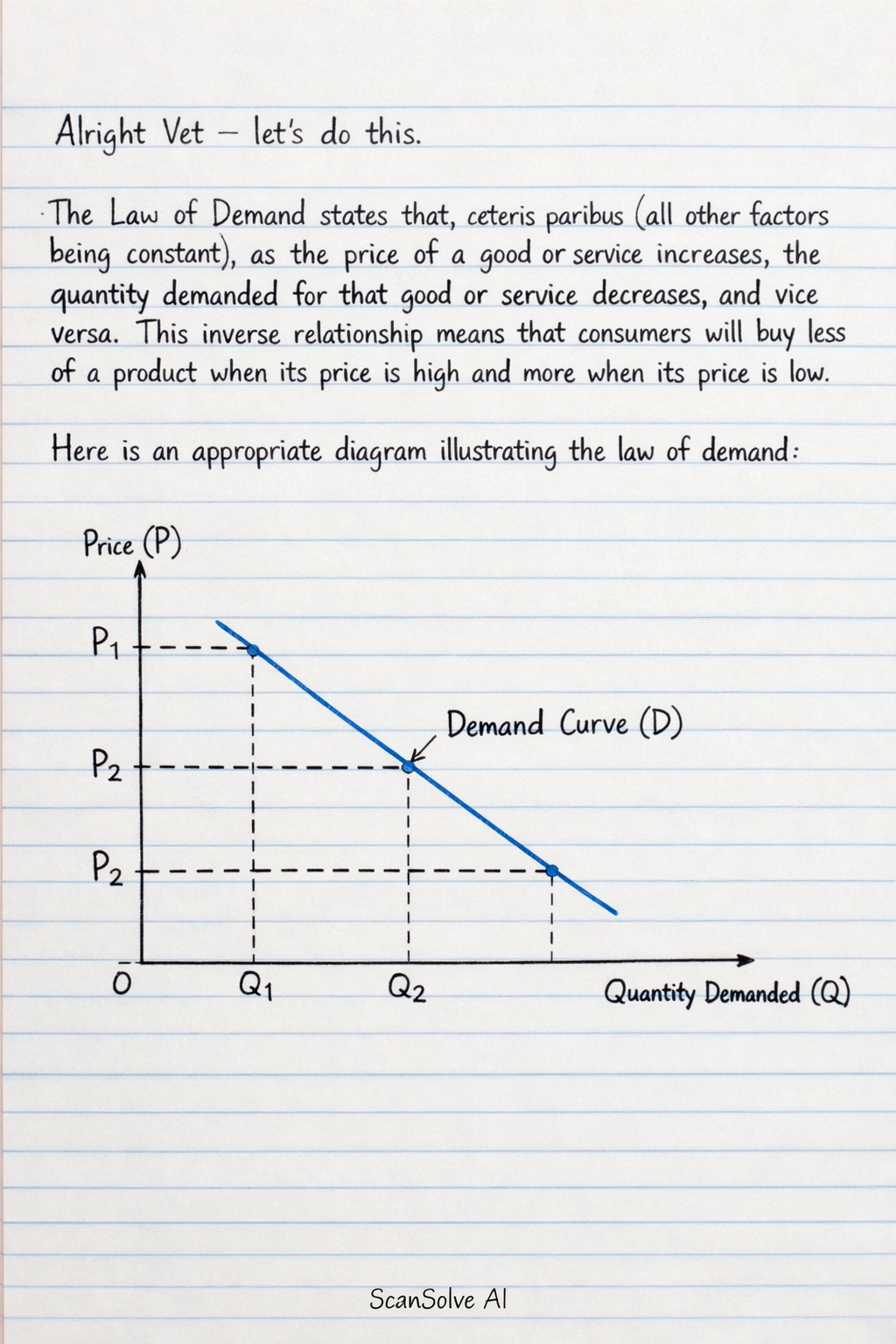
With the aid of an appropriate diagram state and explain the law of demand.
Economics
ScanSolve AI Answer
The Law of Demand states that, ceteris paribus (all other factors being constant), as the price of a good or service increases, the quantity demanded for that good or service decreases, and vice versa. This inverse relationship means that consumers will buy less of a product when its price is high and more when its price is low.
Here is an appropriate diagram illustrating the law of demand:
\begin{tikzpicture}
\draw[->] (0,0) -- (5,0) node[right] {Quantity Demanded (Q)};
\draw[->] (0,0) -- (0,5) node[above] {Price (P)};

\draw[thick, blue] (1,4) -- (4,1) node[below right] {Demand Curve (D)};

\node at (0,-0.2) {0};

\draw[dashed] (0,4) -- (1,4) -- (1,0);
\node at (-0.3,4) {$P_1$};
\node at (1,-0.3) {$Q_1$};

\draw[dashed] (0,1) -- (4,1) -- (4,0);
\node at (-0.3,1) {$P_2$};
\node at (4,-0.3) {$Q_2$};

\end{tikzpicture}
Explanation of the Diagram:
The diagram shows a downward-sloping demand curve (D).
- When the price is high (), the quantity demanded is low ().
- When the price decreases to , the quantity demanded increases to . This movement along the demand curve visually represents the inverse relationship between price and quantity demanded, which is the essence of the law of demand.
Was this helpful?
Still stuck on this one?
Ask a follow-up, and the answer starts from this question.
Got a different question?Ask your own question
More Economics Questions
QExplain the law of supply and illustrate a change in quantity supplied with an example and diagram.QDiscuss the theory of demand and supply and explain how market equilibrium is determined. Illustrate…QDefine quantity demanded and illustrate it with a demand schedule and a demand curve.QThe law of demand defines the relationship between which two variables?QDraw the demand and supply curves, determine the equilibrium price and quantity.
Browse by topic:Microeconomics
Handwritten Step-by-Step Solution
Get this as a handwritten image on WhatsApp — like a tutor wrote it for you.
Try on WhatsApp