
We read your photo as:
A rifle fires a bullet of mass 0.02 kg and observes that the rifle of mass 0.8 kg pushes backwards. If the bullet flies off with a velocity of 500 m/s, calculate the recoil velocity of the rifle.
ScanSolve AI Answer
Step-by-step solution
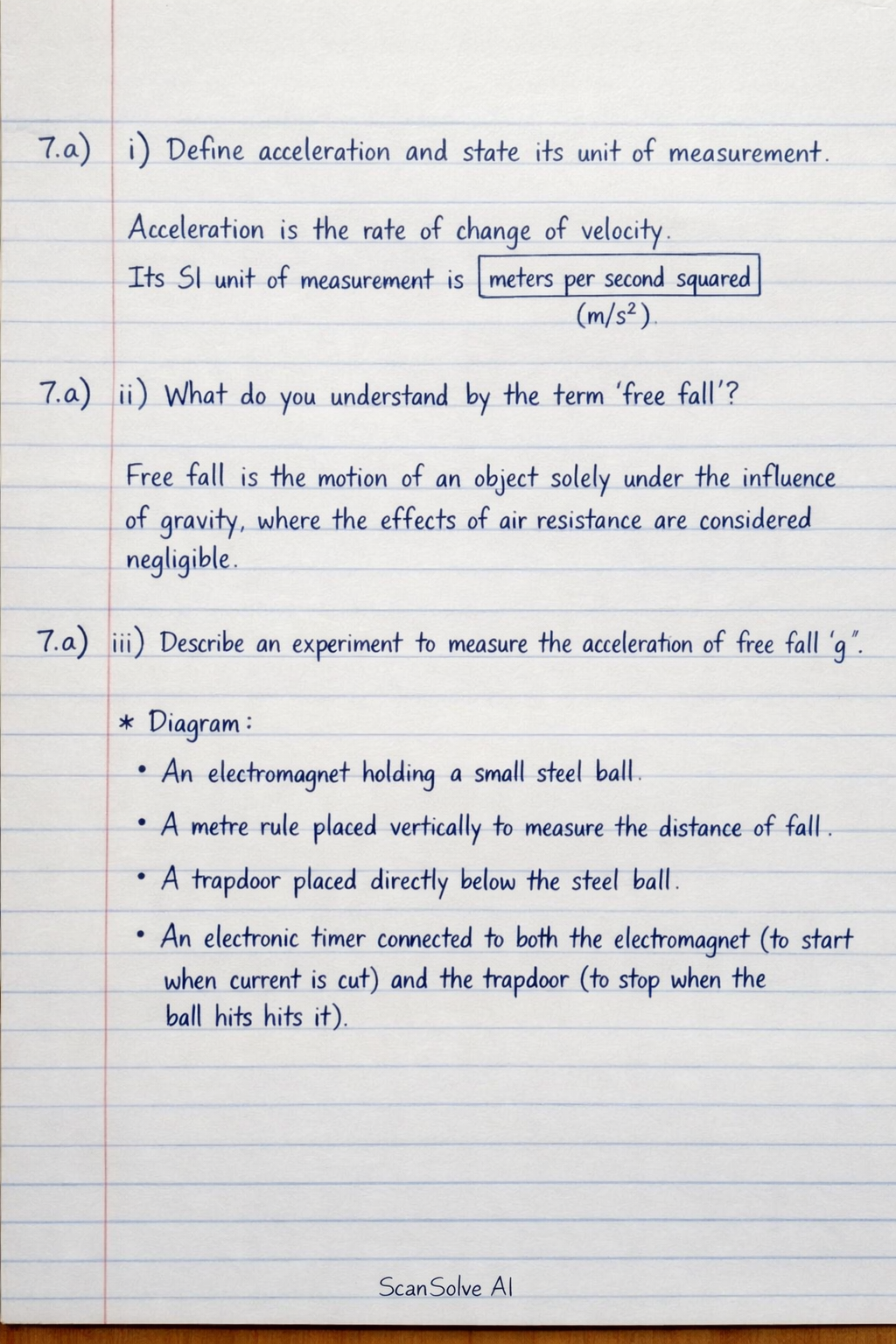
3 steps7.a) i) Define acceleration and state its unit of measurement.
Acceleration is the rate of change of velocity. Its SI unit of measurement is .
7.a) ii) What do you understand by the term 'free fall'?
Free fall is the motion of an object solely under the influence of gravity, where the effects of air resistance are considered negligible.
7.a) iii) Describe an experiment to measure the acceleration of free fall 'g'.
-
Diagram: A labelled diagram would show:
- An electromagnet holding a small steel ball.
- A metre rule placed vertically to measure the distance of fall.
- A trapdoor placed directly below the steel ball.
- An electronic timer connected to both the electromagnet (to start when current is cut) and the trapdoor (to stop when the ball hits it).
-
Procedure:
- Set up the apparatus with the electromagnet holding the steel ball above the trapdoor.
- Measure the vertical distance () from the bottom of the steel ball to the top of the trapdoor using the metre rule.
- Switch on the electromagnet to hold the ball.
- Start the electronic timer.
- Switch off the electromagnet. The ball falls, and the timer starts simultaneously.
- When the ball hits the trapdoor, the circuit is broken, and the timer stops. Record the time ().
- Repeat steps 2-6 several times for the same distance to obtain an average time.
- Repeat the entire experiment for different distances .
-
Measurements:
- The distance () the steel ball falls, measured in meters.
- The time () taken for the steel ball to fall that distance, measured in seconds.
-
How to obtain a value of 'g': Assuming the ball starts from rest (), the equation of motion is . Since , the equation simplifies to . Rearranging for , we get . Alternatively, a graph of versus can be plotted. This should yield a straight line passing through the origin. The gradient of this line will be , so .
-
Precautions:
- Ensure the metre rule is held perfectly vertical to accurately measure the distance .
- Take multiple readings for time for each distance and calculate the average to minimize random errors.
- Ensure the electromagnet releases the ball cleanly without imparting any initial velocity.
- Avoid parallax error when reading the metre rule.
- Conduct the experiment in a draft-free environment to minimize air resistance.
7.b) A hunter fires a bullet of mass and observes that the rifle of mass pushes backwards (recoils) as the bullet flies off with a velocity of .
7.b) i) State the law of conservation of momentum.
The total momentum of an isolated system remains constant if no external forces act on it. This means the total momentum before an interaction (like firing a rifle) is equal to the total momentum after the interaction.
7.b) ii) Calculate the recoil velocity of the rifle.
State the given values.
Mass of bullet,
Velocity of bullet,
Mass of rifle,
Initial velocity of bullet and rifle,Apply the law of conservation of momentum.
Total initial momentum = Total final momentum
Solve for the recoil velocity of the rifle ().
The negative sign indicates that the rifle recoils in the opposite direction to the bullet's motion.
The recoil velocity of the rifle is .7.c) Figure 5 below shows distance-time graphs for two athletes A and B in a race.
7.c) i) Describe the motion of athlete A.
The distance-time graph for athlete A is a curve with an increasing gradient. An increasing gradient on a distance-time graph indicates that the speed is increasing. Therefore, athlete A is .7.c) ii) Describe the motion of athlete B.
The distance-time graph for athlete B is a straight line passing through the origin. A straight line on a distance-time graph indicates a constant gradient, which means constant speed. Therefore, athlete B is moving at a $\boxed{\
Still stuck on this one?
Ask a follow-up, and the answer starts from this question.
More Physics Questions
Handwritten Step-by-Step Solution
Get this as a handwritten image on WhatsApp — like a tutor wrote it for you.
Try on WhatsApp