
We read your photo as:
A) Step 1: Suggest the meaning of the poem.
ScanSolve AI Answer
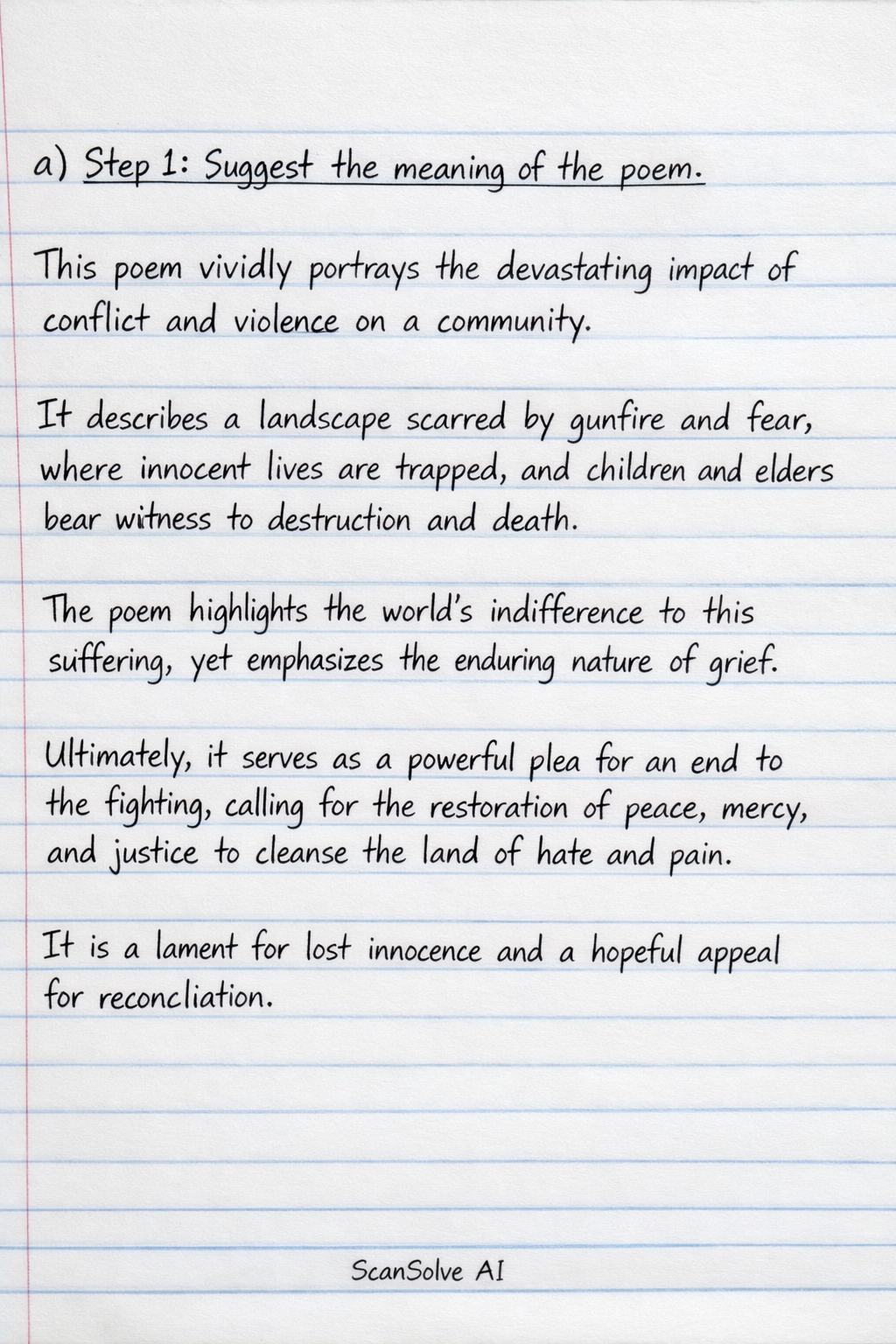
a) Step 1: Suggest the meaning of the poem.
This poem vividly portrays the devastating impact of conflict and violence on a community. It describes a landscape scarred by gunfire and fear, where innocent lives are trapped, and children and elders bear witness to destruction and death. The poem highlights the world's indifference to this suffering, yet emphasizes the enduring nature of grief. Ultimately, it serves as a powerful plea for an end to the fighting, calling for the restoration of peace, mercy, and justice to cleanse the land of hate and pain. It is a lament for lost innocence and a hopeful appeal for reconciliation.
b) Step 1: Give the meaning in context of the italicized words and expressions.
- i) ...the windows bare (line 3): This phrase suggests that the windows are empty, stripped of curtains or glass, indicating destruction, abandonment, or poverty due to conflict.
- ii) ...eyes wide with dread (line 6): This describes a child's eyes filled with intense fear or terror, reflecting the horrifying realities they witness.
- iii) ...turns its head away (line 11): This implies that the world ignores or chooses not to acknowledge the suffering and violence occurring.
- iv) ...and justice reign (line 15): This calls for a time when fairness, righteousness, and moral order are established and prevail.
c) Step 1: Identify and comment on the effective use of any TWO figures of speech.
- 1. Personification: "The walls are scarred" (line 3) and "the streets remember song" (line 9).
- Effectiveness: Giving human qualities to inanimate objects like walls and streets effectively conveys the lasting physical and emotional trauma inflicted by the conflict. The scarred walls show permanent damage, while the streets remembering song highlight a lost past of peace, emphasizing the depth of current suffering.
- 2. Metaphor: "fear becomes a constant chain" (line 2).
- Effectiveness: This metaphor powerfully illustrates how fear is not just an emotion but an oppressive, inescapable force that binds and restricts the lives of the people, creating a sense of continuous entrapment and helplessness.
d) Step 1: Establish the rhyme scheme and comment on its effectiveness.
The rhyme scheme of the poem is generally AABB, with a slight variation in the first stanza.
- Stanza 1: streets (A), lane (B), chain (B), bare (C), snare (C) - ABBC C
- Stanza 2: dread (A), dead (A), tones (B), stones (B) - AABB
- Stanza 3: song (A), long (A), away (B), sway (B) - AABB
- Stanza 4: fight (A), night (A), reign (B), pain (B) - AABB Effectiveness: The predominantly consistent AABB rhyme scheme creates a steady, rhythmic flow, making the poem accessible and memorable. This regularity can also evoke a sense of inevitability or the relentless nature of the conflict and suffering described. The slight deviation in the first stanza might reflect the initial chaos and disruption before settling into a more somber, consistent tone.
e) Step 1: Pick out FOUR nouns from the poem and transform them to adjectives.
-
- Noun: Fear Adjective: Fearful
-
- Noun: Dread Adjective: Dreadful
-
- Noun: Grief Adjective: Grievous
-
- Noun: Justice Adjective: Just
Still stuck on this one?
Ask a follow-up, and the answer starts from this question.
More English Questions
Handwritten Step-by-Step Solution
Get this as a handwritten image on WhatsApp — like a tutor wrote it for you.
Try on WhatsApp