
We read your photo as:
Analyze the provided excerpt about leadership types, focusing on the characters Mr. Torch and Hon. Yongrui, and describe the speaker Ramdaye's attitude towards Hon. Ramdaye.
ScanSolve AI Answer
a)
This excerpt is part of a broader discussion about different types of leaders and their characteristics.
- Before this excerpt: The characters were likely discussing various categories of leaders, leading up to Ted introducing the "independent-minded category."
- After this excerpt: The conversation would likely continue to elaborate on the leadership qualities of Hon. Ramdaye and Mayor Mossi, perhaps exploring the implications of Ted's final statement about political competition.
b)
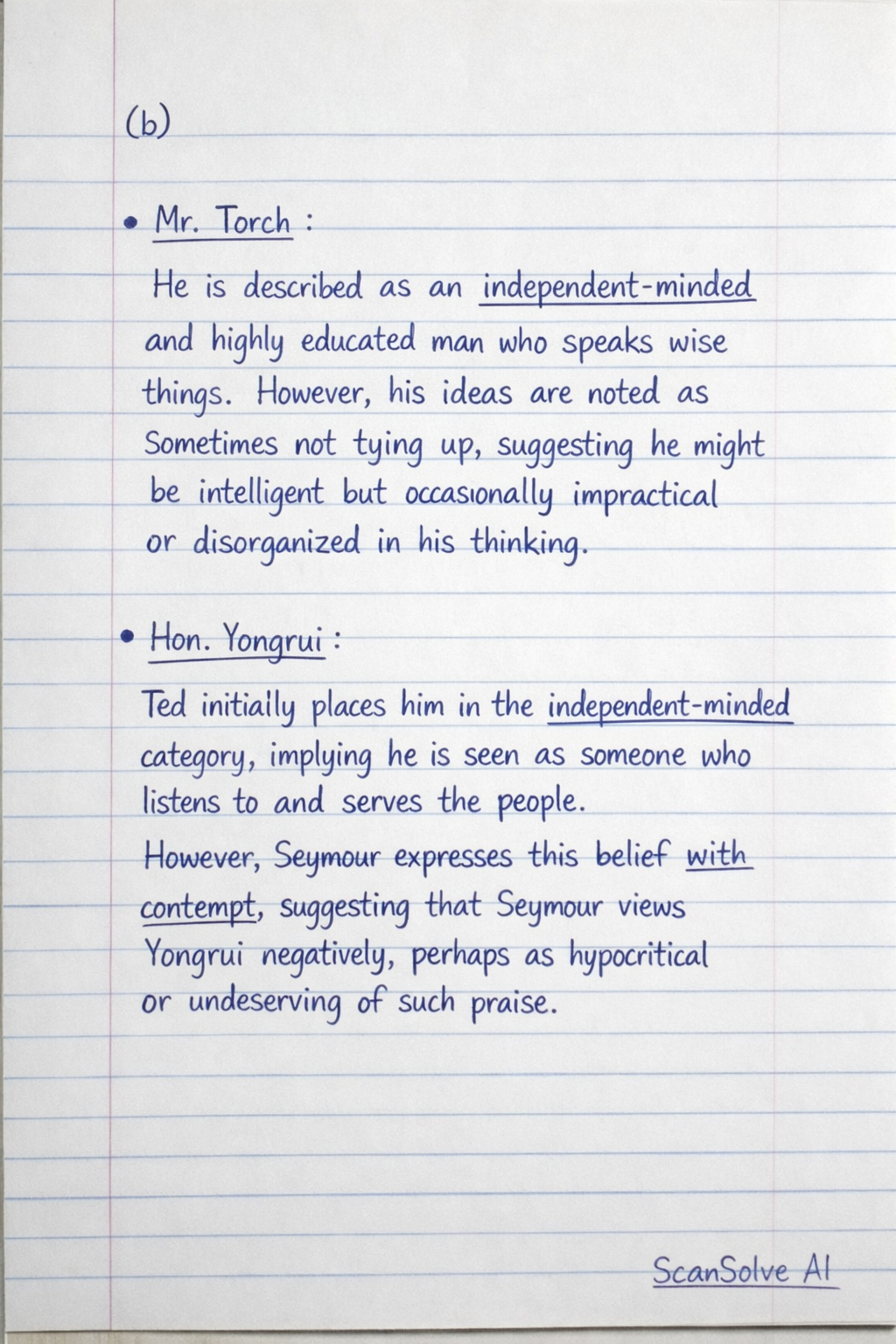
- Mr. Torch: He is described as an independent-minded and highly educated man who speaks wise things. However, his ideas are noted as sometimes not tying up, suggesting he might be intelligent but occasionally impractical or disorganized in his thinking.
- Hon. Yongrui: Ted initially places him in the independent-minded category, implying he is seen as someone who listens to and serves the people. However, Seymour expresses this belief with contempt, suggesting that Seymour views Yongrui negatively, perhaps as hypocritical or undeserving of such praise.
c)
Assuming the question meant the speaker Ramdaye's attitude towards the politician Hon. Ramdaye:
The speaker Ramdaye has a positive and admiring attitude towards Hon. Ramdaye. He describes him as a "highly disciplined man," a "former head teacher," and someone who "exerts the same school discipline in running his ward," indicating respect for his leadership style and character.
d)
Two stylistic devices used in the excerpt are:
- Sarcasm: Illustrated by Seymour's comment, "Shhs, shss, I hear he is terminally ill, so we don't have to worry about him. Some say he ate uninspected meat." This is a sarcastic remark, implying a malicious wish or mocking rumor about Hon. Ramdaye's health.
- Metaphor: Illustrated by Ted's statement, "He said there is always a winner even in a beauty contest of monkeys!" This metaphor compares a political contest to a "beauty contest of monkeys," suggesting that the competition for leadership can be absurd or involve less-than-ideal candidates, yet a winner still emerges.
e)
Two themes addressed in this excerpt are:
- Leadership and Politics: The entire dialogue revolves around the qualities of different leaders (e.g., "independent-minded"), the nature of political competition (e.g., "who has better leadership qualities"), and the figures involved (Hon. Yongrui, Mayor Mossi, Hon. Ramdaye).
- Rivalry and Power Struggles: This is evident in Ramdaye's intense animosity towards Mayor Mossi ("Devil take his soul! He has never liked me.") and Seymour's insinuation that Mossi might have poisoned Ramdaye, highlighting the ruthless and personal nature of political competition.
f)
In a beauty contest of monkeys, he said there is always a winner!
g)
The excerpt only explicitly mentions the "independent-minded category" of leaders according to Ted. Therefore, based solely on this excerpt, other categories cannot be listed.
h)
The meaning of the following expressions as used in the excerpt:
- Kindly soul: A person who is good-natured, compassionate, or benevolent.
- Contempt: A feeling that someone or something is worthless, beneath consideration, or deserving scorn.
- Political star: A person who is becoming increasingly successful and prominent in politics.
- Tie up: To connect, make sense, or be logically consistent.
Still stuck on this one?
Ask a follow-up, and the answer starts from this question.
More English Questions
Handwritten Step-by-Step Solution
Get this as a handwritten image on WhatsApp — like a tutor wrote it for you.
Try on WhatsApp