
Assignment 2 What factors should be considered when selecting an irrigation system for a farm? Explain the term crop water requirement and describe the factors that affect it.in English language with more explanation
ScanSolve AI Answer
Step-by-step solution
4 steps1. What factors should be considered when selecting an irrigation system for a farm?
Identify key factors for irrigation system selection.
Selecting an appropriate irrigation system is crucial for efficient water use and optimal crop production. Several factors must be carefully considered to ensure the system is effective, economical, and sustainable.
Describe the influencing factors.
Here are some key factors to consider:
-
Water Availability and Quality: The source (river, well, reservoir) and quantity of water available are primary considerations. The quality of water (salinity, pH, sediment content) is also vital, as poor quality water can harm crops and clog irrigation equipment. For example, drip irrigation is sensitive to poor water quality.
-
Crop Type and Water Requirements: Different crops have varying water needs, root depths, and sensitivities to water application methods. Some crops, like rice, require flooding, while others, like vegetables, benefit from precise, localized watering. The growth stage of the crop also influences its water demand.
-
Soil Type and Topography: Soil texture (sandy, loamy, clayey) affects its water infiltration rate and water-holding capacity. Sandy soils drain quickly and require frequent, light irrigation, while clayey soils hold water longer. The topography of the land (slope, uniformity) dictates whether gravity-fed systems (like surface irrigation) are feasible or if pressurized systems (like sprinklers or drip) are necessary.
-
Climate Conditions: Local climatic factors such as temperature, humidity, wind speed, and rainfall patterns significantly influence evaporation rates and crop water demand. In windy areas, sprinkler irrigation might lead to high water loss due to drift, making drip irrigation a more efficient choice.
-
Energy and Labor Availability: The cost and availability of energy (electricity, fuel) for pumping water are critical, especially for pressurized systems. The amount of labor required for operation, maintenance, and repair of the irrigation system also needs to be factored into the overall cost and feasibility.
2. Explain the term crop water requirement and describe the factors that affect it.
-
Define crop water requirement.
Crop water requirement refers to the total amount of water needed by a specific crop to grow optimally and produce its maximum potential yield under given climatic conditions. This includes water lost through transpiration (water vapor released by plants) and evaporation from the soil surface, collectively known as evapotranspiration (). It is typically expressed in units of depth (e.g., millimeters or inches) over a specific period.
Describe the factors that affect crop water requirement.
Several factors influence a crop's water requirement:
-
Climatic Factors: These are the most significant drivers.
- Temperature: Higher temperatures increase evapotranspiration.
- Solar Radiation: More intense sunlight leads to higher rates of photosynthesis and transpiration.
- Humidity: Lower humidity increases the vapor pressure deficit, leading to higher transpiration.
- Wind Speed: Stronger winds increase the rate of water vapor removal from plant surfaces and the soil, thus increasing evapotranspiration. These climatic factors collectively determine the reference evapotranspiration (), which is the evapotranspiration from a hypothetical reference crop.
-
Crop Type and Variety: Different crops have inherent physiological differences in how much water they need. For example, a water-intensive crop like rice will have a higher water requirement than a drought-tolerant crop like millet. Even within the same crop species, different varieties can have varying water needs.
-
Growth Stage of the Crop: A crop's water requirement changes significantly throughout its life cycle. It is generally low during initial growth stages, increases during vegetative growth and flowering/fruit development, and then may decrease during maturity and ripening.
-
Soil Type: While soil type doesn't directly determine the amount of water a crop needs, it affects how frequently water needs to be applied to meet that requirement. Soils with low water-holding capacity (e.g., sandy soils) require more frequent, smaller irrigations, whereas soils with high water-holding capacity (e.g., clayey soils) can be irrigated less frequently with larger amounts.
-
Management Practices: Certain agricultural practices can influence the actual water used by a crop. For instance, mulching can reduce soil evaporation, and effective weed control minimizes water competition from unwanted plants. Planting density can also affect water use per unit area.
-
Still stuck on this one?
Ask a follow-up, and the answer starts from this question.
More English Questions
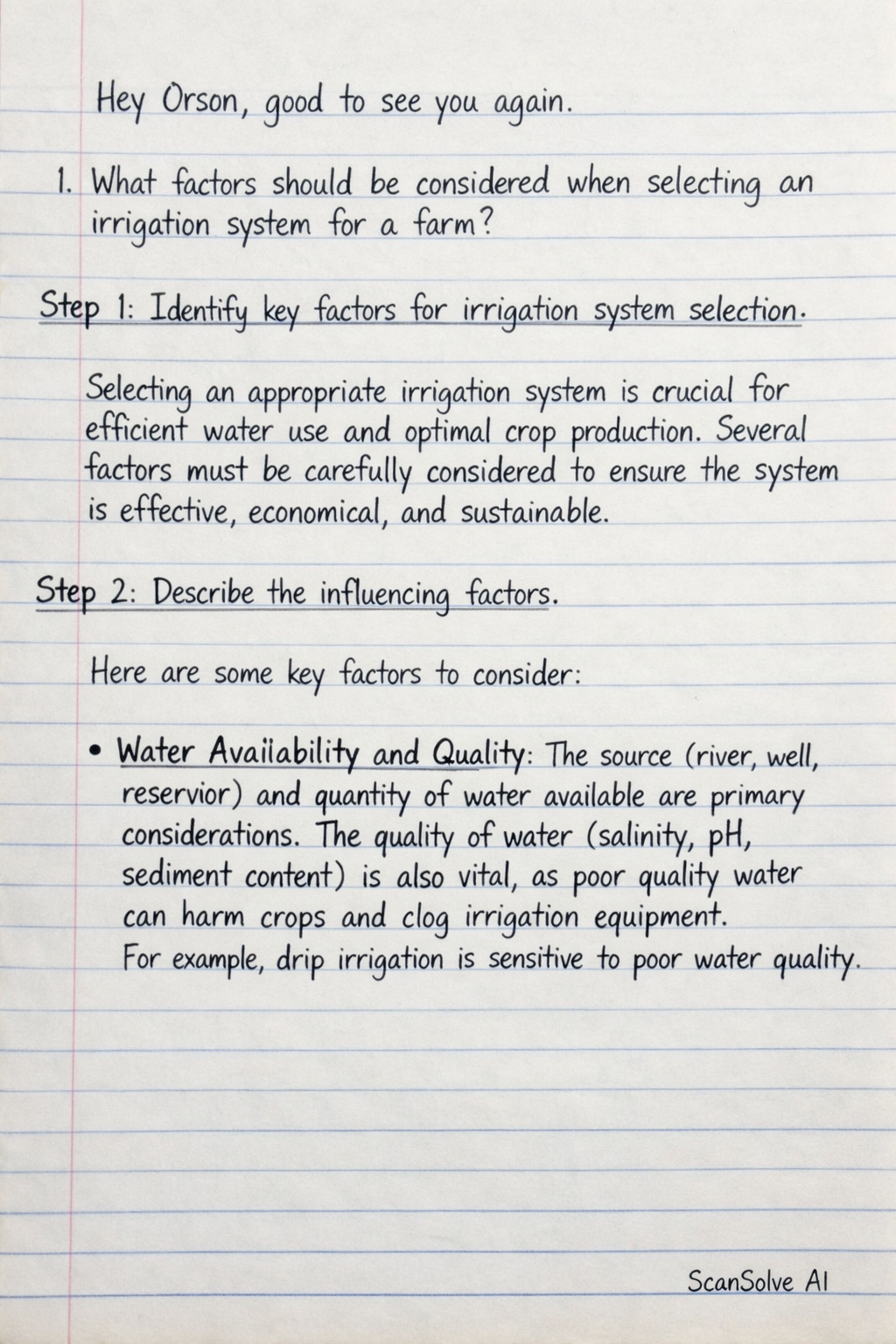
Handwritten Step-by-Step Solution
Get this as a handwritten image on WhatsApp — like a tutor wrote it for you.
Try on WhatsApp