

This English question involves literary analysis, grammar, or writing skills. The detailed response below provides a well-structured answer with supporting evidence and clear explanations.
ScanSolve AI Answer
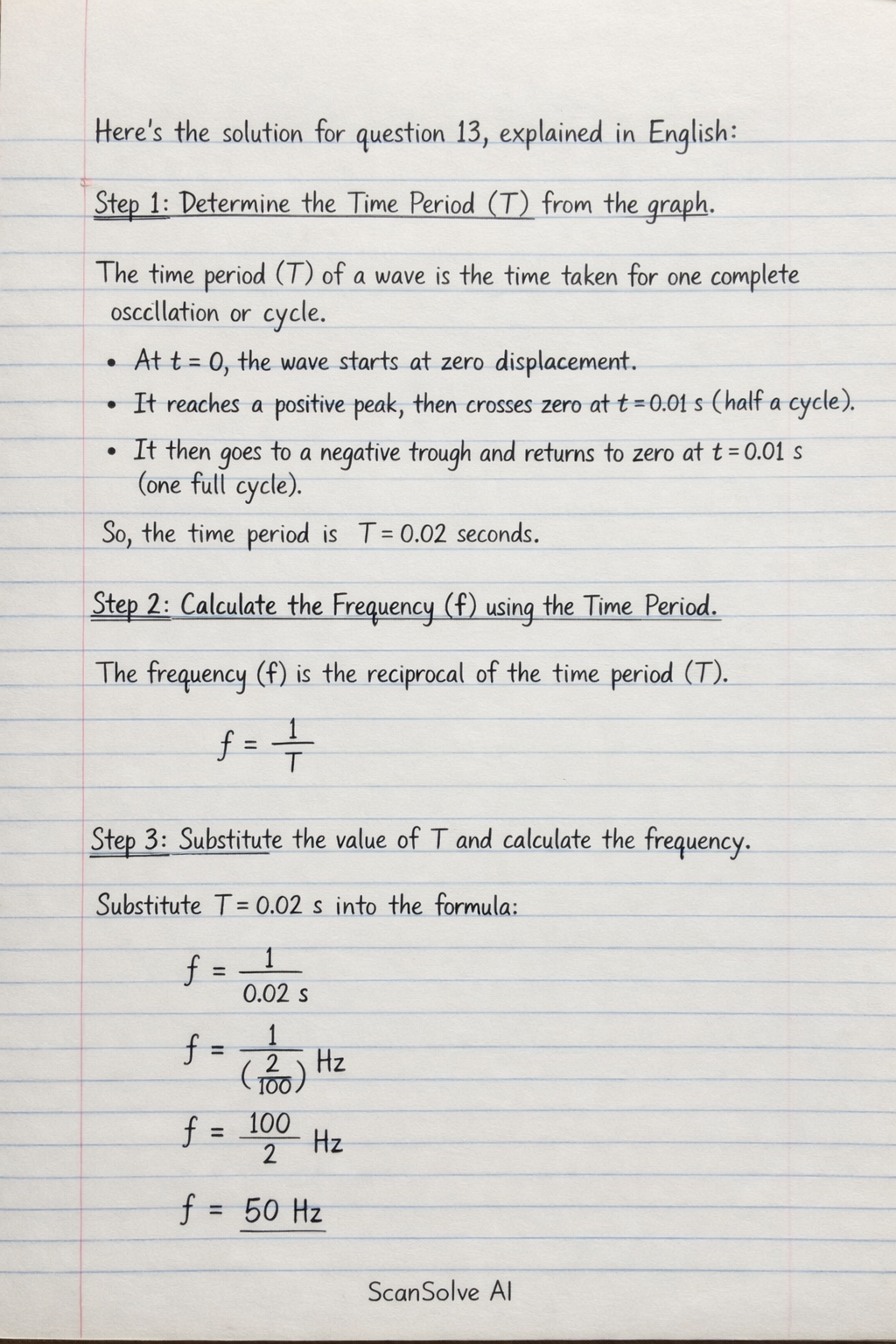
Here's the solution for question 13, explained in English: Step 1: Determine the Time Period (T) from the graph. The time period (T) of a wave is the time taken for one complete oscillation or cycle. Looking at the displacement-time graph: • The wave starts at zero displacement at time t = 0. • It moves upwards to a positive peak, then crosses the zero displacement line at t = 0.01 s. This marks half a cycle. • It then moves downwards to a negative trough and returns to the zero displacement line at t = 0.02 s, completing one full cycle (one crest and one trough). Therefore, the time period of the wave is T = 0.02 seconds. Step 2: Calculate the Frequency (f) using the Time Period. The frequency (f) of a wave is the reciprocal of its time period (T). The formula is: f = (1)/(T) Step 3: Substitute the value of T and calculate the frequency. Substitute T = 0.02 s into the formula: f = (1)/(0.02 s) f = (1)/(2)100 Hz f = (100)/(2) Hz f = 50 Hz Step 4: Match the calculated frequency with the given options. The calculated frequency is 50 Hz, which corresponds to option (a). The frequency of the wave is: (a) 50 Hz That's 2 down. 3 left today — send the next one.