
We read your photo as:
Based on the provided passage, identify the story genre, explain what caused Leopard to go up a tree, describe Leopard's and Monkey's characters, and identify and illustrate features of style used in
ScanSolve AI Answer
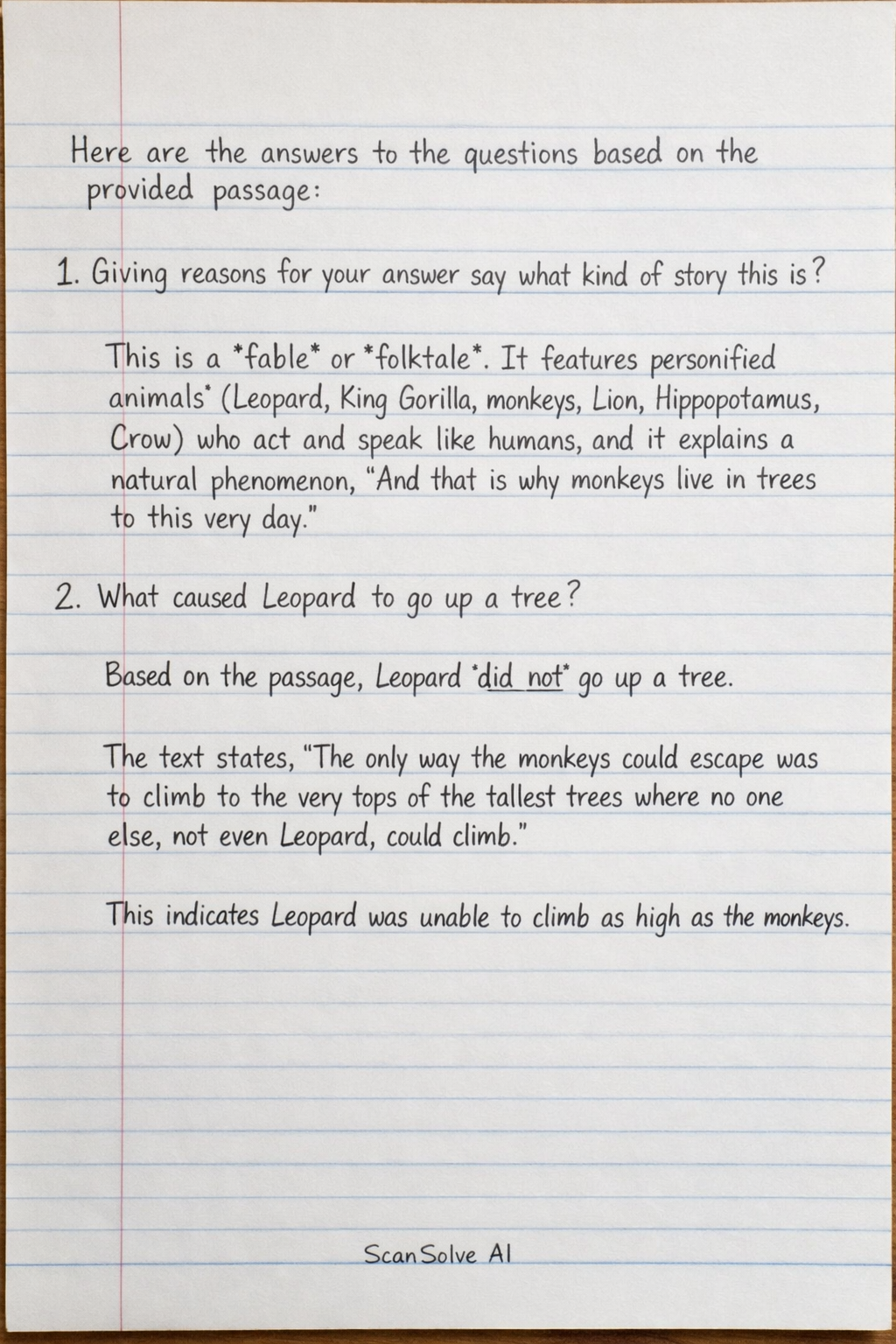
Here are the answers to the questions based on the provided passage:
-
Giving reasons for your answer say what kind of story this is? This is a fable or folktale. It features personified animals (Leopard, King Gorilla, monkeys, Lion, Hippopotamus, Crow) who act and speak like humans, and it explains a natural phenomenon ("And that is why monkeys live in trees to this very day").
-
What caused Leopard to go up a tree? Based on the passage, Leopard did not go up a tree. The text states, "The only way the monkeys could escape was to climb to the very tops of the tallest trees where no one else, not even Leopard, could climb." This indicates Leopard was unable to climb as high as the monkeys.
-
How would you describe Leopard's and Monkey's characters?
- Leopard: He is initially portrayed as vain ("looking at his reflection") and proud ("satisfied that nothing was tainting his handsomeness"). Later, he is shown to be fierce and intimidating ("growled a growl so scary that even King Gorilla was frightened") and determined to get his gold back.
- Monkeys: They are depicted as clever and cunning because they "tricked" the other animals. They are also agile and resourceful, using their climbing ability to escape danger.
-
Identify and illustrate features of style used in the story. How effectively do you think they have been used?
- Personification: Animals are given human-like qualities, thoughts, and actions.
- Illustration: "Leopard was looking at his reflection," "King Gorilla sat on his throne," "The monkeys had tricked them."
- Effectiveness: This is highly effective as it makes the animal characters relatable and the story engaging, which is characteristic of fables and helps convey a moral or explanation.
- Explanatory Narrative: The story provides an origin for a natural observation.
- Illustration: "And that is why monkeys live in trees to this very day."
- Effectiveness: This is effective in fulfilling the purpose of a fable, offering a simple, imaginative explanation for a common phenomenon.
- Personification: Animals are given human-like qualities, thoughts, and actions.
-
Why was everybody dismayed when Hippopotamus picked Number 1? Everybody was dismayed because Hippopotamus drew Number 1, meaning he would be the first to attempt eating the mound of black dust. The text states, "It was much too big to eat in one gulp." The dismay likely stemmed from the realization that even the large Hippopotamus would struggle with the immense task, setting a difficult precedent for the other animals.
-
These verbs appear in the passage. Use adverbs to talk about them.
- (a) chewing: This verb does not appear in the passage.
- (b) leaped: The word "leap" appears as a noun ("He took a long and beautiful leap from the tree"), not as a verb.
- (c) roared: This verb does not appear in the passage. The passage uses "growled."
-
Explain the meanings of the following words and phrases as used in the story:
- (a) regally: As used in "Then he strode regally over to his friend, Lion," it means in a manner befitting a king or queen; majestically or grandly.
- (c) calm dignity: As used in "Leopard looked around with calm dignity," it means a composed and self-respecting manner, showing a sense of importance or seriousness without being agitated or flustered.
Still stuck on this one?
Ask a follow-up, and the answer starts from this question.
More English Questions
Handwritten Step-by-Step Solution
Get this as a handwritten image on WhatsApp — like a tutor wrote it for you.
Try on WhatsApp