
We read your photo as:
Based on the provided text, answer the following questions: 4.1.1, 4.1.2, 4.1.3, and 4.1.4.
ScanSolve AI Answer
Here are the answers to the questions based on the provided text:
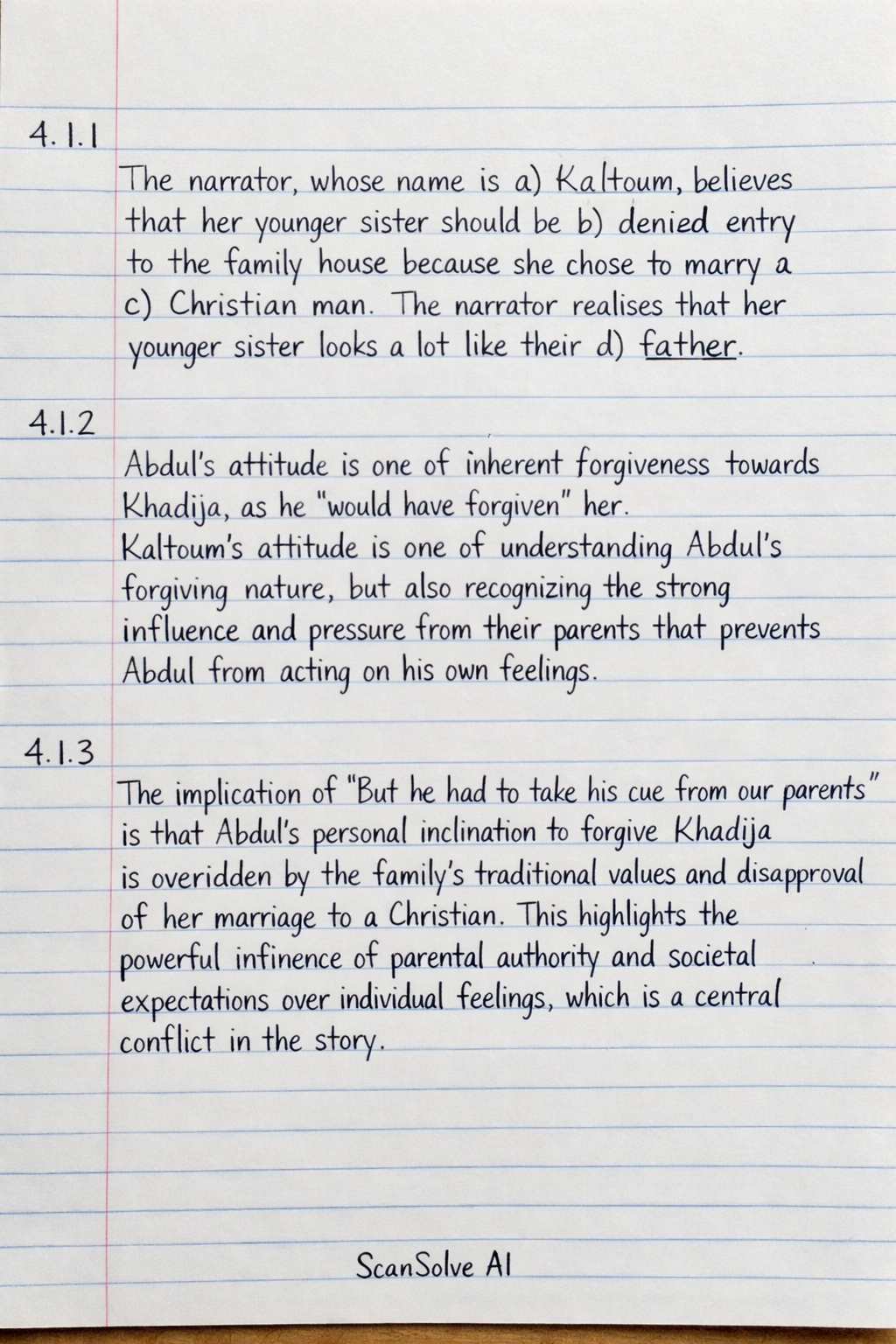
4.1.1
The narrator, whose name is a) Kaltoum, believes that her younger sister should be b) denied entry to the family house because she chose to marry a c) Christian man. The narrator realises that her younger sister looks a lot like their d) father.
4.1.2
Abdul's attitude is one of inherent forgiveness towards Khadija, as he "would have forgiven" her. Kaltoum's attitude is one of understanding Abdul's forgiving nature, but also recognizing the strong influence and pressure from their parents that prevents Abdul from acting on his own feelings.
4.1.3
The implication of 'But he had to take his cue from our parents' is that Abdul's personal inclination to forgive Khadija is overridden by the family's traditional values and disapproval of her marriage to a Christian. This highlights the powerful influence of parental authority and societal expectations over individual feelings, which is a central conflict in the story.
4.1.4
a) Kaltoum makes Khadija feel cheap by participating in the family custom of offering her food in a bowl wrapped in a cloth, which is a symbolic gesture meaning they refuse to eat with her and are rejecting her.
b) Khadija persistently visits the shop on Fridays because she desperately seeks reconciliation and acceptance from her family, despite their repeated rejections and insults. She is willing to endure their poor treatment in the hope of regaining their love and belonging.
4.1.5
a) The figure of speech in these lines is a simile.
b) This figure of speech is relevant to the short story because it powerfully illustrates Khadija's desperate and self-sacrificing persistence in seeking her family's acceptance, even when they treat her harshly. It emphasizes the depth of her longing for reconciliation and the emotional pain she endures, drawing a parallel to the complex and often destructive dynamics of an abusive relationship.
Still stuck on this one?
Ask a follow-up, and the answer starts from this question.
More English Questions
Handwritten Step-by-Step Solution
Get this as a handwritten image on WhatsApp — like a tutor wrote it for you.
Try on WhatsApp