
This English question involves literary analysis, grammar, or writing skills. The detailed response below provides a well-structured answer with supporting evidence and clear explanations.
ScanSolve AI Answer
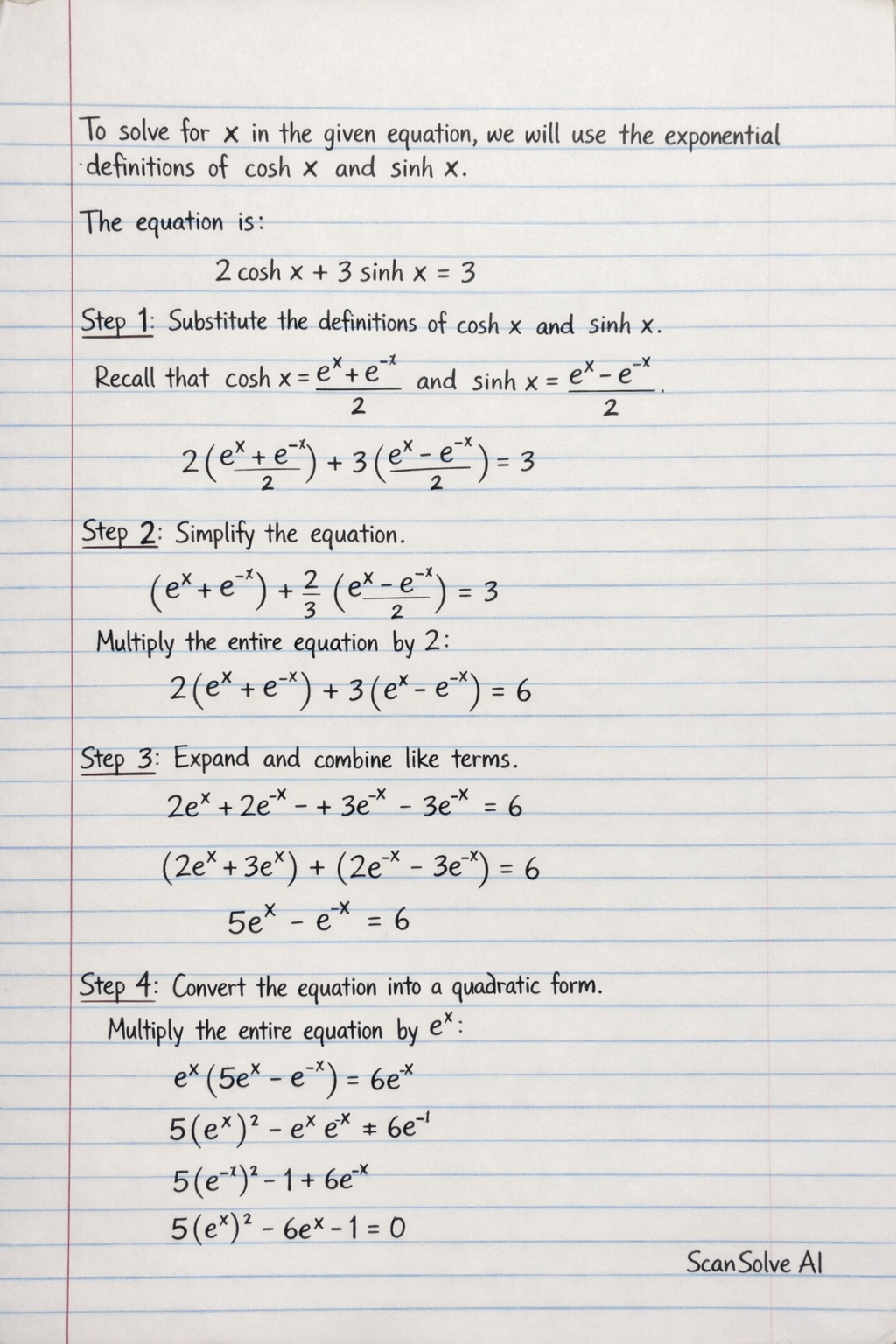
To solve for x in the given equation, we will use the exponential definitions of x and x. The equation is: 2 x + 3 x = 3 Step 1: Substitute the definitions of x and x. Recall that x = e^x + e^-x2 and x = e^x - e^-x2. 2 (e^x + e^-x2) + 3 (e^x - e^-x2) = 3 Step 2: Simplify the equation. (e^x + e^-x) + (3)/(2)(e^x - e^-x) = 3 Multiply the entire equation by 2 to eliminate the fraction: 2(e^x + e^-x) + 3(e^x - e^-x) = 6 Step 3: Expand and combine like terms. 2e^x + 2e^-x + 3e^x - 3e^-x = 6 (2e^x + 3e^x) + (2e^-x - 3e^-x) = 6 5e^x - e^-x = 6 Step 4: Convert the equation into a quadratic form. Multiply the entire equation by e^x to eliminate e^-x: e^x (5e^x - e^-x) = 6e^x 5(e^x)^2 - e^x e^-x = 6e^x Since e^x e^-x = e^x-x = e^0 = 1: 5(e^x)^2 - 1 = 6e^x Rearrange into a standard quadratic form ay^2 + by + c = 0, where y = e^x: 5(e^x)^2 - 6e^x - 1 = 0 Step 5: Solve the quadratic equation for e^x. Let y = e^x. The equation becomes 5y^2 - 6y - 1 = 0. Using the quadratic formula y = -b ± sqrt(b^2 - 4ac)2a: y = -(-6) ± sqrt((-6)^2 - 4(5)(-1))2(5) y = 6 ± sqrt(36 + 20)10 y = 6 ± sqrt(56)10 Simplify sqrt(56) = sqrt(4 × 14) = 2sqrt(14): y = 6 ± 2sqrt(14)10 y = 3 ± sqrt(14)5 Step 6: Solve for x. Since y = e^x, we have two possible values for e^x: e^x = 3 + sqrt(14)5 or e^x = 3 - sqrt(14)5 For the second case, sqrt(14) is approximately 3.74. So, 3 - sqrt(14) would be negative. Since e^x must always be positive, the solution e^x = 3 - sqrt(14)5 is not valid. Therefore, we only consider: e^x = 3 + sqrt(14)5 Take the natural logarithm of both sides: (e^x) = (3 + sqrt(14)5) x = (3 + sqrt(14)5) The solution for x is: x = (3 + sqrt(14)5) That's 2 down. 3 left today — send the next one.