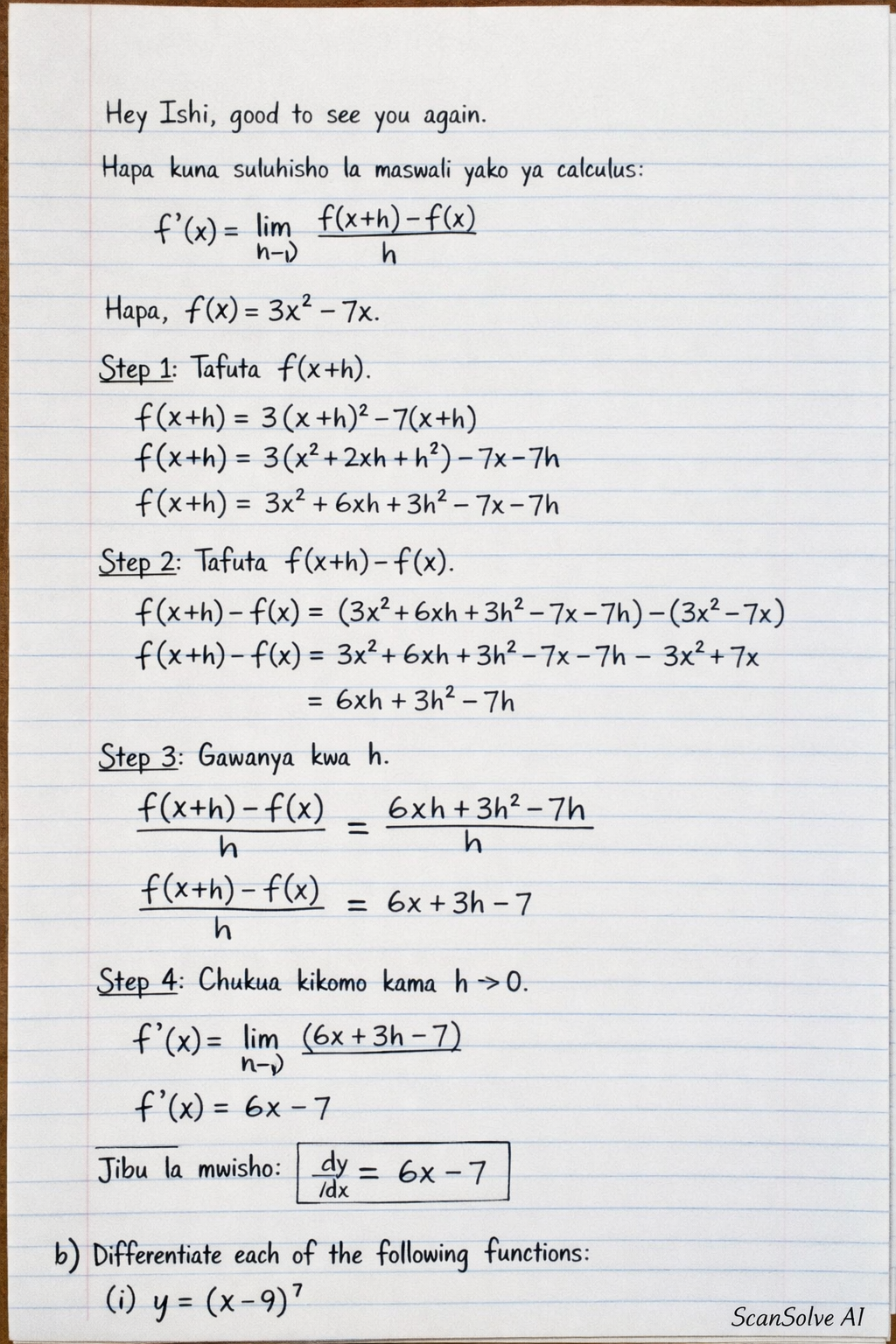
Step 3: Gawanya kwa h.
hf(x+h)−f(x)=h6xh+3h2−7hhf(x+h)−f(x)=6x+3h−7
Step 4: Chukua kikomo kama h→0.
f′(x)=limh→0(6x+3h−7)f′(x)=6x−7
Jibu la mwisho:
dxdy=6x−7
b) Differentiate each of the following functions:
(i) y=(x−9)7
Tunatumia sheria ya mnyororo (chain rule).
Step 1: Acha u=x−9. Kisha y=u7.
Step 2: Tafuta dudy na dxdu.
dudy=7u6dxdu=1
Step 3: Tumia sheria ya mnyororo dxdy=dudy⋅dxdu.
dxdy=7u6⋅1dxdy=7(x−9)6
Jibu la mwisho:
dxdy=7(x−9)6
(ii) y=x2sin3x
Tunatumia sheria ya bidhaa (product rule): dxd(uv)=u′v+uv′.
Step 1: Acha u=x2 na v=sin3x.
Step 2: Tafuta u′ na v′.
u′=dxd(x2)=2xv′=dxd(sin3x)=cos3x⋅dxd(3x)=3cos3x
Step 3: Tumia sheria ya bidhaa.
dxdy=(2x)(sin3x)+(x2)(3cos3x)dxdy=2xsin3x+3x2cos3x
Jibu la mwisho:
dxdy=2xsin3x+3x2cos3x
(iii) y=x+1x3+1
Kwanza, rahisiisha usemi kwa kutumia utambulisho wa jumla ya cubes a3+b3=(a+b)(a2−ab+b2).
Step 1: Rahisiisha usemi.
y=x+1(x+1)(x2−x+1)
Kwa x=−1, usemi unakuwa:
y=x2−x+1
Step 2: Tofautisha usemi uliorahisishwa.
dxdy=dxd(x2−x+1)dxdy=2x−1
Jibu la mwisho:
dxdy=2x−1
c) Locate the stationary points of the function z=x3+y3−3x−6y−1 and hence determine their nature.
Ili kupata pointi za stationary, tunapata derivatives za sehemu ya kwanza na kuziweka sawa na sifuri.
Step 1: Tafuta derivatives za sehemu ya kwanza.
∂x∂z=3x2−3∂y∂z=3y2−6
Step 2: Weka derivatives za sehemu sawa na sifuri na utatue kwa x na y.
3x2−3=0⟹3x2=3⟹x2=1⟹x=±13y2−6=0⟹3y2=6⟹y2=2⟹y=±2
Pointi za stationary ni: (1,2), (1,−2), (−1,2), (−1,−2).
Step 3: Tafuta derivatives za sehemu ya pili ili kuamua asili ya pointi.
∂x2∂2z=6x∂y2∂2z=6y∂x∂y∂2z=0
Tunatumia mtihani wa derivative ya pili na discriminant D=∂x2∂2z∂y2∂2z−(∂x∂y∂2z)2.
Step 4: Tathmini kila pointi ya stationary.
• Kwa pointi (1,2):
∂x2∂2z=6(1)=6∂y2∂2z=62D=(6)(62)−(0)2=362
Kwa kuwa D>0 na ∂x2∂2z>0, pointi hii ni local minimum.
• Kwa pointi (1,−2):
∂x2∂2z=6(1)=6∂y2∂2z=6(−2)=−62D=(6)(−62)−(0)2=−362
Kwa kuwa D<0, pointi hii ni saddle point.
• Kwa pointi (−1,2):
∂x2∂2z=6(−1)=−6∂y2∂2z=62D=(−6)(62)−(0)2=−362
Kwa kuwa D<0, pointi hii ni saddle point.
• Kwa pointi (−1,−2):
∂x2∂2z=6(−1)=−6∂y2∂2z=6(−2)=−62D=(−6)(−62)−(0)2=362
Kwa kuwa D>0 na ∂x2∂2z<0, pointi hii ni local maximum.
Jibu la mwisho:
Pointi za stationary na asili yake ni:
• (1,2): local minimum
• (1,−2): saddle point
• (−1,2): saddle point
• (−1,−2): local maximum
Tuma swali linalofuata 📸
Was this helpful?
Need help with your own homework?
Get instant step-by-step solutions to any question. Free to start.
This English question involves literary analysis, grammar, or writing skills. The detailed response below provides a well-structured answer with supporting evidence and clear explanations.
ScanSolve AI Answer
Hapa kuna suluhisho la maswali yako ya calculus: a) Differentiate y = 3x^2 - 7x from first principles. Ili kutofautisha kutoka kanuni za kwanza, tunatumia fomula: f'(x) = _h 0 (f(x+h) - f(x))/(h) Hapa, f(x) = 3x^2 - 7x. Step 1: Tafuta f(x+h). f(x+h) = 3(x+h)^2 - 7(x+h) f(x+h) = 3(x^2 + 2xh + h^2) - 7x - 7h f(x+h) = 3x^2 + 6xh + 3h^2 - 7x - 7h Step 2: Tafuta f(x+h) - f(x). f(x+h) - f(x) = (3x^2 + 6xh + 3h^2 - 7x - 7h) - (3x^2 - 7x) f(x+h) - f(x) = 3x^2 + 6xh + 3h^2 - 7x - 7h - 3x^2 + 7x f(x+h) - f(x) = 6xh + 3h^2 - 7h Step 3: Gawanya kwa h. (f(x+h) - f(x))/(h) = (6xh + 3h^2 - 7h)/(h) (f(x+h) - f(x))/(h) = 6x + 3h - 7 Step 4: Chukua kikomo kama h 0. f'(x) = _h 0 (6x + 3h - 7) f'(x) = 6x - 7 Jibu la mwisho: (dy)/(dx) = 6x - 7 b) Differentiate each of the following functions: (i) y = (x-9)^7 Tunatumia sheria ya mnyororo (chain rule). Step 1: Acha u = x-9. Kisha y = u^7. Step 2: Tafuta (dy)/(du) na (du)/(dx). (dy)/(du) = 7u^6 (du)/(dx) = 1 Step 3: Tumia sheria ya mnyororo (dy)/(dx) = (dy)/(du) · (du)/(dx). (dy)/(dx) = 7u^6 · 1 (dy)/(dx) = 7(x-9)^6 Jibu la mwisho: (dy)/(dx) = 7(x-9)^6 (ii) y = x^2 3x Tunatumia sheria ya bidhaa (product rule): (d)/(dx)(uv) = u'v + uv'. Step 1: Acha u = x^2 na v = 3x. Step 2: Tafuta u' na v'. u' = (d)/(dx)(x^2) = 2x v' = (d)/(dx)( 3x) = 3x · (d)/(dx)(3x) = 3 3x Step 3: Tumia sheria ya bidhaa. (dy)/(dx) = (2x)( 3x) + (x^2)(3 3x) (dy)/(dx) = 2x 3x + 3x^2 3x Jibu la mwisho: (dy)/(dx) = 2x 3x + 3x^2 3x (iii) y = (x^3+1)/(x+1) Kwanza, rahisiisha usemi kwa kutumia utambulisho wa jumla ya cubes a^3+b^3 = (a+b)(a^2-ab+b^2). Step 1: Rahisiisha usemi. y = ((x+1)(x^2-x+1))/(x+1) Kwa x ≠ -1, usemi unakuwa: y = x^2-x+1 Step 2: Tofautisha usemi uliorahisishwa. (dy)/(dx) = (d)/(dx)(x^2-x+1) (dy)/(dx) = 2x - 1 Jibu la mwisho: (dy)/(dx) = 2x - 1 c) Locate the stationary points of the function z = x^3 + y^3 - 3x - 6y - 1 and hence determine their nature. Ili kupata pointi za stationary, tunapata derivatives za sehemu ya kwanza na kuziweka sawa na sifuri. Step 1: Tafuta derivatives za sehemu ya kwanza. ( z)/( x) = 3x^2 - 3 ( z)/( y) = 3y^2 - 6 Step 2: Weka derivatives za sehemu sawa na sifuri na utatue kwa x na y. 3x^2 - 3 = 0 3x^2 = 3 x^2 = 1 x = ± 1 3y^2 - 6 = 0 3y^2 = 6 y^2 = 2 y = ± sqrt(2) Pointi za stationary ni: (1, sqrt(2)), (1, -sqrt(2)), (-1, sqrt(2)), (-1, -sqrt(2)). Step 3: Tafuta derivatives za sehemu ya pili ili kuamua asili ya pointi. (^2 z)/( x^2) = 6x (^2 z)/( y^2) = 6y (^2 z)/( x y) = 0 Tunatumia mtihani wa derivative ya pili na discriminant D = (^2 z)/( x^2) (^2 z)/( y^2) - ((^2 z)/( x y))^2. Step 4: Tathmini kila pointi ya stationary. • Kwa pointi (1, sqrt(2)): (^2 z)/( x^2) = 6(1) = 6 (^2 z)/( y^2) = 6sqrt(2) D = (6)(6sqrt(2)) - (0)^2 = 36sqrt(2) Kwa kuwa D > 0 na (^2 z)/( x^2) > 0, pointi hii ni local minimum. • Kwa pointi (1, -sqrt(2)): (^2 z)/( x^2) = 6(1) = 6 (^2 z)/( y^2) = 6(-sqrt(2)) = -6sqrt(2) D = (6)(-6sqrt(2)) - (0)^2 = -36sqrt(2) Kwa kuwa D < 0, pointi hii ni saddle point. • Kwa pointi (-1, sqrt(2)): (^2 z)/( x^2) = 6(-1) = -6 (^2 z)/( y^2) = 6sqrt(2) D = (-6)(6sqrt(2)) - (0)^2 = -36sqrt(2) Kwa kuwa D < 0, pointi hii ni saddle point. • Kwa pointi (-1, -sqrt(2)): (^2 z)/( x^2) = 6(-1) = -6 (^2 z)/( y^2) = 6(-sqrt(2)) = -6sqrt(2) D = (-6)(-6sqrt(2)) - (0)^2 = 36sqrt(2) Kwa kuwa D > 0 na (^2 z)/( x^2) < 0, pointi hii ni local maximum. Jibu la mwisho: Pointi za stationary na asili yake ni: • (1, sqrt(2)): local minimum • (1, -sqrt(2)): saddle point • (-1, sqrt(2)): saddle point • (-1, -sqrt(2)): local maximum Tuma swali linalofuata 📸