

This English question involves literary analysis, grammar, or writing skills. The detailed response below provides a well-structured answer with supporting evidence and clear explanations.
ScanSolve AI Answer
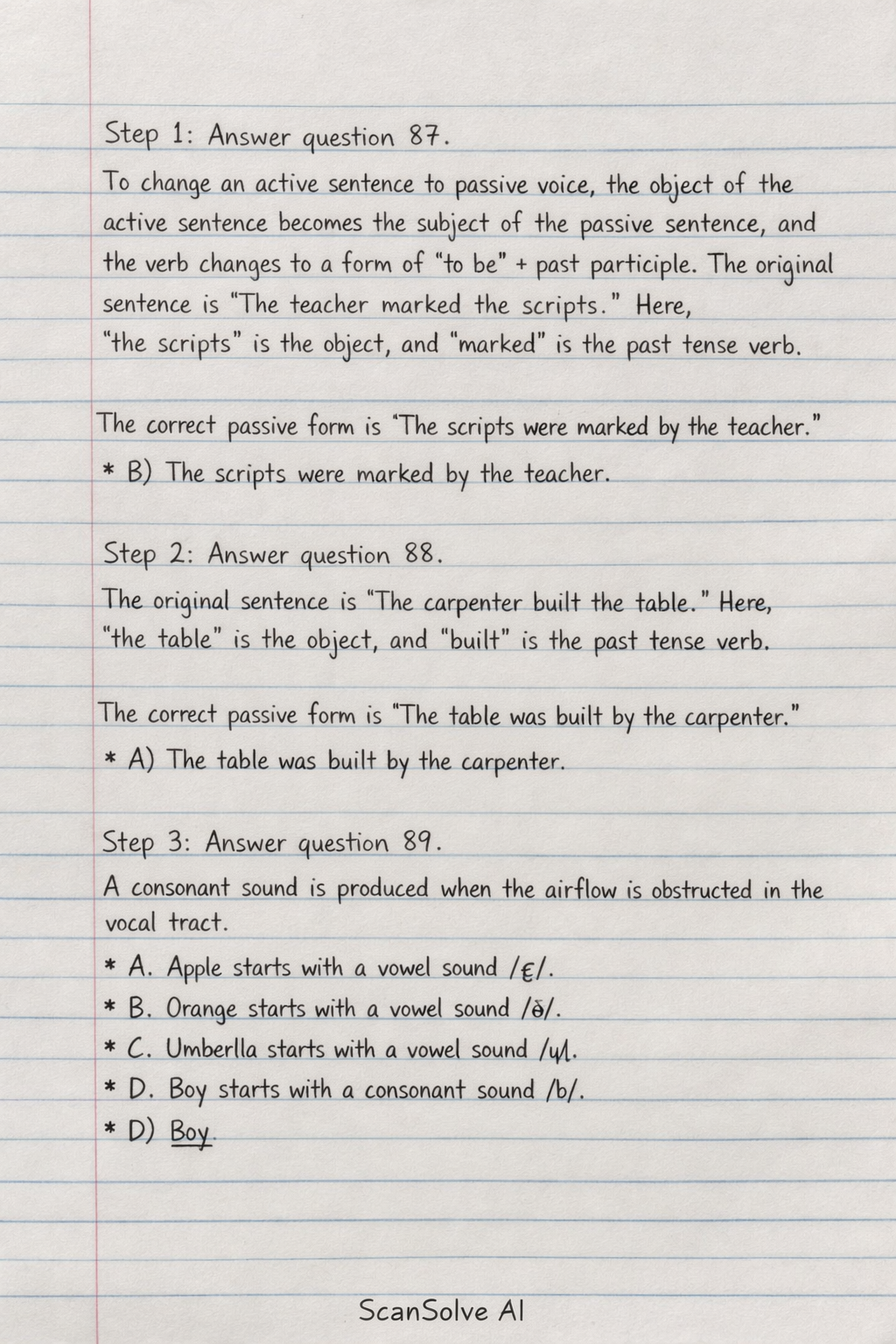
Step 1: Answer question 87. To change an active sentence to passive voice, the object of the active sentence becomes the subject of the passive sentence, and the verb changes to a form of "to be" + past participle. The original sentence is "The teacher marked the scripts." Here, "the scripts" is the object, and "marked" is the past tense verb. The correct passive form is "The scripts were marked by the teacher." B) The scripts were marked by the teacher. Step 2: Answer question 88. The original sentence is "The carpenter built the table." Here, "the table" is the object, and "built" is the past tense verb. The correct passive form is "The table was built by the carpenter." A) The table was built by the carpenter. Step 3: Answer question 89. A consonant sound is produced when the airflow is obstructed in the vocal tract. A. Apple starts with a vowel sound /æ/. B. Orange starts with a vowel sound /ɒ/. C. Umbrella starts with a vowel sound /ʌ/. D. Boy starts with a consonant sound /b/. D) Boy Step 4: Answer question 90. A diphthong is a sound formed by the combination of two vowels in a single syllable, in which the sound begins as one vowel and moves towards another. The "oa" in "boat" produces the /oʊ/ sound. C) /oʊ/ Step 5: Answer question 91. The vowel sound /ʌ/ is the 'uh' sound, as heard in words like 'cup', 'cut', or 'but'. A. Cup contains the /ʌ/ sound. B. Cap contains the /æ/ sound. C. Coop contains the /uː/ sound. D. Keep contains the /iː/ sound. A) Cup Step 6: Answer question 92. The diphthong /aɪ/ is the 'eye' sound, as heard in words like 'my', 'light', or 'time'. A. Day contains the /eɪ/ sound. B. Boy contains the /ɔɪ/ sound. C. Time contains the /aɪ/ sound. D. Home contains the /oʊ/ sound. C) Time Step 7: Answer question 93. The vowel sound /ɪ/ is the 'ih' sound, as heard in words like 'sit', 'pin', or 'bid'. A. Bird contains the /ɜː/ sound. B. Bed contains the /e/ sound. C. Bad contains the /æ/ sound. D. Bid contains the /ɪ/ sound. D) Bid Step 8: Answer question 94. A consonant sound involves some obstruction of the airflow. A. /eɪ/ is a diphthong (vowel sound). B. /aɪ/ is a diphthong (vowel sound). C. /p/ is a consonant sound. D. /ɔɪ/ is a diphthong (vowel sound). C) /p/ Step 9: Answer question 95. The word "house" contains the diphthong /aʊ/, which is the 'ow' sound. A) /aʊ/ Step 10: Answer questions 96-100 by filling in the blanks in the passage. 96: "Every student is expected to be diligent* in his or her studies." (Diligent means hardworking and careful.) 97: "Success in education depends not only on intelligence but also on hard work and perseverance*." (Perseverance means persistence in doing something despite difficulty.) 98: "Teachers play an important role in guiding students and helping them achieve* their academic goals." (Achieve means to successfully reach a goal.) 99: "A good student attends classes regularly, completes assignments on time, and participates* actively in classroom activities." (Participates is the correct verb form to agree with "student" and "completes".) 100: "Such a student also respects school rules and maintains good relationships* with teachers and fellow students." (Relationships refers to the way people interact with each other.) The completed answers are: 96. B) diligent 97. A) perseverance 98. C) achieve 99. A) participates 100. B) relationships Send me the next one 📸