
We read your photo as:
Choose from the alternatives lettered A to D the one which is nearest in meaning to the underlined word or expression in each sentence.
ScanSolve AI Answer
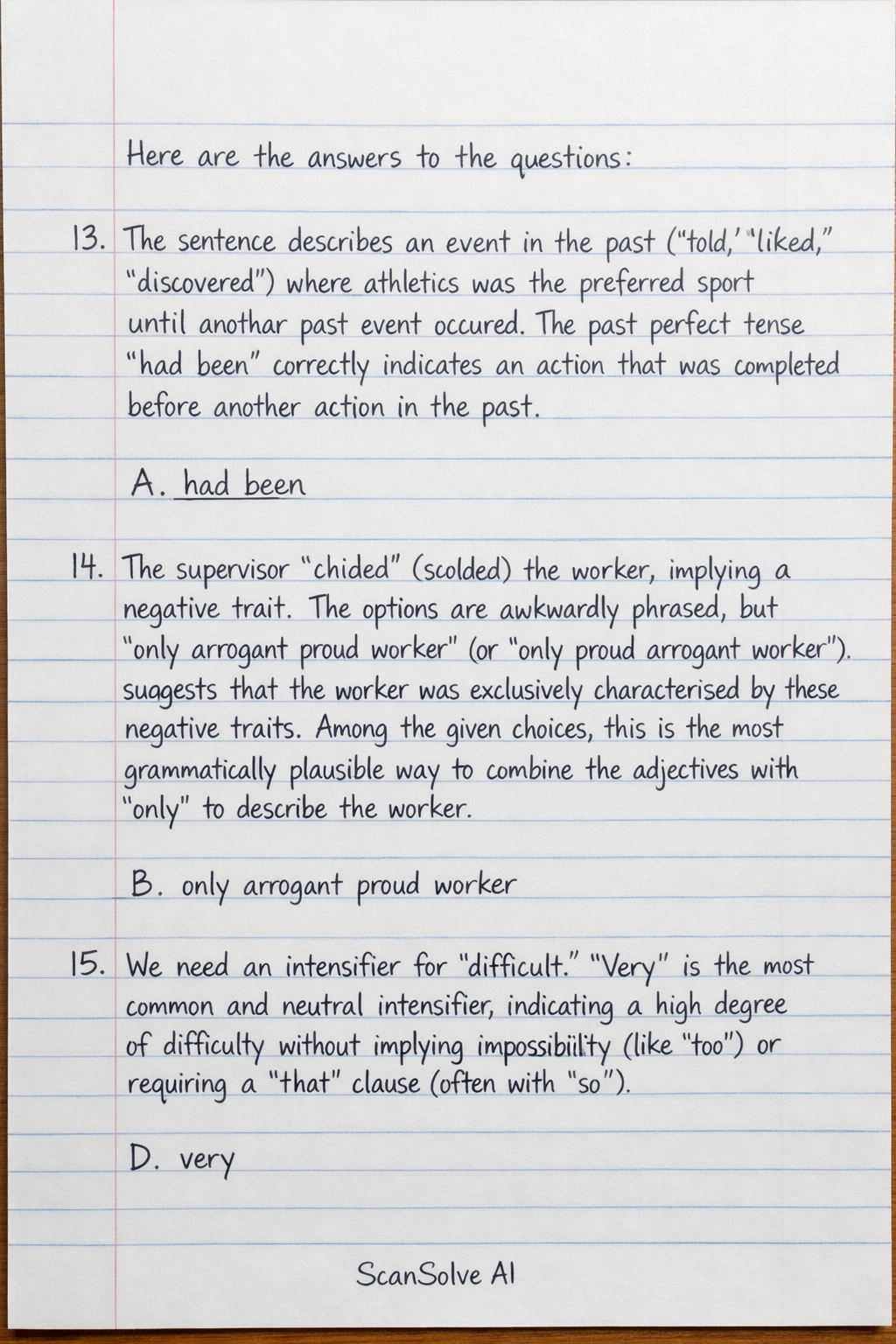
Here are the answers to the questions:
-
The sentence describes an event in the past ("told," "liked," "discovered") where athletics was the preferred sport until another past event occurred. The past perfect tense "had been" correctly indicates an action that was completed before another action in the past.
- A. had been
-
The supervisor "chided" (scolded) the worker, implying a negative trait. The options are awkwardly phrased, but "only arrogant proud worker" (or "only proud arrogant worker") suggests that the worker was exclusively characterized by these negative traits. Among the given choices, this is the most grammatically plausible way to combine the adjectives with "only" to describe the worker.
- B. only arrogant proud worker
-
We need an intensifier for "difficult." "Very" is the most common and neutral intensifier, indicating a high degree of difficulty without implying impossibility (like "too") or requiring a "that" clause (often with "so").
- D. very
-
The verb "decide" when referring to an issue or topic is commonly followed by the preposition "about" or "on." "Decide about" is used when considering or forming an opinion on a matter, which fits the context of not being able to easily make up one's mind regarding an issue.
- A. about
-
"Money" is an uncountable noun. "Much" is the correct quantifier to use with uncountable nouns to indicate a large quantity, especially in a comparative context like "more money... than you think."
- B. much
-
The sentence states "Henry must tell Cynthia that he believes in ______." If Henry believes in Cynthia, the correct pronoun referring to Cynthia is "her."
- A. her
-
The question asks about the current state of the baggage ("now") after it was given to another person. The present perfect passive voice "has been given" correctly describes a past action with a result that is relevant to the present.
- B. has been
-
The phrase "no one has had any peace" is in the present perfect tense, indicating a state that began in the past and continues to the present. "Since" is used to introduce a point in time from which an action or state has continued.
- B. Since
-
The word abandonment refers to the act of leaving someone or something permanently. Desertion is a direct synonym, specifically meaning to abandon a person, cause, or duty.
- B. desertion
Still stuck on this one?
Ask a follow-up, and the answer starts from this question.
More English Questions
Handwritten Step-by-Step Solution
Get this as a handwritten image on WhatsApp — like a tutor wrote it for you.
Try on WhatsApp