

This English question involves literary analysis, grammar, or writing skills. The detailed response below provides a well-structured answer with supporting evidence and clear explanations.
ScanSolve AI Answer
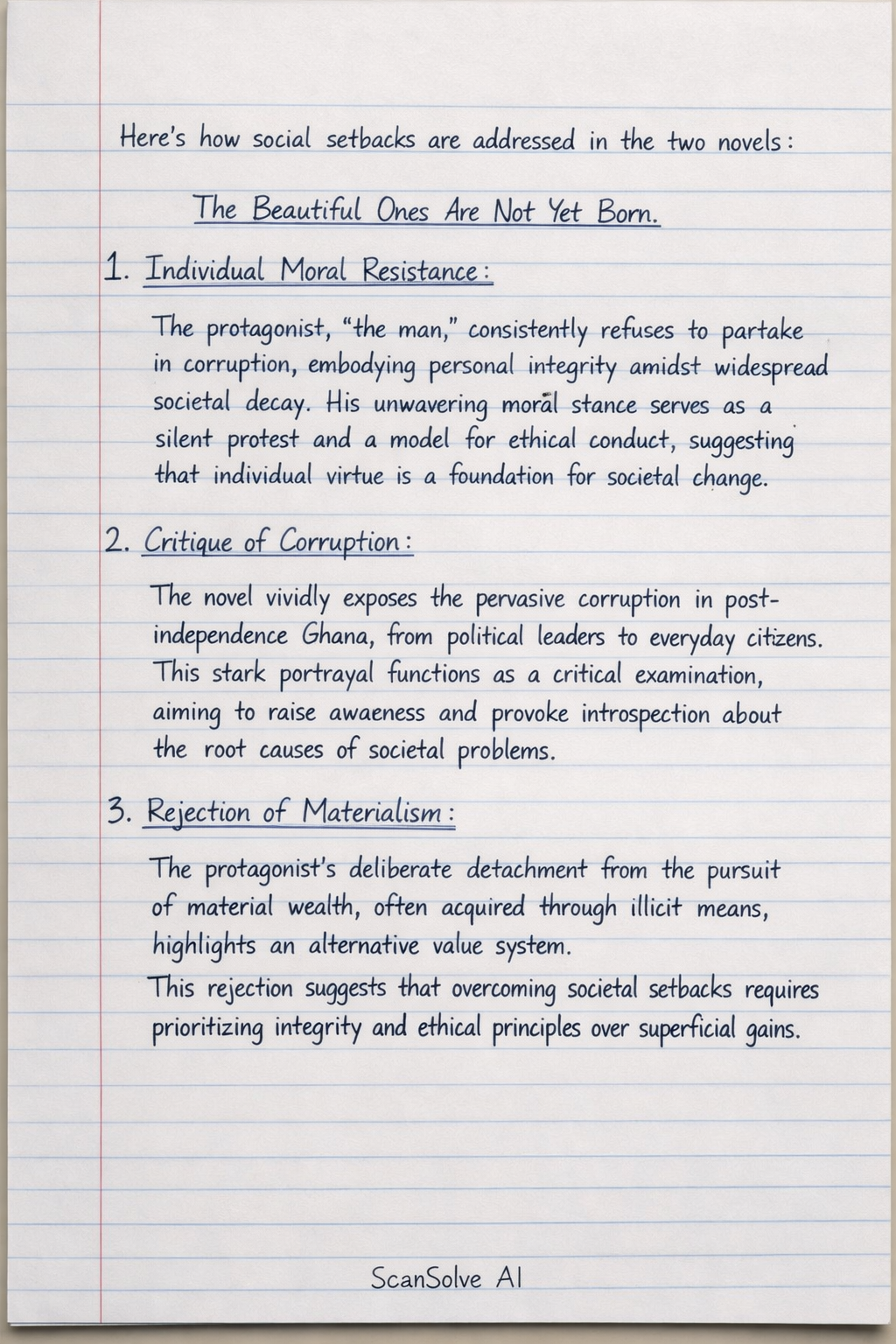
Here's how social setbacks are addressed in the two novels: The Beautiful Ones Are Not Yet Born Individual Moral Resistance: The protagonist, "the man," consistently refuses to partake in corruption, embodying personal integrity amidst widespread societal decay. His unwavering moral stance serves as a silent protest and a model for ethical conduct, suggesting that individual virtue is a foundation for societal change. Critique of Corruption: The novel vividly exposes the pervasive corruption in post-independence Ghana, from political leaders to everyday citizens. This stark portrayal functions as a critical examination, aiming to raise awareness and provoke introspection about the root causes of societal problems. Rejection of Materialism: The protagonist's deliberate detachment from the pursuit of material wealth, often acquired through illicit means, highlights an alternative value system. This rejection suggests that overcoming societal setbacks requires prioritizing integrity and ethical principles over superficial gains. Hope for Future Generations: The novel's title itself, "The Beautiful Ones Are Not Yet Born," implies a long-term solution through the eventual emergence of an uncorrupted generation. It offers a hopeful vision for a future society free from the moral compromises of the present. A Man of the People Exposure of Political Corruption: The novel meticulously details the rampant corruption, nepotism, and abuse of power by politicians like Chief Nanga. By bringing these systemic flaws to light, Achebe aims to inform the public and foster condemnation, which is crucial for demanding accountability. Citizen Opposition and Activism: Odili's decision to challenge Chief Nanga in an election, despite the personal risks, demonstrates the importance of active citizen participation in opposing corrupt governance. His actions highlight the necessity of individuals fighting for democratic principles and societal improvement. The Military Coup: The novel concludes with a military coup that overthrows the corrupt government. This drastic event is presented as a "solution" to the intractable political problems, bringing an immediate, albeit undemocratic, end to the rampant corruption and misrule. Critique of Public Apathy: Achebe also critiques the electorate's complicity and short-sightedness, as they often prioritize immediate personal gains (bribes) over national welfare. By highlighting this, the novel implicitly calls for greater civic responsibility and discernment among the populace to prevent the perpetuation of corrupt systems.