
We read your photo as:
Correct the following run-on sentences. Question 19: In the last five minutes of the second half. Jason had scored twice bringing the running total to third position.
ScanSolve AI Answer
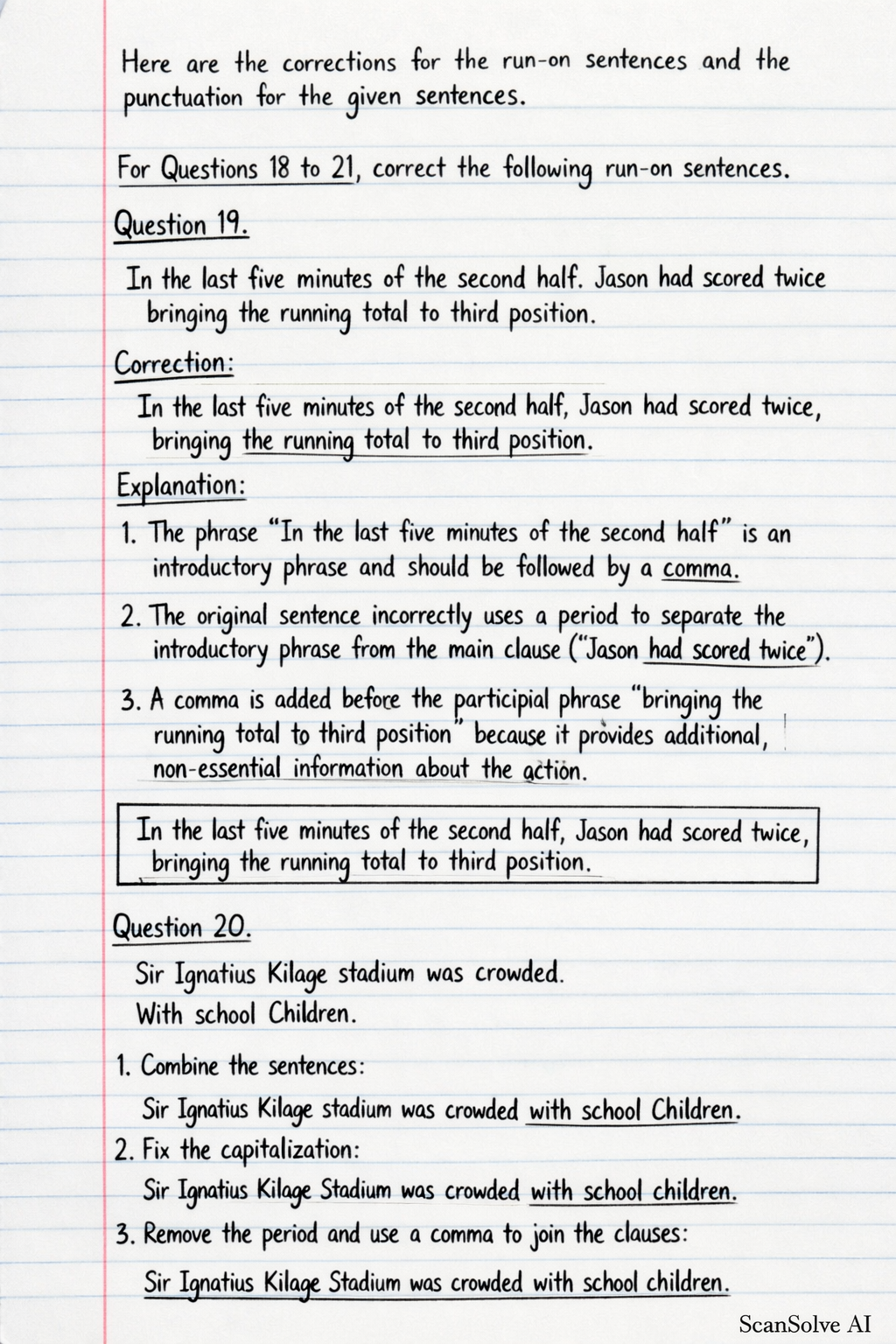
Here are the corrections for the run-on sentences and the punctuation for the given sentences.
For Questions 18 to 21, correct the following run-on sentences.
Question 19.
In the last five minutes of the second half. Jason had scored twice bringing the running total to third position.
- Correction: In the last five minutes of the second half, Jason had scored twice, bringing the running total to third position.
Explanation:
- The phrase "In the last five minutes of the second half" is an introductory phrase and should be followed by a comma.
- The original sentence incorrectly uses a period to separate the introductory phrase from the main clause ("Jason had scored twice").
- A comma is added before the participial phrase "bringing the running total to third position" because it provides additional, non-essential information about the action.
Question 20.
Sir Ignatius Kilage stadium was crowded. With school Children.
- Correction: Sir Ignatius Kilage stadium was crowded with school children.
Explanation:
- The original sentence incorrectly uses a period to separate the main clause ("Sir Ignatius Kilage stadium was crowded") from a prepositional phrase ("With school Children") that completes the thought.
- The prepositional phrase should be directly connected to the main clause.
- "Children" should not be capitalized.
Question 21.
Sub-Warden of each block of dormitories. Signed the clearance forms.
- Correction: The Sub-Warden of each block of dormitories signed the clearance forms.
Explanation:
- This was a sentence fragment, not a run-on sentence. The subject ("Sub-Warden of each block of dormitories") was separated from its verb ("Signed the clearance forms") by a period.
- The period is removed, and "The" is added for proper sentence structure, making it a complete sentence.
For Questions 22 to 25, punctuate the sentences using Commas where necessary.
Question 22.
Police arrived held him and took him away in a bright Shinny expensive car
- Correction: Police arrived, held him, and took him away in a bright, shiny, expensive car.
Explanation:
- Commas are used to separate items in a series of verbs ("arrived, held him, and took him away").
- Commas are used to separate coordinate adjectives ("bright, shiny, expensive") that describe the noun "car."
- "Shinny" is corrected to "shiny."
Question 23.
There are three ways to get good grades: first pay attention Second take notes third Study
- Correction: There are three ways to get good grades: first, pay attention; second, take notes; third, study.
Explanation:
- The colon correctly introduces the list of ways.
- Commas are used after introductory adverbs like "first," "second," and "third" when they introduce items in a list.
- Semicolons are used to separate items in a list when the items themselves contain commas or are complex phrases, ensuring clarity.
- "Study" is corrected to lowercase as it's part of the list item.
Question 24.
What bandicoots do what time of the day they feed how fast they Can run and how they live are explained in this book
- Correction: What bandicoots do, what time of the day they feed, how fast they can run, and how they live are explained in this book.
Explanation:
- This sentence has a compound subject consisting of a series of noun clauses: "What bandicoots do," "what time of the day they feed," "how fast they can run," and "how they live."
- Commas are used to separate these clauses in the series, similar to separating items in a list.
- "Can" is corrected to lowercase "can."
Still stuck on this one?
Ask a follow-up, and the answer starts from this question.
More English Questions
Handwritten Step-by-Step Solution
Get this as a handwritten image on WhatsApp — like a tutor wrote it for you.
Try on WhatsApp