
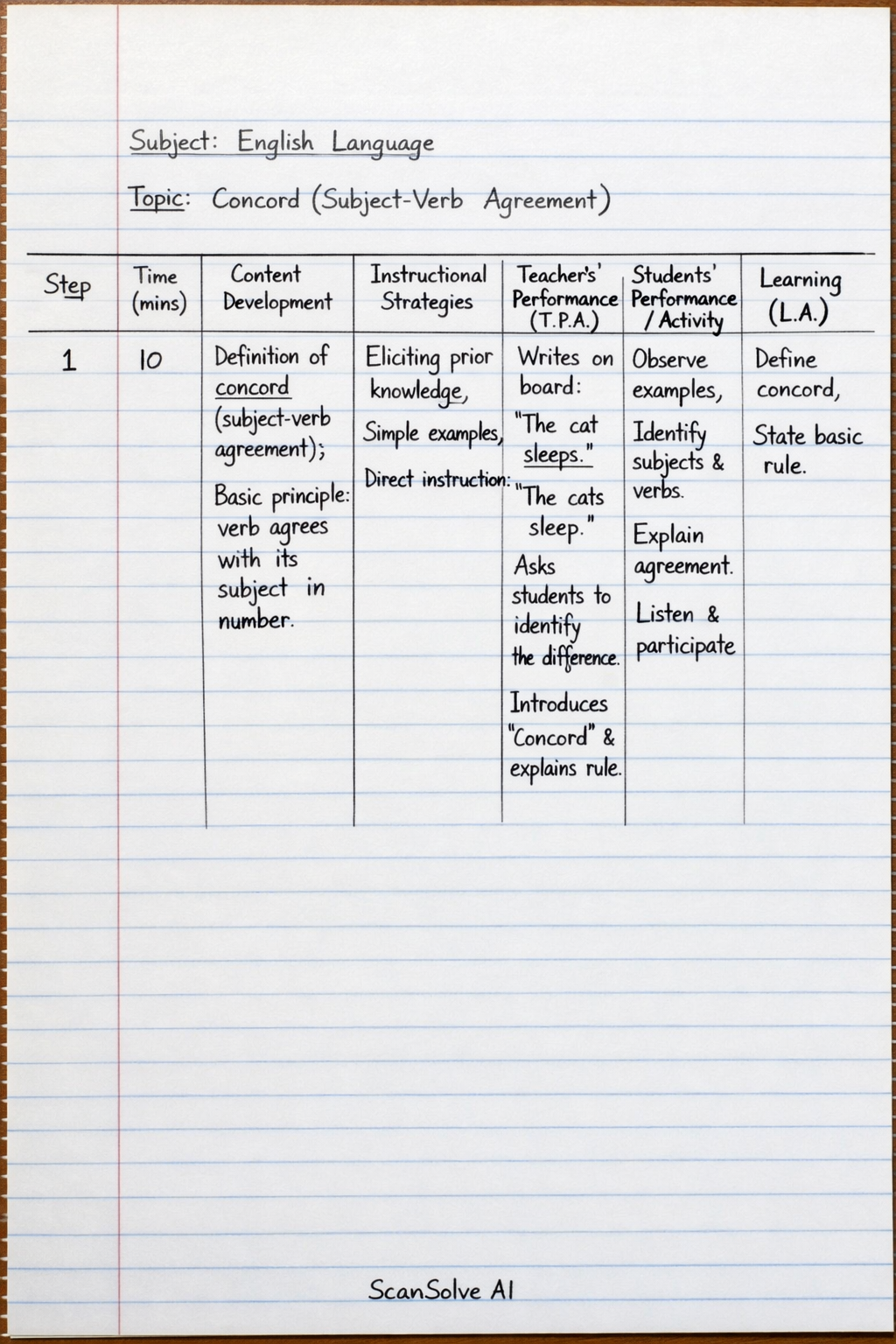
We read your photo as:
Create a lesson plan on Concord (Subject-Verb Agreement) using the provided tabular format, including definition, basic rules, and examples.
English
ScanSolve AI Answer
Here is the lesson plan on Concord (Subject-Verb Agreement) in the tabular form you've provided, using the column headers from your image.
Subject: English Language
Topic: Concord (Subject-Verb Agreement)
| Step | Time (mins) | Content Development | Instructional Strategies | Teacher's Performance (T.P.A.) | Students' Performance/Activity | Learning (L.A.) |
|---|---|---|---|---|---|---|
| 1 | 10 | Definition of concord (subject-verb agreement); basic principle: verb agrees with its subject in number. | Eliciting prior knowledge, simple examples, direct instruction. | Teacher writes simple sentences (e.g., "The cat sleeps." vs. "The cats sleep.") on the board. Asks students to identify the difference. Introduces the term "concord" and explains its meaning and basic rule. | Students observe the example sentences, identify the subjects and verbs, and attempt to explain the agreement. They listen attentively and participate in defining concord. | Students are able to define concord and state its basic rule regarding subject-verb agreement. |
| 2 | 15 | Detailed explanation of fundamental rules: Singular subjects take singular verbs; plural subjects take plural verbs. Focus on "to be" (is/are, was/were) and "to have" (has/have) with subjects. | Guided practice, sentence construction, fill-in-the-blanks exercises. | Teacher provides various examples for singular and plural subjects with different verbs. Guides students through practice sentences, correcting errors and reinforcing the rules. | Students identify subjects and verbs in given sentences. They choose the correct verb form to complete sentences and construct their own sentences demonstrating basic concord. | Students can apply the basic rules of concord to simple sentences. |
| 3 | 20 | Complex scenarios: Compound subjects ("and" vs. "or/nor"); indefinite pronouns (e.g., "each," "every"); collective nouns; phrases between subject and verb. | Group work, problem-solving, error analysis. | Teacher presents challenging sentences illustrating advanced rules. Divides students into groups to analyze sentences and identify correct concord. Facilitates discussion on common errors. | Students work in groups to analyze complex sentences, identify the correct subject and verb, and justify their choices. They participate in discussions about tricky cases. | Students can identify and correctly apply concord rules in more complex sentence structures. |
| 4 | 15 | Review of all concord rules learned; application in writing and speaking. | Sentence correction, short paragraph writing, peer review. | Teacher provides a short passage with concord errors for students to correct. Encourages students to write a few sentences or a short paragraph, focusing on correct subject-verb agreement. | Students correct errors in a given passage. They write their own sentences/paragraphs demonstrating correct concord and provide feedback to peers. | Students can demonstrate consistent and accurate use of concord in their written and spoken English. |
Was this helpful?
Still stuck on this one?
Ask a follow-up, and the answer starts from this question.
Got a different question?Ask your own question
More English Questions
QWrite a Lesson Plan best just using Set repetition & DP. Concord do it in a tabular formQCan you write a lesson plan for micro teaching on this topic concordQCan you help me with a lesson plan for micro teaching lesson plan and the topic is concord and also…QLesson plan in English pleaseQUnderline the correct verb in the following sentences. Compose meaningful sentences using the given…
Handwritten Step-by-Step Solution
Get this as a handwritten image on WhatsApp — like a tutor wrote it for you.
Try on WhatsApp