
Develop a check list on suitability of land required in establishment of coriander.consider that following.ph, texture, structure, aeration, water holding, fertilizer,soil organisms and soil colour.all answers in English
English
ScanSolve AI Answer
Here is a checklist for the suitability of land required for the establishment of coriander:
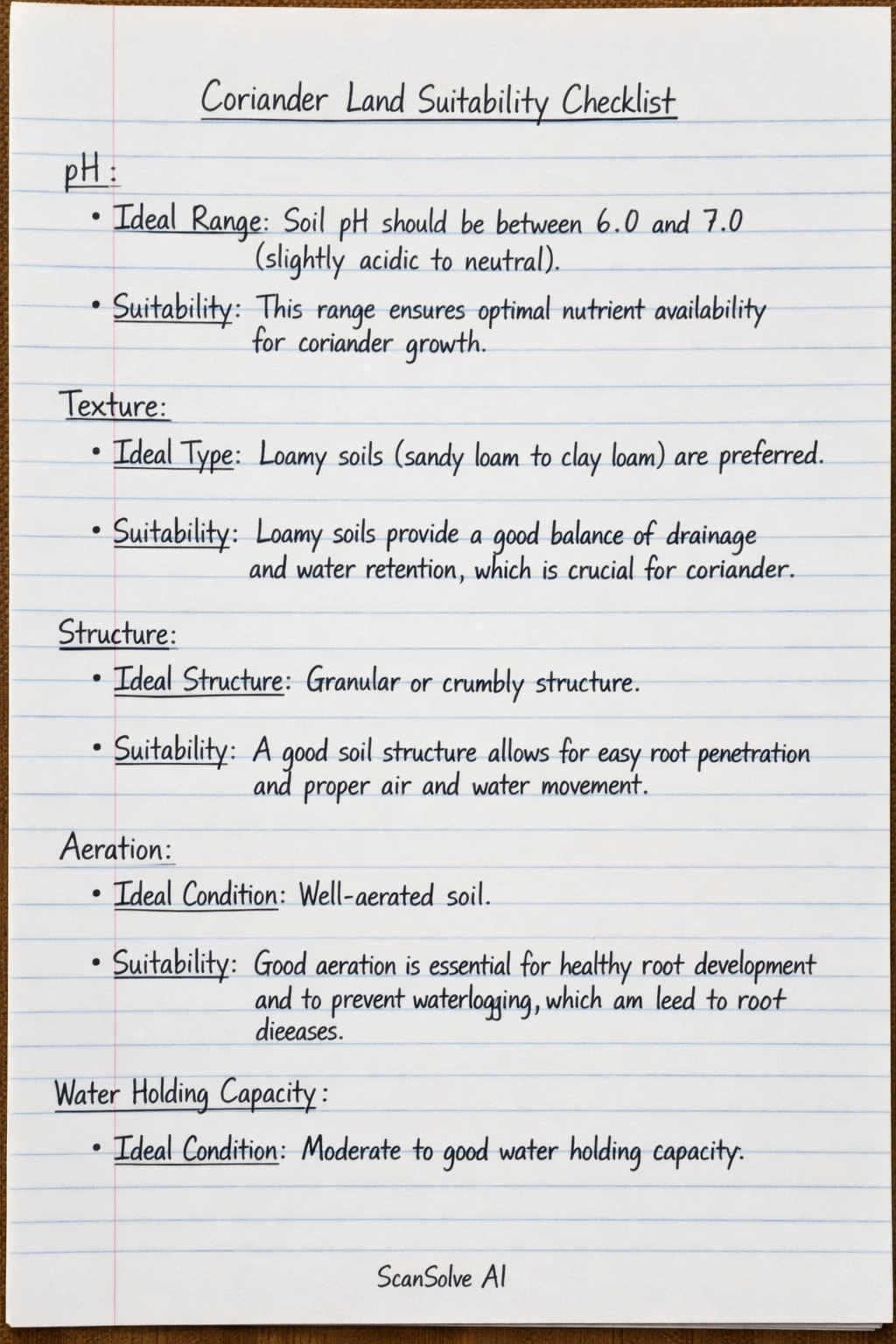
Coriander Land Suitability Checklist
- pH:
- Ideal Range: Soil pH should be between 6.0 and 7.0 (slightly acidic to neutral).
- Suitability: This range ensures optimal nutrient availability for coriander growth.
- Texture:
- Ideal Type: Loamy soils (sandy loam to clay loam) are preferred.
- Suitability: Loamy soils provide a good balance of drainage and water retention, which is crucial for coriander.
- Structure:
- Ideal Structure: Granular or crumbly structure.
- Suitability: A good soil structure allows for easy root penetration and proper air and water movement.
- Aeration:
- Ideal Condition: Well-aerated soil.
- Suitability: Good aeration is essential for healthy root development and to prevent waterlogging, which can lead to root diseases.
- Water Holding Capacity:
- Ideal Condition: Moderate to good water holding capacity.
- Suitability: The soil should be able to retain sufficient moisture for the plants without becoming waterlogged, ensuring a consistent water supply.
- Fertility:
- Ideal Condition: Rich in organic matter and essential nutrients.
- Suitability: Fertile soil provides the necessary nutrients for vigorous growth, especially nitrogen for leafy growth.
- Soil Organisms:
- Ideal Condition: Presence of beneficial soil microorganisms.
- Suitability: Healthy soil microbial activity improves nutrient cycling, soil structure, and can help suppress plant diseases.
- Soil Colour:
- Ideal Condition: Darker soil colours (e.g., dark brown, black).
- Suitability: Darker soils often indicate higher organic matter content and better fertility, and they tend to absorb more solar radiation, warming up faster.
Was this helpful?
Still stuck on this one?
Ask a follow-up, and the answer starts from this question.
Got a different question?Ask your own question
More English Questions
QDiscuss and note down land standards required for establishment of corriander.all answers in EnglishQDescribe these routine management practices in the production of coriander.Weed control,pest and…QSusan bought a land for a certain agricultural activity. Identify three uses of land for…QDiscuss the cultivation of ginger the following headings (1) soil requirement (2) land preparationQCan you provide a list of questions and answers about soil conservation and crop cultivation?
Handwritten Step-by-Step Solution
Get this as a handwritten image on WhatsApp — like a tutor wrote it for you.
Try on WhatsApp