
We read your photo as:
Can you provide a list of questions and answers about soil conservation and crop cultivation?
ScanSolve AI Answer
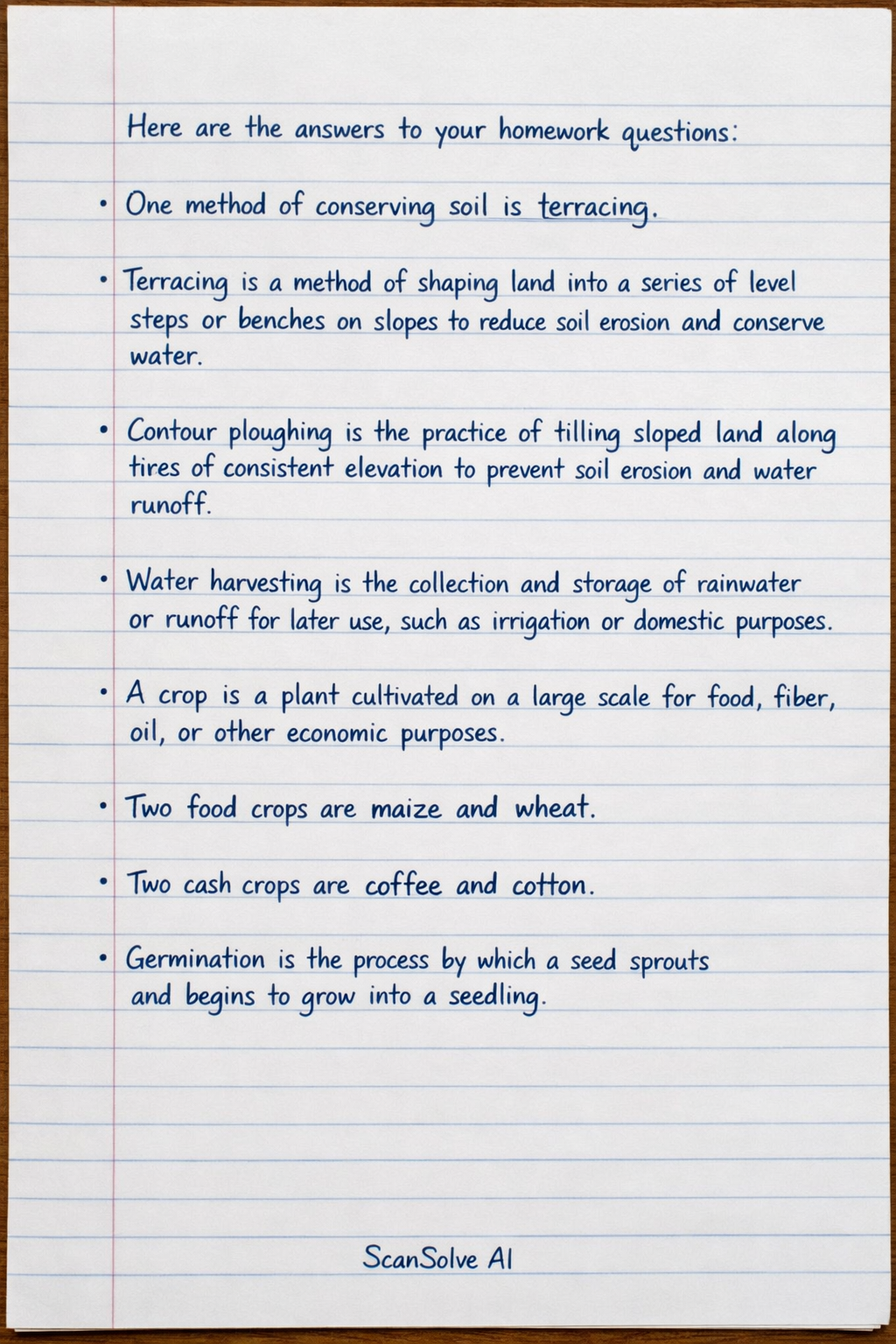
Here are the answers to your homework questions:
-
Name one method of conserving soil.
- One method of conserving soil is terracing.
-
What is terracing?
- Terracing is a method of shaping land into a series of level steps or benches on slopes to reduce soil erosion and conserve water.
-
What is contour ploughing?
- Contour ploughing is the practice of tilling sloped land along lines of consistent elevation to prevent soil erosion and water runoff.
-
What is water harvesting?
- Water harvesting is the collection and storage of rainwater or runoff for later use, such as irrigation or domestic purposes.
-
What is a crop?
- A crop is a plant cultivated on a large scale for food, fiber, oil, or other economic purposes.
-
Name two food crops.
- Two food crops are maize and wheat.
-
Name two cash crops.
- Two cash crops are coffee and cotton.
-
What is germination?
- Germination is the process by which a seed sprouts and begins to grow into a seedling.
-
State three conditions for germination.
- Three conditions for germination are water, warmth, and oxygen.
-
What is crop rotation?
- Crop rotation is the practice of growing different types of crops in the same area in sequenced seasons to improve soil health, optimize nutrients, and combat pests and weeds.
-
Why is crop rotation important?
- Crop rotation is important because it improves soil fertility, reduces pest and disease build-up, and helps control weeds.
-
What is intercropping?
- Intercropping is the practice of growing two or more crops simultaneously in the same field during the same growing season.
-
Name two crop diseases.
- Two crop diseases are rust and blight.
-
What is pruning?
- Pruning is the selective removal of parts of a plant, such as branches, buds, or roots, to improve growth, shape, or yield.
-
What is thinning?
- Thinning is the removal of some plants from a crop to reduce competition and allow the remaining plants to grow larger and healthier.
-
What is transplanting?
- Transplanting is the process of moving a plant from one location to another, typically from a nursery bed to a permanent growing site.
-
What is spacing in farming?
- Spacing in farming refers to the distance between individual plants or rows of plants to ensure adequate light, water, and nutrient availability.
-
What is sustainable farming?
- Sustainable farming is an approach to agriculture that meets the needs of the present without compromising the ability of future generations to meet their own needs, focusing on environmental health, economic profitability, and social and economic equity.
-
What is livestock farming?
- Livestock farming is the raising of domesticated animals such as cattle, sheep, pigs, and poultry for products like meat, milk, eggs, and wool.
-
Name three livestock animals.
- Three livestock animals are cattle, sheep, and goats.
-
What do livestock animals feed on?
- Livestock animals feed on forage (grass, hay), grains, and supplementary feeds.
-
What is a livestock house called?
- A livestock house can be called a barn or a shed.
-
Why are animals vaccinated?
- Animals are vaccinated to protect them from diseases and prevent the spread of infections within the herd or flock.
-
Name two livestock diseases.
- Two livestock diseases are foot-and-mouth disease and anthrax.
-
What is milking?
- Milking is the process of extracting milk from the mammary glands of dairy animals, typically cows, goats, or sheep.
-
Name two livestock products.
- Two livestock products are milk and meat.
-
Why is hygiene important in livestock keeping?
- Hygiene is important in livestock keeping to prevent the spread of diseases, ensure animal health, and maintain the quality of livestock products.
-
What is breeding?
- Breeding is the process of mating animals to produce offspring, often with the aim of improving desirable traits in the next generation.
-
What is artificial insemination?
- Artificial insemination is a reproductive technology where sperm is manually introduced into the female reproductive tract without natural mating.
-
What is deworming?
- Deworming is the administration of medication to livestock to eliminate or reduce internal parasitic worms.
-
What is a balanced diet for animals?
- A balanced diet for animals is one that provides all the essential nutrients (carbohydrates, proteins, fats, vitamins, minerals, water) in the correct proportions for their health and productivity.
-
What is zero grazing?
- Zero grazing is a livestock management system where animals are kept in confinement and feed is brought to them, rather than allowing them to graze in pastures.
-
What is climate change and how does it affect agriculture?
- Climate change refers to long-term shifts in temperatures and weather patterns. It affects agriculture by causing unpredictable weather, droughts, floods, and changes in growing seasons, impacting crop yields and livestock health.
-
What is land preparation?
- Land preparation is the process of getting the soil ready for planting by tilling, leveling, and adding amendments.
-
State two reasons for preparing land before planting.
- Two reasons for preparing land are to create a fine seedbed for good germination and to control weeds.
-
Name two tools used in land preparation.
- Two tools used in land preparation are a plough and a harrow.
-
What is clearing of land?
- Clearing of land is the removal of vegetation, rocks, and debris from an area to make it suitable for cultivation or construction.
-
Why is ploughing important?
- Ploughing is important because it loosens and aerates the soil, incorporates organic matter, and helps control weeds and pests.
-
What is harrowing?
- Harrowing is a secondary tillage operation that breaks up clods, levels the soil surface, and prepares a fine seedbed after ploughing.
Still stuck on this one?
Ask a follow-up, and the answer starts from this question.
More Geography Questions
Handwritten Step-by-Step Solution
Get this as a handwritten image on WhatsApp — like a tutor wrote it for you.
Try on WhatsApp