
We read your photo as:
Develop a speech outline on the effects of smoking on teenagers, including purpose, audience, and a structured outline with intro, body, and conclusion.
ScanSolve AI Answer
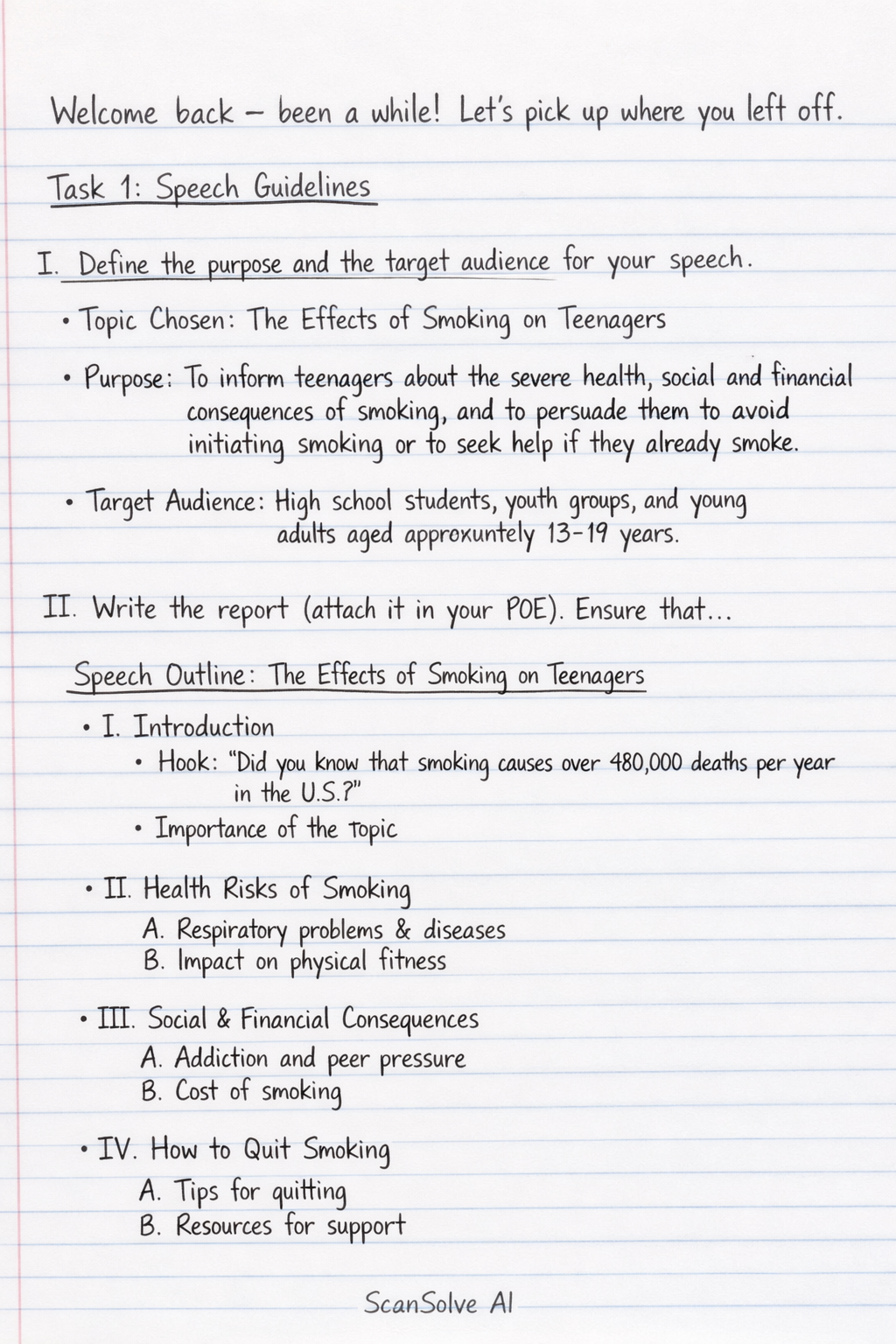
Task 1: Speech Guidelines
I. Define the purpose and the target audience for your speech.
- Topic Chosen: The Effects of Smoking on Teenagers
- Purpose: To inform teenagers about the severe health, social, and financial consequences of smoking, and to persuade them to avoid initiating smoking or to seek help if they already smoke.
- Target Audience: High school students, youth groups, and young adults aged approximately 13-19 years.
II. Write the report (attach it in your POE). Ensure that...
Below is a structured outline for the speech, demonstrating how the content would meet the specified guidelines for grammar, logical sequencing, supported arguments, and overall structure.
Speech Outline: The Effects of Smoking on Teenagers
- Introduction
- Hook: Begin with a compelling statistic or a relatable scenario about peer pressure and curiosity regarding smoking among teenagers.
- Background: Briefly define smoking and acknowledge its persistent presence despite public health campaigns.
- Thesis Statement: Clearly state that smoking poses significant and multifaceted risks to teenagers' health, social standing, and future prospects, necessitating informed choices and prevention.
- Body Paragraph 1: Health Consequences
- Topic Sentence: Smoking inflicts immediate and long-term damage on a teenager's developing body.
- Supporting Details: Discuss reduced lung capacity, increased respiratory infections, stained teeth, and bad breath. Emphasize the rapid onset of nicotine addiction and the heightened risk of chronic diseases like cancer, heart disease, and emphysema later in life.
- Evidence: Reference data from reputable health organizations (e.g., World Health Organization, Centers for Disease Control and Prevention) on youth smoking rates and associated health issues.
- Body Paragraph 2: Social and Psychological Impact
- Topic Sentence: Beyond physical harm, smoking can negatively affect a teenager's social interactions and mental well-being.
- Supporting Details: Explore the social stigma, potential isolation from non-smoking peers, and the financial burden that can limit social activities. Address the psychological trap of nicotine addiction, leading to irritability, anxiety, and a false sense of stress relief.
- Evidence: Cite studies on adolescent psychology and social dynamics related to substance use, highlighting the cycle of addiction and its mental health implications.
- Body Paragraph 3: Financial and Future Implications
- Topic Sentence: The financial cost of smoking is substantial and can hinder a teenager's future opportunities.
- Supporting Details: Detail the cumulative cost of cigarettes over time, diverting funds from education, hobbies, or savings. Discuss how smoking can impact athletic performance, academic focus, and even future employment prospects in health-conscious industries.
- Evidence: Provide a simple calculation of annual spending on cigarettes and discuss how health issues can limit career choices or quality of life.
- Conclusion
- Restate Thesis: Briefly reiterate the critical dangers of smoking across health, social, and financial domains for teenagers.
- Call to Action: Encourage the audience to make informed decisions, resist peer pressure, support friends in making healthy choices, and seek resources for quitting if they have started.
- Final Thought: End with a powerful, memorable statement about taking control of one's health and future for a vibrant, smoke-free life.
Task 2: Training Workshop Report
I. Define the audience and purpose of the report.
- Audience: The report is intended for my supervisor, department head, or the management team responsible for professional development within the organization. It may also be shared with colleagues considering similar training.
- Purpose: To provide a comprehensive overview of the "Effective Communication Skills for Professional Development" workshop, evaluate its relevance and impact, highlight key learnings, and offer recommendations for future training initiatives or internal application.
II. The report must cover the following:
Report on "Effective Communication Skills for Professional Development" Workshop
- 1. Introduction This report details my attendance at the "Effective Communication Skills for Professional Development" workshop held from [Start Date] to [End Date]. The workshop aimed to enhance crucial communication competencies vital for professional growth and organizational efficiency.
- 2. Objectives of the Workshop
The primary objectives of the workshop were:
- To improve participants' verbal and non-verbal communication techniques.
- To develop advanced active listening and constructive feedback skills.
- To equip attendees with strategies for effective conflict resolution and managing difficult conversations.
- To foster stronger team communication and collaborative practices.
- 3. Duration The workshop was a two-day intensive program, conducted on [Start Date] and [End Date], with sessions running daily from 9:00 AM to 4:00 PM, including scheduled breaks.
- 4. Main Highlights of the Workshop Key highlights included highly interactive sessions on active listening, featuring practical exercises like paraphrasing and empathetic responses. Significant time was dedicated to non-verbal communication analysis, using video examples to illustrate the impact of body language. Participants engaged in conflict resolution role-plays and learned the feedback sandwich technique for delivering constructive criticism. A segment on cross-cultural communication provided valuable insights into diverse communication styles.
- 5. Lessons Learned The workshop reinforced the critical importance of active listening in preventing misunderstandings and building rapport. I gained a deeper understanding of how non-verbal cues significantly influence message reception and the necessity of congruence between verbal and non-verbal communication. Practical frameworks for structuring difficult conversations and providing effective feedback were invaluable. The training also emphasized the need for clarity and conciseness in all professional interactions and heightened my awareness of personal communication habits.
- 6. Challenges
- Time Constraints: The broad scope of topics meant some areas felt rushed, limiting deeper exploration.
- Diverse Skill Levels: The varied experience levels among participants occasionally slowed down group exercises.
- Application Gap: Consistently applying newly learned techniques in real-world, high-pressure work environments immediately after the workshop presents an ongoing challenge.
- 7. Recommendations
- Follow-up Sessions: I recommend implementing shorter, focused follow-up sessions within the next three months to reinforce learned skills and address practical application challenges.
- Internal Practice Groups: Establishing voluntary internal practice groups would allow colleagues to continue honing communication skills through peer feedback and role-playing.
- Resource Sharing: Creating a shared repository of communication resources (e.g., articles, templates) would support ongoing learning.
- Tailored Training: For future initiatives, consider more specialized workshops addressing specific communication challenges relevant to different departments (e.g., client-facing communication, leadership communication).
Still stuck on this one?
Ask a follow-up, and the answer starts from this question.
More English Questions
Handwritten Step-by-Step Solution
Get this as a handwritten image on WhatsApp — like a tutor wrote it for you.
Try on WhatsApp