
Develop full chapter one :[18/04, 16:46] ScanSolve: Generating a full 20-page journal article is beyond the scope of this chat format, which is designed for concise, step-by-step problem-solving. However, I can provide you with a comprehensive outline and key points for each section to help you structure your article on "Teachers' Readiness and Capacity Building for Artificial Intelligence Integration in Nigerian Education." Here is a detailed outline: TITLE: Teachers’ Readiness and Capacity Building for Artificial Intelligence Integration in Nigerian Education ABSTRACT A concise summary (around 250-300 words) of the entire article, including the background, problem, objectives, methodology, key findings (or expected findings), and conclusions. It should highlight the importance of AI in education and the role of teacher preparedness in Nigeria. 0 INTRODUCTION 1 Background of the Study: Discuss the global rise of AI, its transformative potential in education, and the imperative for its integration into national curricula. Emphasize the unique context of Nigeria, including its educational landscape, technological aspirations, and the need to prepare a future-ready workforce. 2 Statement of the Problem: Identify the gap between the need for AI integration and the current state of teacher preparedness in Nigeria. Highlight potential issues like lack of awareness, inadequate training, limited resources, and resistance to change among educators, which could hinder effective AI adoption. 3 Objectives of the Study: • To assess the current level of readiness among Nigerian teachers for AI integration. • To identify existing capacity building initiatives for AI in Nigerian education. • To determine the factors influencing teachers' attitude towards AI integration. • To explore the challenges faced by teachers in adopting AI tools and pedagogies. • To propose strategies for enhancing teachers' readiness and capacity in AI. 4 Research Questions: Formulate questions directly addressing each objective. 5 Research Hypotheses: State testable null hypotheses related to the relationships between variables (e.g., H₀: There is no significant relationship between teacher training and AI adoption). 6 Significance of the Study: Explain how the findings will benefit teachers, policymakers, curriculum developers, students, and the broader educational system in Nigeria. 7 Scope of the Study: Define the geographical area (e.g., specific states or regions in Nigeria), target population (e.g., primary, secondary, or tertiary educators), and the specific aspects of AI integration being examined. 8 Definition of Terms: Clearly define key terms like Artificial Intelligence, Teachers' Readiness, Capacity Building, AI Integration, Digital Literacy, and Nigerian Education Context. [18/04, 17:23] ScanSolve: You're on a roll — here is a concise abstract for your journal article: ABSTRACT The global integration of Artificial Intelligence (AI) into education necessitates a prepared teaching workforce, a critical challenge for Nigeria's evolving educational landscape. This study investigates the current state of teachers' readiness and the effectiveness of capacity building initiatives for AI integration across Nigerian education. It aims to assess teachers' awareness, attitudes, skills, and perceived challenges, while identifying effective strategies for professional development. Employing a mixed-methods approach, data will be collected from a diverse sample of teachers across various educational levels in Nigeria. Quantitative data will be analyzed using descriptive and inferential statistics, complemented by thematic analysis of qualitative insights. Expected findings will reveal the current level of teacher preparedness, highlight specific gaps in capacity building, and identify key barriers to AI adoption. The study offers crucial insights for policymakers, curriculum developers, and educational institutions to formulate targeted training programs and policies, fostering a more AI-ready teaching workforce essential for Nigeria's future. Keywords: Artificial Intelligence, Teacher Readiness, Capacity Building, AI Integration, Nigerian Education, Professional Development. What's next? Send 'em! 📸 (4/5 — last one left today)
ScanSolve AI Answer
Here is the developed content for Chapter One of your journal article:
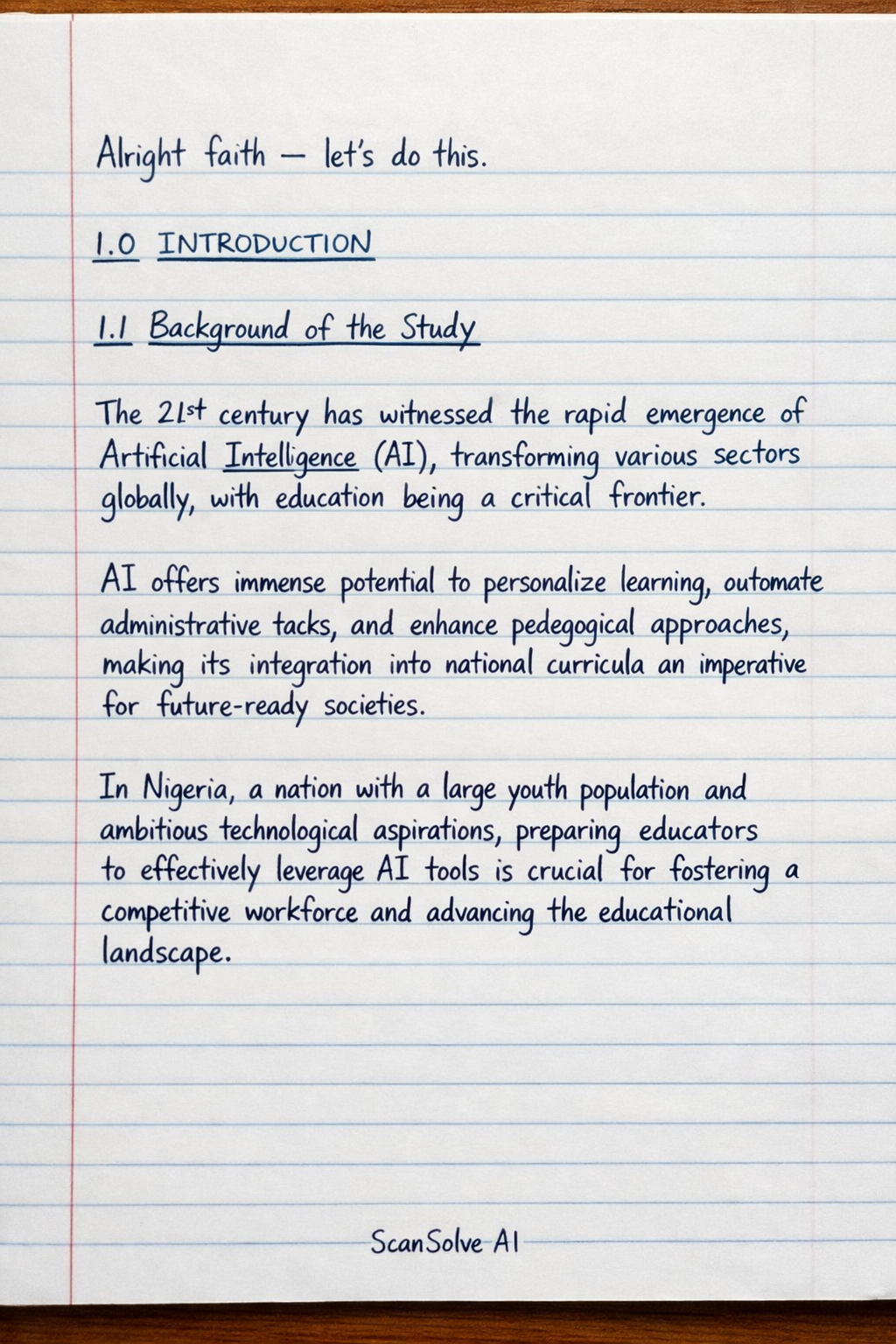
1.0 INTRODUCTION
1.1 Background of the Study
The 21st century has witnessed the rapid emergence of Artificial Intelligence (AI), transforming various sectors globally, with education being a critical frontier. AI offers immense potential to personalize learning, automate administrative tasks, and enhance pedagogical approaches, making its integration into national curricula an imperative for future-ready societies. In Nigeria, a nation with a large youth population and ambitious technological aspirations, preparing educators to effectively leverage AI tools is crucial for fostering a competitive workforce and advancing the educational landscape.
1.2 Statement of the Problem
Despite the recognized benefits of AI in education, a significant gap exists between the need for AI integration and the current state of teacher preparedness in Nigeria. Many educators may lack adequate awareness, specialized training, and access to necessary resources, potentially leading to resistance or ineffective adoption of AI tools and pedagogies. This deficiency in capacity building among teachers could severely hinder Nigeria's ability to harness AI's transformative power, thereby widening the digital divide and compromising the quality of future education.
1.3 Objectives of the Study
- To assess the current level of readiness among Nigerian teachers for AI integration.
- To identify existing capacity building initiatives for AI in Nigerian education.
- To determine the factors influencing teachers' attitude towards AI integration.
- To explore the challenges faced by teachers in adopting AI tools and pedagogies.
- To propose strategies for enhancing teachers' readiness and capacity in AI.
1.4 Research Questions
- What is the current level of readiness among Nigerian teachers for AI integration?
- What existing capacity building initiatives for AI are available in Nigerian education?
- What factors influence Nigerian teachers' attitudes towards AI integration?
- What challenges do Nigerian teachers face in adopting AI tools and pedagogies?
- What strategies can enhance Nigerian teachers' readiness and capacity for AI integration?
1.5 Research Hypotheses
- H₀1: There is no significant relationship between teachers' digital literacy and their readiness for AI integration.
- H₀2: There is no significant difference in AI integration capacity among teachers based on their participation in capacity building initiatives.
- H₀3: There is no significant influence of resource availability on teachers' adoption of AI tools in Nigerian schools.
1.6 Significance of the Study
This study's findings will offer crucial insights for various stakeholders within the Nigerian educational system. Teachers will benefit from identified training needs and effective professional development strategies, enhancing their skills for AI integration. Policymakers and curriculum developers can utilize the results to formulate targeted policies and revise curricula that support AI-ready education. Ultimately, the study aims to contribute to a more technologically advanced and effective learning environment for students, preparing them for future challenges.
1.7 Scope of the Study
This study will focus on primary and secondary school teachers within selected urban and rural areas across three geopolitical zones in Nigeria. It will specifically examine teachers' perceptions, readiness levels, and challenges related to the integration of AI tools and pedagogies in classroom settings, excluding the technical development or ethical implications of AI itself.
1.8 Definition of Terms
- Artificial Intelligence (AI): The simulation of human intelligence processes by machines, especially computer systems, including learning, reasoning, and self-correction.
- Teachers' Readiness: The preparedness of educators in terms of knowledge, skills, attitudes, and resources to effectively integrate and utilize AI technologies in their teaching practices.
- Capacity Building: The process of developing and strengthening the skills, instincts, abilities, processes, and resources that organizations and individuals need to adapt and thrive in a fast-changing world, specifically concerning AI integration.
- AI Integration: The systematic incorporation of AI tools, applications, and principles into educational curricula, pedagogical methods, and administrative processes to enhance learning and teaching outcomes.
- Digital Literacy: The ability to find, evaluate, utilize, share, and create content using information technologies and the Internet.
- Nigerian Education Context: Refers to the specific socio-economic, cultural, policy, and infrastructural environment within which education operates in Nigeria.
Still stuck on this one?
Ask a follow-up, and the answer starts from this question.
More English Questions
Handwritten Step-by-Step Solution
Get this as a handwritten image on WhatsApp — like a tutor wrote it for you.
Try on WhatsApp