Do all questions in english and don't do questions number 19
|English
Do all questions in english and don't do questions number 19
ScanSolve AI Answer
Answer
35
Here are the solutions to the questions:
Section C
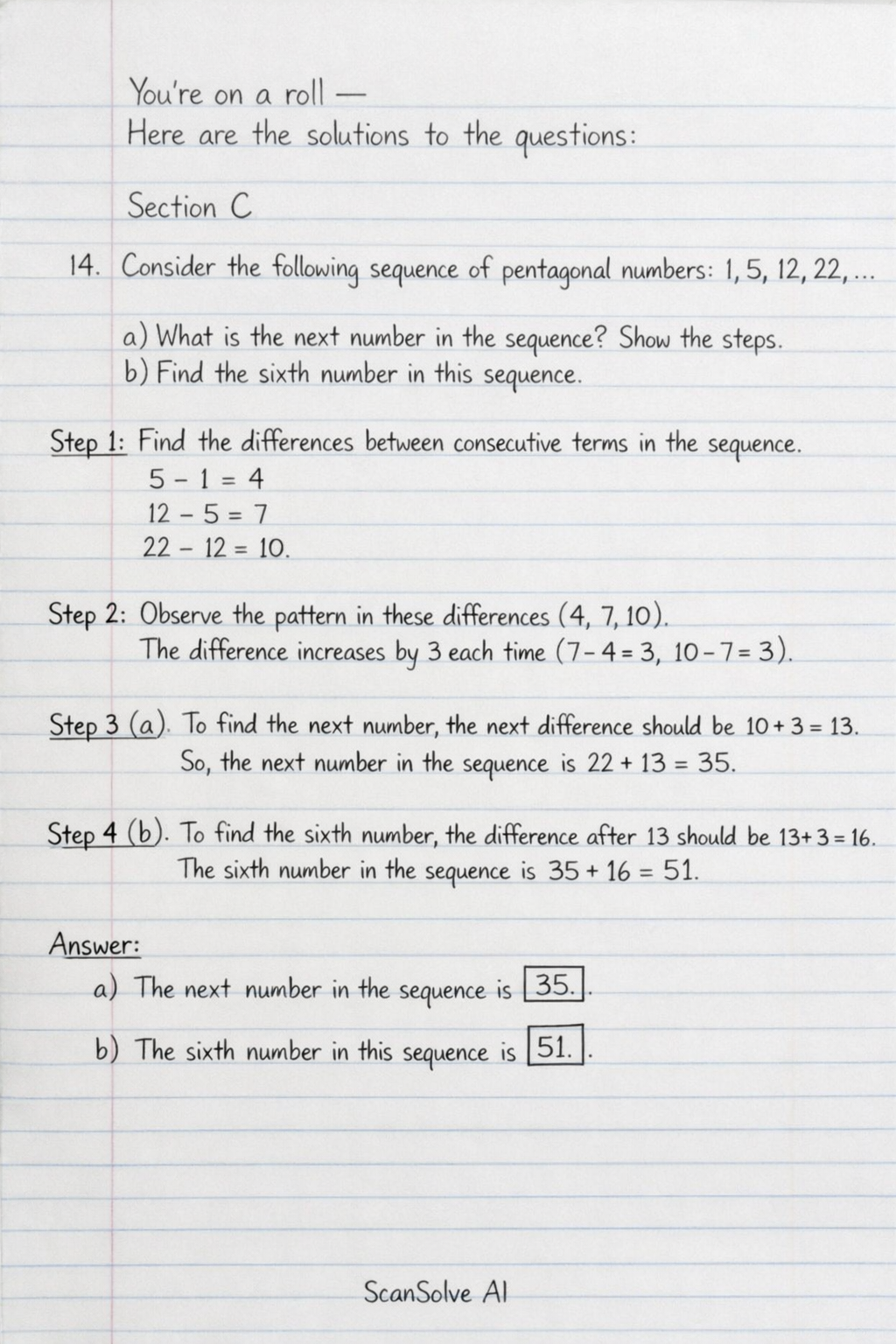
14. Consider the following sequence of pentagonal numbers: 1,5,12,22,…a) What is the next number in the sequence? Show the steps.b) Find the sixth number in this sequence.
Step 1: Find the differences between consecutive terms in the sequence.
5−1=4
12−5=7
22−12=10
Step 2: Observe the pattern in these differences (4,7,10). The difference increases by 3 each time (7−4=3, 10−7=3).
Step 3 (a): To find the next number, the next difference should be 10+3=13.
So, the next number in the sequence is 22+13=35.
Step 4 (b): To find the sixth number, the difference after 13 should be 13+3=16.
The sixth number in the sequence is 35+16=51.
Answer:
a) The next number in the sequence is 35.
b) The sixth number in this sequence is 51.
ORCreate a pattern as specified: Product of three consecutive natural numbers starting from 1.
Step 1: Calculate the product of three consecutive natural numbers, starting with 1.
1×2×3=6
2×3×4=24
3×4×5=60
4×5×6=120
Answer:6,24,60,120,…
15. Solve:a) Use 700;400;150;50 to make 1,000 using + and −.b) Use 1,500;600;200 to make 1,900 using + and −.
Step 1 (a): Combine the numbers 700,400,150,50 using addition and subtraction to get 1,000.
700+400−150+50=1100−150+50=950+50=1000
Step 2 (b): Combine the numbers 1,500,600,200 using addition and subtraction to get 1,900.
1500+600−200=2100−200=1900
Answer:
a) 700+400−150+50=1000
b) 1500+600−200=1900
Section D
16. Generate the sequence by applying the Collatz Conjecture starting with 21. How many steps does it take for the sequence to reach 1? Can you identify any patterns in the sequence of numbers?
Step 1: Apply the Collatz Conjecture rules (if even, divide by 2; if odd, multiply by 3 and add 1) starting from 21.
21 (odd) →3×21+1=64
64 (even) →64/2=32
32 (even) →32/2=16
16 (even) →16/2=8
8 (even) →8/2=4
4 (even) →4/2=2
2 (even) →2/2=1
Step 2: Count the number of steps taken to reach 1.
It takes 7 steps to reach 1.
Step 3: Identify any patterns in the sequence.
After the first step, the number becomes 64, which is a power of 2. From this point, the sequence consists of successive divisions by 2 until it reaches 1.
17. Using a protractor and ruler, draw and classify each of the following angles.a) ∠RST=37∘b) ∠XYZ=155∘
Step 1 (a): For ∠RST=37∘
To draw: Use a ruler to draw a ray ST. Place the center of the protractor at point S and align the 0∘ mark with ray ST. Mark a point at the 37∘ mark and draw another ray SR from point S to this mark.
To classify:37∘ is an angle greater than 0∘ and less than 90∘. Therefore, it is an Acuteangle.
Step 2 (b): For ∠XYZ=155∘
To draw: Use a ruler to draw a ray YZ. Place the center of the protractor at point Y and align the 0∘ mark with ray YZ. Mark a point at the 155∘ mark and draw another ray YX from point Y to this mark.
To classify:155∘ is an angle greater than 90∘ and less than 180∘. Therefore, it is an Obtuseangle.
ORDraw the following angles and write the measure of each.a) A right angleb) Reflex angle
Step 1 (a): For a right angle
To draw: Use a ruler to draw a ray. Place the center of the protractor at the endpoint of the ray and align the 0∘ mark with the ray. Mark a point at the 90∘ mark and draw another ray from the endpoint to this mark.
Measure: A right angle measures 90∘.
Step 2 (b): For a reflex angle
To draw: Use a ruler to draw a ray. Place the center of the protractor at the endpoint of the ray and align the 0∘ mark with the ray. Mark a point at any angle between 180∘ and 360∘ (e.g., 240∘) and draw another ray from the endpoint to this mark. The larger angle formed is the reflex angle.
Measure: A reflex angle measures greaterthan180∘andlessthan360∘.
Section E
18. A famous chocolate factory prints special three-digit codes inside its gift boxes. These codes offer exciting rewards to customers. To promote mental math skills, the company has introduced a simple rule: If the sum of the digits of a code is 18, the customer wins a special chocolate hamper. During a festive sale, the following codes were found inside different boxes: 972,864,753,990,645.
i) Which of the following codes wins a chocolate hamper: 753 or 990?ii) Create a three-digit code that will win the chocolate hamper.iii) Determine whether the code 645 wins a prize. Show your calculation.
Step 1 (i): Calculate the sum of the digits for codes 753 and 990.
For code 753: 7+5+3=15.
For code 990: 9+9+0=18.
Since the sum of the digits for 990 is 18, it wins a chocolate hamper.
Step 2 (ii): Create a three-digit code whose digits sum to 18.
For example, 6+6+6=18.
Step 3 (iii): Calculate the sum of the digits for code 645.
For code 645: 6+4+5=15.
Since the sum of the digits is 15 (not 18), code 645 does not win a prize.
Answer:
i) 990
ii) 666 (Other valid codes include 981,783, etc.)
This English question involves literary analysis, grammar, or writing skills. The detailed response below provides a well-structured answer with supporting evidence and clear explanations.
ScanSolve AI Answer
Here are the solutions to the questions: Section C 14. Consider the following sequence of pentagonal numbers: 1, 5, 12, 22, a) What is the next number in the sequence? Show the steps. b) Find the sixth number in this sequence. Step 1: Find the differences between consecutive terms in the sequence. 5 - 1 = 4 12 - 5 = 7 22 - 12 = 10 Step 2: Observe the pattern in these differences (4, 7, 10). The difference increases by 3 each time (7-4=3, 10-7=3). Step 3 (a): To find the next number, the next difference should be 10 + 3 = 13. So, the next number in the sequence is 22 + 13 = 35. Step 4 (b): To find the sixth number, the difference after 13 should be 13 + 3 = 16. The sixth number in the sequence is 35 + 16 = 51. Answer: a) The next number in the sequence is 35. b) The sixth number in this sequence is 51. OR Create a pattern as specified: Product of three consecutive natural numbers starting from 1. Step 1: Calculate the product of three consecutive natural numbers, starting with 1. 1 × 2 × 3 = 6 2 × 3 × 4 = 24 3 × 4 × 5 = 60 4 × 5 × 6 = 120 Answer: 6, 24, 60, 120, 15. Solve: a) Use 700; 400; 150; 50 to make 1,000 using + and -. b) Use 1,500; 600; 200 to make 1,900 using + and -. Step 1 (a): Combine the numbers 700, 400, 150, 50 using addition and subtraction to get 1,000. 700 + 400 - 150 + 50 = 1100 - 150 + 50 = 950 + 50 = 1000 Step 2 (b): Combine the numbers 1,500, 600, 200 using addition and subtraction to get 1,900. 1500 + 600 - 200 = 2100 - 200 = 1900 Answer: a) 700 + 400 - 150 + 50 = 1000 b) 1500 + 600 - 200 = 1900 Section D 16. Generate the sequence by applying the Collatz Conjecture starting with 21. How many steps does it take for the sequence to reach 1? Can you identify any patterns in the sequence of numbers? Step 1: Apply the Collatz Conjecture rules (if even, divide by 2; if odd, multiply by 3 and add 1) starting from 21. 1. 21 (odd) → 3 × 21 + 1 = 64 2. 64 (even) → 64 / 2 = 32 3. 32 (even) → 32 / 2 = 16 4. 16 (even) → 16 / 2 = 8 5. 8 (even) → 8 / 2 = 4 6. 4 (even) → 4 / 2 = 2 7. 2 (even) → 2 / 2 = 1 Step 2: Count the number of steps taken to reach 1. It takes 7 steps to reach 1. Step 3: Identify any patterns in the sequence. After the first step, the number becomes 64, which is a power of 2. From this point, the sequence consists of successive divisions by 2 until it reaches 1. Answer: Sequence: 21, 64, 32, 16, 8, 4, 2, 1 Number of steps: 7 Pattern: After the first step, the sequence enters a series of divisions by 2 until it reaches 1. 17. Using a protractor and ruler, draw and classify each of the following angles. a) RST = 37^ b) XYZ = 155^ Step 1 (a): For RST = 37^ To draw: Use a ruler to draw a ray ST. Place the center of the protractor at point S and align the 0^ mark with ray ST. Mark a point at the 37^ mark and draw another ray SR from point S to this mark. To classify: 37^ is an angle greater than 0^ and less than 90^. Therefore, it is an Acute angle. Step 2 (b): For XYZ = 155^ To draw: Use a ruler to draw a ray YZ. Place the center of the protractor at point Y and align the 0^ mark with ray YZ. Mark a point at the 155^ mark and draw another ray YX from point Y to this mark. To classify: 155^ is an angle greater than 90^ and less than 180^. Therefore, it is an Obtuse angle. OR Draw the following angles and write the measure of each. a) A right angle b) Reflex angle Step 1 (a): For a right angle To draw: Use a ruler to draw a ray. Place the center of the protractor at the endpoint of the ray and align the 0^ mark with the ray. Mark a point at the 90^ mark and draw another ray from the endpoint to this mark. Measure: A right angle measures 90^. Step 2 (b): For a reflex angle To draw: Use a ruler to draw a ray. Place the center of the protractor at the endpoint of the ray and align the 0^ mark with the ray. Mark a point at any angle between 180^ and 360^ (e.g., 240^) and draw another ray from the endpoint to this mark. The larger angle formed is the reflex angle. Measure: A reflex angle measures greater than 180^ and less than 360^. Section E 18. A famous chocolate factory prints special three-digit codes inside its gift boxes. These codes offer exciting rewards to customers. To promote mental math skills, the company has introduced a simple rule: If the sum of the digits of a code is 18, the customer wins a special chocolate hamper. During a festive sale, the following codes were found inside different boxes: 972, 864, 753, 990, 645. i) Which of the following codes wins a chocolate hamper: 753 or 990? ii) Create a three-digit code that will win the chocolate hamper. iii) Determine whether the code 645 wins a prize. Show your calculation. Step 1 (i): Calculate the sum of the digits for codes 753 and 990. For code 753: 7 + 5 + 3 = 15. For code 990: 9 + 9 + 0 = 18. Since the sum of the digits for 990 is 18, it wins a chocolate hamper. Step 2 (ii): Create a three-digit code whose digits sum to 18. For example, 6+6+6=18. Step 3 (iii): Calculate the sum of the digits for code 645. For code 645: 6 + 4 + 5 = 15. Since the sum of the digits is 15 (not 18), code 645 does not win a prize. Answer: i) 990 ii) 666 (Other valid codes include 981, 783, etc.) iii) No, code 645 does not win a prize because the sum of its digits is 6+4+5=15, which is not 18. OR Priti finds a code 909 in her chocolate box. Does she win the hamper? Justify your answer. Step 1: Calculate the sum of the digits for code 909. Sum of digits = 9 + 0 + 9 = 18. Step 2: Compare the sum with the winning condition. Since the sum of the digits is 18, Priti wins the hamper. Answer: Yes, Priti wins the hamper because the sum of the digits of code 909 is 9+0+9=18, which matches the winning condition. What's next?