
CHAPTER FOUR 0 RESULT AND DISCUSSION 1 Introduction This chapter discusses the results obtained in the project with the aid of theory of literature as well as in the context of the objective. For this project the results include, traffic counts results, laboratory test results such as Atterberg limit, sieve analysis, compaction and CBR test. Traffic load class, subgrade CBR and thicknesses of pavement structure. 2 soil mechanical properties determination. I was determining the mechanical properties of the soil by conducting the following tests; 2.1 Compaction test result summary The test was done in the laboratory by using heavy compaction method by using 4.5kg rammer, 5 layers and 27 blows per layer with cylindrical metal mould having 105mm diameter x 115mm high. The materials and tools used for this test are Air-dried soil passing on 20mm sieve, Mould with its base plate and collar, A metal trays, 4.5kg rammer, A balance, water, Containers/ tins, Measuring cylinder and oven. The aim of doing this test is to determine the relationship between the maximum dry density and the optimum moisture content that is used for field compaction and for CBR tests. Table 4.1 Compaction test result Chainage 0+050 0+250 0+600 0+950 MDD(Kg/m3) 1870 1855 1830 1816 OMC (%) 2 2 8 6 2.2 Atterberg Limit test summary of result. This includes Plastic limit, Liquid limit, Plasticity index and Linear shrinkage. The test was done in the laboratory by using Cone penetrometer method. The materials and equipment’s used for this test are air-dried soil passing on 0.425mm sieve, A flat glass plate, water, two spatulas, Containers or tins, Measuring cylinder, A balance, Linear shrinkage mould and oven. The aim of doing this test is to determine the general consistency of soil (i.e. the range of water contents at which the soil changes from solid to plastic and from plastic to liquid states. Table 4.2: Indicates the results of PL, LL, and PI are summarized Chainage 0+050 0+250 0+600 0+950 LL% 5 6 5 9 PL% NP NP NP NP PI% NP NP NP NP LS% 0 0 0 0 Table 4.3: Sieve Analysis Results Chainage 0+050 0+250 0+600 0+950 Grading modulus (GM) 23 16 28 31 2.3 CBR test results. The existing soil subgrade strength does not within the required; after 4 days, the soaked CBR design was determined to be 14% (at 95% MDD) and the CBR strength of the subgrade is classified as S7. According to Pavement and Material Design Manual of 1999, minimum CBR for subgrade should be greater than or equal to 15%. For subgrade having CBR less than 15% should be improved by adding more layers and if the subgrade having CBR greater than 15% there is no need of improved of subgrade strength. For this project the CBR value is less than 15%, hence the improvement of subgrade strength is needed. The table indicates results of CBR and other results are presented on working sheet. Table 4.4: Results of CBR test Chainage 0+050 0+250 0+600 0+950 CBR at 2.5mm penetration at 95%MDD 13 13 14 15 Swell (%) 43 39 42 37 2.1 Subgrade Improvement The design catalogue requires that all subgrade is brought to design strength with a minimum CBR of 15%. Because the subgrade strength is less than 15%, it implies that improvement has to be done. By referring to PMDM figure 5.4 shown below, using moderate climatic zone and subgrade class S7 with general requirements. Figure 4.1: Design of improved subgrade layers. 3 Determination of Traffic counts data. Estimation of Annual Average Daily Traffic (AADT) is extremely important in traffic planning and operations for the state departments of transportation, because AADT provides information for the planning of new road construction, determination of roadway geometry, congestion management, pavement design safety considerations, etc. Accurate AADT data are crucial to the calibration and validation of travel demand models. Traffic count was done manually by carrying out an observation of present road for seven days for 12 hours per day to establish Annual Average Daily Traffic Volume (AADT). One station will be established (Matofali Centre). From traffic counts data we can establish the number of vehicles that will use the road as well to know the expected load for design purposes. Table 4.5: Traffic count data VEHICLE CATEGORY DAYS Direction 01 Direction 02 Buses MGV HGV VHGV Buses MGV HGV VHGV 7 tones 5 Tones 13 tones 21 Tones 7 tones 5 tones 13 tones 21 tones Monday 32 22 25 28 46 20 27 17 Tuesday 12 20 23 2 36 34 17 9 Wednesday 2 17 39 3 26 34 28 3 Thursday 30 50 45 25 17 18 15 20 Friday 22 28 43 20 10 22 8 2 Saturday 14 43 40 3 4 15 6 1 Sunday 19 22 20 11 12 10 3 2 Total 131 202 235 92 151 153 104 54 ADT 19 29 34 14 22 22 15 8 Mid-point 5 4 9 17 5 4 9 17 VEF 1103 0404 5541 1903 1103 0404 5541 1903 E80 0957 1716 8394 6642 4266 8888 3115 5224 Total E80 7709 1493 Source: Author view Since in design the greater E80 total among the one direction is used for the design, so the standard equivalent axle load(t1) equals to 436.7709 Heavy Axles’ Proportion =Number of E80 from axles of 13 tones and heavier in the survey ×100% Total number of E80 from all heavy vehicles of E80% =×100% = 87.15% Hence the proportion is greater than 50%, so it is heavy traffic requirement CESAL Where by: n = design life of pavement t1= average daily number of standard axles in the year of traffic survey. r = annual growth rate expressed as a decimal fraction But t1 =436.7709 n = 15 years r = 5% = 0.05 = 365×436.7709[(1+0.05)15-1] 05 = 3.4401×10⁶ E80 Therefore, Cumulative Equivalent of Standard axle load (CESAL) =with 3.4401×10⁶ E80 TLC 10-H Table 4.2: Traffic Load Classes – TLC Design traffic load (E80×106) Traffic Load Class (TLC) <0.2 TLC 02 2 to 0.5 TLC 05 5 to 1 TLC 1 1 to 3 TLC 3 3 to 10 TLC 10 10 to 20 TLC 20 20 to 50 TLC 50 Data which used to improved subgrade layers Climate: moderate climatic zone Material: Granular material CBR value = 14% = S7 TLC 10-H Traffic Class: Heavy G15 300mm- upper layer None- lower layer Design of subgrade layers improved subgrade G15 300mm Subbase course require C1 200mm Base course requires CRR 150mm Surfacing layer require AC 50 mm Pavement layers AC 50mm CRR 150mm C1 200mm G15 300mm 4.1 Surface treatment. Surface treatment (AC) is process of applying a new layer of asphalt concrete over an existing road surface .The primary goals is to improve or restore the performance and appearance of the pavement, where by enhance the smoothness of the surface ,reduce tire noise and improve skid resistance for vehicles. Give out good recommendation according these chapter.put in English language
ScanSolve AI Answer
Answer
Ili kutoa mapendekezo mazuri kulingana na sura hii, tutazingatia matokeo ya vipimo vya udongo, data ya hesabu ya trafiki, na mahitaji ya uboreshaji wa subgrade.
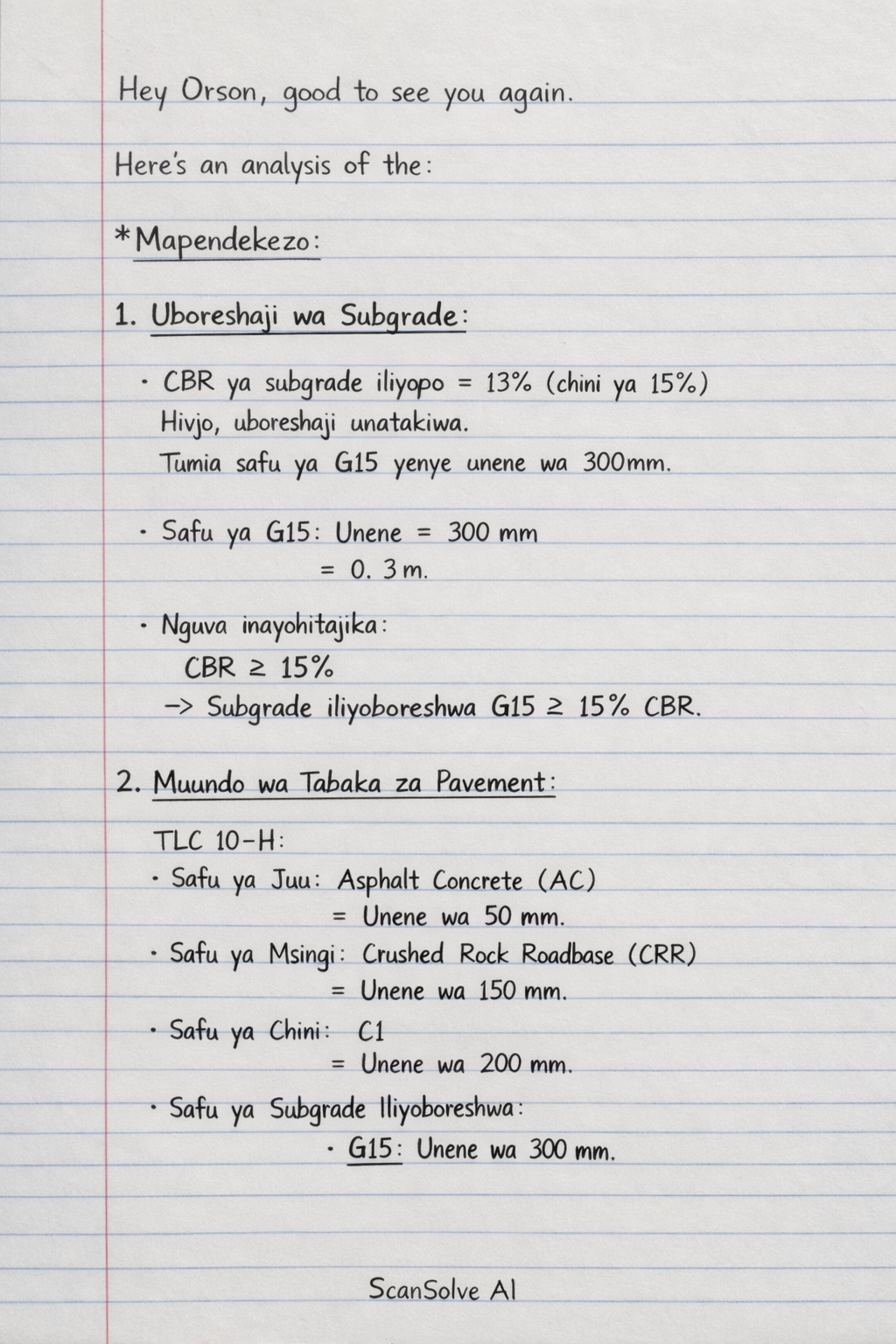
Mapendekezo:
-
Uboreshaji wa Subgrade: Kwa kuwa thamani ya CBR ya subgrade iliyopo ni chini ya 15% (kwa mfano, 13-15%), uboreshaji wa subgrade ni muhimu. Inapendekezwa kutumia safu ya juu ya G15 yenye unene wa 300mm kama ilivyobainishwa katika muundo wa tabaka za subgrade zilizoboreshwa. Hii itahakikisha subgrade inafikia nguvu inayohitajika ya CBR ya angalau 15%.
-
Muundo wa Tabaka za Pavement: Kulingana na matokeo ya vipimo na darasa la mzigo wa trafiki (TLC 10-H), muundo wa tabaka za pavement unapaswa kuwa:
- Safu ya Juu (Surfacing Layer): Asphalt Concrete (AC) yenye unene wa 50mm.
- Safu ya Msingi (Base Course): Crushed Rock Roadbase (CRR) yenye unene wa 150mm.
- Safu ya Chini (Subbase Course): C1 yenye unene wa 200mm.
- Safu ya Subgrade Iliyoboreshwa: G15 yenye unene wa 300mm.
-
Ufuatiliaji wa Ubora wa Nyenzo: Ni muhimu kuhakikisha kuwa nyenzo zote zinazotumika katika ujenzi wa barabara, hasa G15, C1, CRR, na AC, zinakidhi viwango vya ubora vilivyobainishwa. Vipimo vya maabara vinapaswa kufanywa mara kwa mara ili kuthibitisha sifa za kiufundi za nyenzo hizi.
-
Usimamizi wa Trafiki: Kwa kuwa barabara ina mzigo mkubwa wa trafiki (TLC 10-H), ni muhimu kuzingatia usimamizi wa trafiki wakati wa ujenzi ili kupunguza usumbufu na kuhakikisha usalama wa wafanyakazi na watumiaji wa barabara.
-
Matengenezo ya Uso wa Barabara: Baada ya ujenzi, matengenezo ya mara kwa mara ya uso wa barabara (surface treatment) yanapaswa kufanywa ili kudumisha utendaji na mwonekano wa pavement, kuboresha ulaini, kupunguza kelele za matairi, na kuongeza mshikamano wa matairi na barabara.
-
Uchunguzi wa Udongo wa Kina: Ingawa vipimo vya msingi vimefanywa, uchunguzi wa kina zaidi wa udongo katika maeneo tofauti ya barabara unaweza kutoa data sahihi zaidi na kusaidia katika kuboresha muundo wa pavement kwa ufanisi zaidi.
Haya ndiyo mapendekezo muhimu kulingana na matokeo na majadiliano yaliyotolewa.
Still stuck on this one?
Ask a follow-up, and the answer starts from this question.
More English Questions
Handwritten Step-by-Step Solution
Get this as a handwritten image on WhatsApp — like a tutor wrote it for you.
Try on WhatsApp