
We read your photo as:
Explain the concepts of poor road conditions, their causes in South Africa, and related project tasks.
ScanSolve AI Answer
Here are the solutions to the questions based on the provided image:
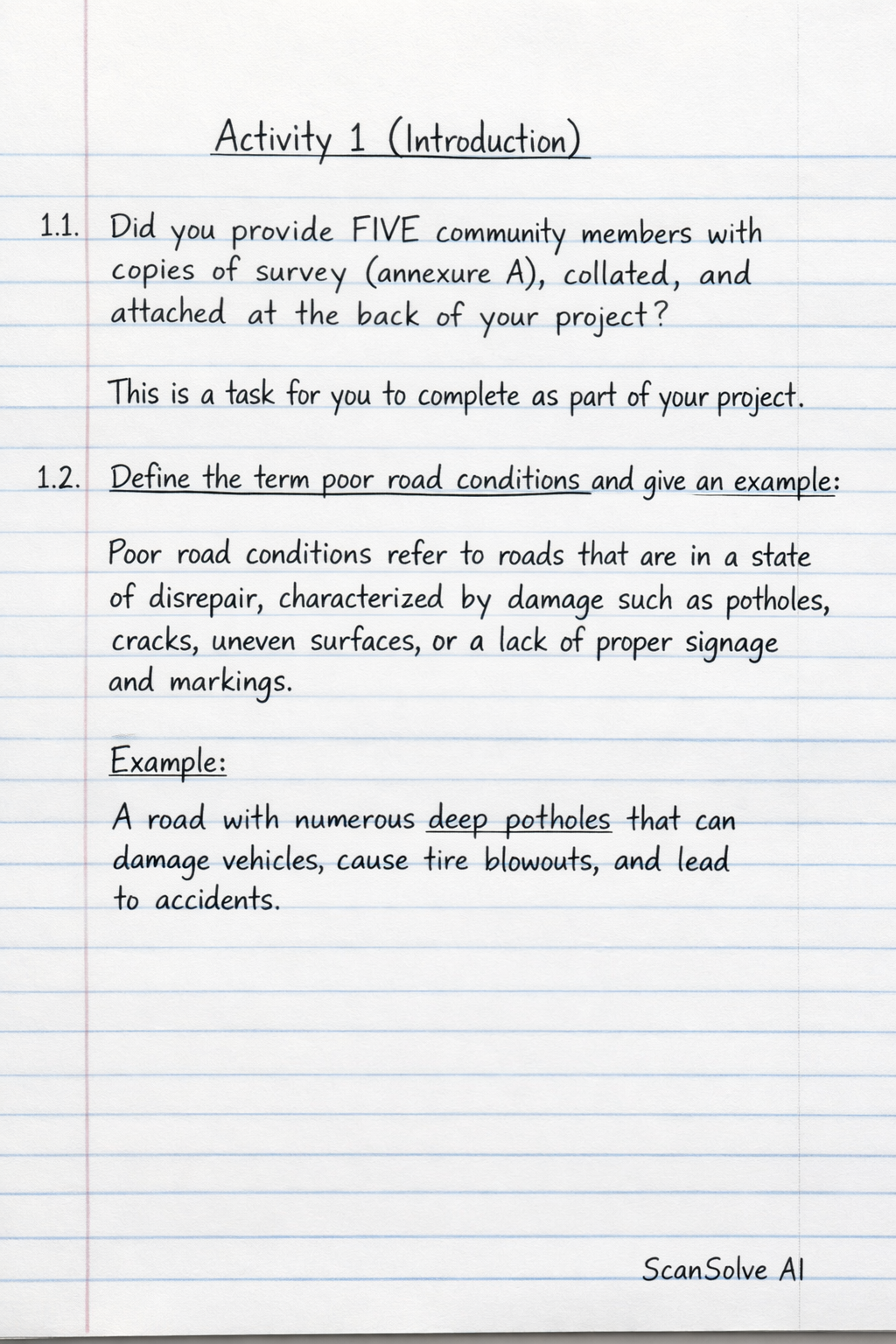
Activity 1 (Introduction)
-
1.1. Did you provide FIVE community members with copies of survey (annexure A), collated, and attached at the back of your project? This is a task for you to complete as part of your project.
-
1.2. Define the term poor road conditions and give an example.
- Poor road conditions refer to roads that are in a state of disrepair, characterized by damage such as potholes, cracks, uneven surfaces, or a lack of proper signage and markings.
- Example: A road with numerous deep potholes that can damage vehicles, cause tire blowouts, and lead to accidents.
-
1.3. Give FOUR main causes of poor road conditions in South Africa?
- Lack of maintenance: Insufficient funding or neglect in regular upkeep and repairs of road infrastructure.
- Heavy traffic and overloading: Roads are often not designed to withstand the weight and volume of heavy vehicles, leading to accelerated wear and tear.
- Poor construction quality: The use of substandard materials or improper construction techniques can result in roads that deteriorate quickly.
- Environmental factors: Extreme weather conditions, such as heavy rains, floods, and extreme temperatures, contribute significantly to road damage.
-
1.4. Explain what is meant by the term community services.
- Community services are public services provided by government bodies or non-profit organizations to benefit the general public and improve the quality of life within a community. These services often address social, health, educational, and infrastructural needs.
-
1.5. Discuss THREE responsibilities of the people about community services.
- Reporting issues: Citizens have a responsibility to report problems with community services, such as potholes, broken streetlights, or water leaks, to the relevant local authorities.
- Participating in community initiatives: Engaging in local forums, meetings, or volunteer efforts to provide feedback, suggest improvements, or assist in maintaining community services.
- Paying taxes: Contributing to the funding of community services through taxes, which enables the government to provide and maintain essential infrastructure and services.
Activity 2 (Findings)
-
2.1. State FOUR basic human rights violated when people get involved in road accidents due to poor road infrastructure.
- Right to life: Accidents caused by poor roads can lead to fatalities.
- Right to dignity: Injuries and disabilities resulting from accidents can severely impact a person's dignity and overall quality of life.
- Right to bodily integrity/security of the person: Accidents can cause severe physical harm, injury, and permanent disability.
- Right to a safe environment: Poor road infrastructure contributes to an unsafe living and commuting environment, infringing on the right to safety.
-
2.2. Mention FIVE roles that community leaders/local authorities should play in addressing bad road conditions.
- Regular inspection and assessment: Conduct routine checks of roads to identify damage and prioritize areas for repair.
- Budget allocation and resource management: Ensure sufficient funds are allocated for road maintenance and repairs, and manage these resources effectively and transparently.
- Implementation of maintenance programs: Develop and execute timely plans for the repair, rehabilitation, and upkeep of roads.
- Community engagement and feedback mechanisms: Establish accessible channels for citizens to report road issues and provide feedback on infrastructure conditions.
- Enforcement of quality standards: Oversee road construction and repair projects to ensure they meet required quality and safety standards, preventing premature deterioration.
-
2.3. Define the term human rights violations.
- Human rights violations occur when a state or non-state actor infringes upon the fundamental rights and freedoms to which all individuals are entitled, as enshrined in national laws and international conventions.
-
2.4. Discuss TWO key pieces of legislation governing road safety in South Africa.
- National Road Traffic Act (Act 93 of 1996): This is the primary legislation governing all aspects of road traffic in South Africa. It covers driver licensing, vehicle registration, road traffic signs, rules of the road, and enforcement, all aimed at promoting safety and order on public roads.
- South African National Roads Agency Limited and National Roads Act (Act 7 of 1998): This act established SANRAL and outlines its responsibilities for the management, maintenance, and development of the national road network. By ensuring the quality and safety of national roads, this legislation plays a crucial role in overall road safety.
Activity 3 (Findings)
- 3.1. Describe how poor roads and accidents affect access to:
- Healthcare:
- Emergency services: Poor road conditions can significantly delay ambulances and other emergency vehicles from reaching accident scenes or transporting patients to hospitals, potentially leading to worse health outcomes or fatalities.
- Routine medical care: Individuals, especially in rural or underserved areas, may struggle to access clinics or hospitals for regular check-ups, chronic disease management, or maternal care due to impassable or dangerous roads.
- Education:
- Student attendance: Poor road conditions make it difficult and unsafe for students to travel to school, particularly in rural areas, leading to increased absenteeism and reduced learning opportunities.
- Teacher access: Teachers may also face challenges commuting to schools, especially in remote areas, which can affect the consistency and quality of education provided.
- Employment:
- Commuting challenges: Employees face longer, more dangerous, and more expensive commutes, increasing vehicle wear and tear and the risk of accidents. This can lead to job loss, reduced productivity, and higher personal costs.
- Economic development: Poor infrastructure deters businesses from investing in areas with bad roads, limiting job creation and hindering overall economic growth and development.
- Healthcare:
Still stuck on this one?
Ask a follow-up, and the answer starts from this question.
More Geography Questions
Handwritten Step-by-Step Solution
Get this as a handwritten image on WhatsApp — like a tutor wrote it for you.
Try on WhatsApp