
We read your photo as:
Identify soil structures A, B, C, D, and relate them to soil compaction, arid climates, and crop production.
ScanSolve AI Answer
Step-by-step solution
4 stepsIdentify the soil structures shown in the diagram.
- Structure A: Appears as vertical columns, characteristic of prismatic or columnar structure.
- Structure B: Consists of small, rounded, porous aggregates, characteristic of granular or crumb structure.
- Structure C: Shows irregular, block-like aggregates, characteristic of blocky structure.
- Structure D: Displays flat, plate-like aggregates stacked horizontally, characteristic of platy structure.
1.1.1 Indicate the structure A and D.
Structure A: Prismatic (or Columnar)
Structure D: PlatyIndicate the letter representing a structure to which each statement applies.
a) It is found in compacted soil:
Platy structure (D) is often found in compacted soil layers, especially near the surface, as compaction flattens the soil aggregates.b) Develops in soils of arid climate:
Prismatic or columnar structures (A) are commonly found in the subsoil of arid and semi-arid regions, often associated with the accumulation of salts.1.1.2 The letters are:
a) It is found in compacted soil: D
b) Develops in soils of arid climate: A
Indicate a letter of a structure you would recommend to the farmer for crop production.
For optimal crop production, a soil structure that allows for good aeration, water infiltration, and root penetration is ideal. Granular or crumb structure (B) provides these conditions.
1.1.3 The recommended structure is: B
Give THREE reasons for the recommendation in QUESTION 1.1.3.
The granular/crumb structure (B) is recommended because:
- It promotes good aeration, allowing oxygen to reach plant roots for respiration.
- It facilitates excellent water infiltration and drainage, preventing waterlogging while ensuring water is available to roots.
- It allows for easy root penetration and growth, enabling plants to access nutrients and water efficiently.
1.1.4 Three reasons for recommendation:
- Good aeration
- Good water infiltration and drainage
- Easy root penetration
Still stuck on this one?
Ask a follow-up, and the answer starts from this question.
More Geography Questions
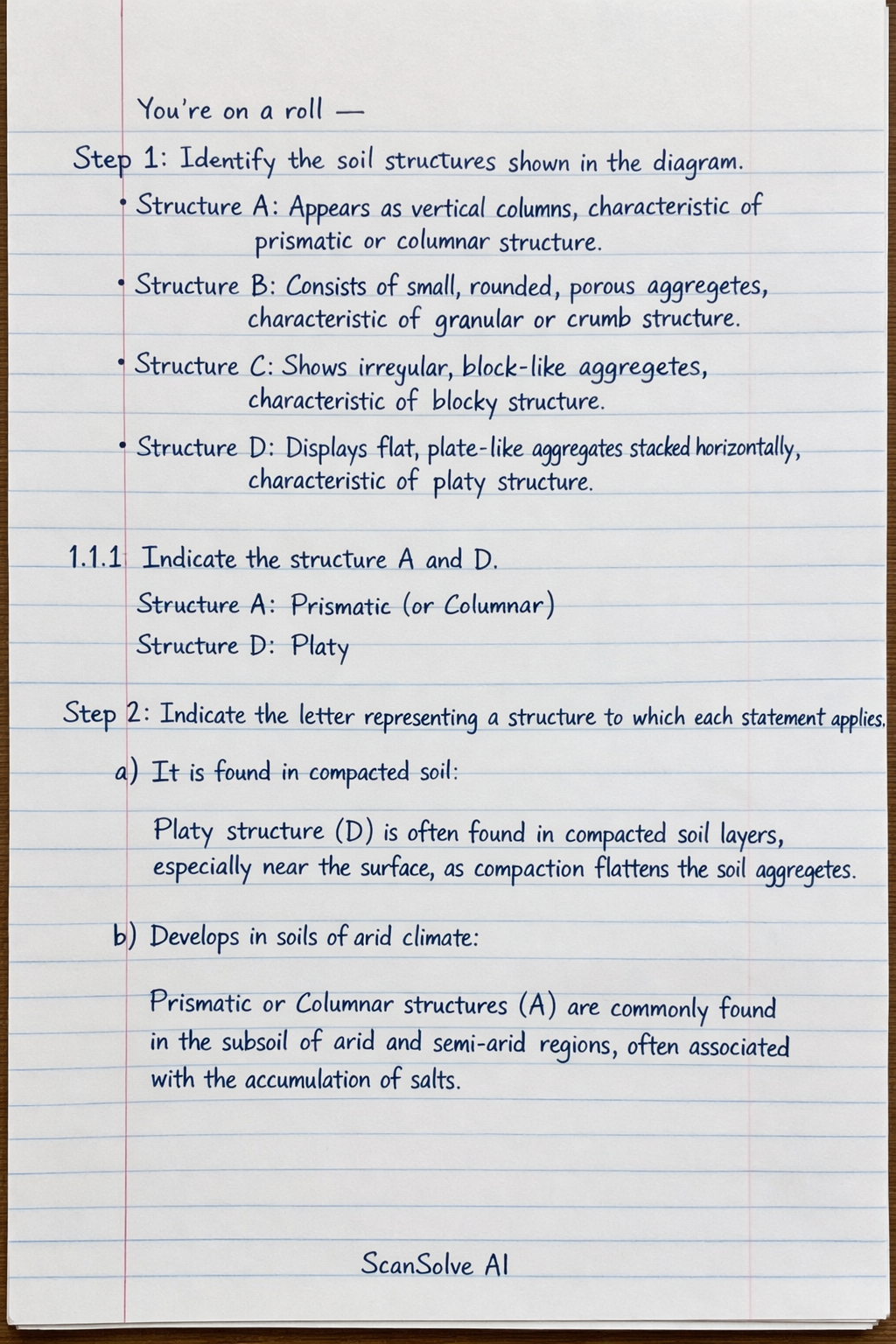
Handwritten Step-by-Step Solution
Get this as a handwritten image on WhatsApp — like a tutor wrote it for you.
Try on WhatsApp