
We read your photo as:
Describe and differentiate between leaching/percolation, salination/acidification, and soil crusting/compaction.
Geography
ScanSolve AI Answer
Here's the last one for today, michelle:
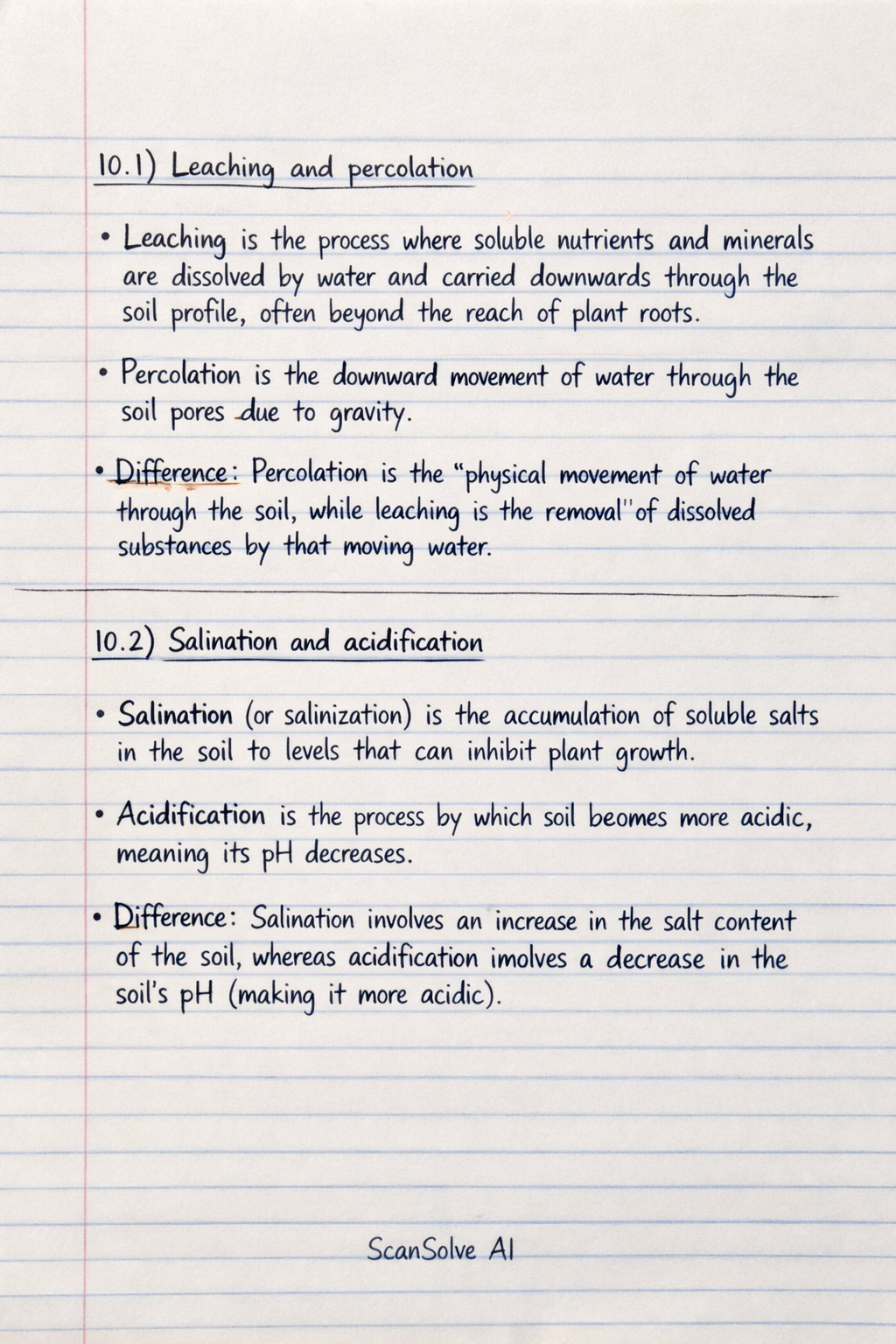
10.1) Leaching and percolation
- Leaching is the process where soluble nutrients and minerals are dissolved by water and carried downwards through the soil profile, often beyond the reach of plant roots.
- Percolation is the downward movement of water through the soil pores due to gravity.
- Difference: Percolation is the physical movement of water through the soil, while leaching is the removal of dissolved substances by that moving water.
10.2) Salination and acidification
- Salination (or salinization) is the accumulation of soluble salts in the soil to levels that can inhibit plant growth.
- Acidification is the process by which soil becomes more acidic, meaning its pH decreases.
- Difference: Salination involves an increase in the salt content of the soil, whereas acidification involves a decrease in the soil's pH (making it more acidic).
10.3) Soil crusting and soil compaction
- Soil crusting is the formation of a hard, thin layer on the soil surface, often caused by the impact of raindrops breaking down soil aggregates, followed by drying.
- Soil compaction is the increase in soil bulk density and decrease in porosity due to external pressure, such as from heavy machinery or livestock, which reduces air and water movement.
- Difference: Soil crusting is a surface phenomenon affecting the top layer of soil, while soil compaction affects the deeper layers or the entire soil profile.
10.4) Mono-cropping and monoculture
- Mono-cropping is the practice of growing the same crop species in the same field year after year.
- Monoculture is the cultivation of a single crop species over a large area, often for many years, as a dominant agricultural system.
- Difference: Mono-cropping specifically refers to the temporal repetition of a single crop in a particular field, while monoculture is a broader system where one crop dominates a large agricultural landscape, which can include mono-cropping.
10.5) Crop rotation and intercropping
- Crop rotation is the practice of growing a sequence of different crops on the same land over a period of time, rather than growing the same crop continuously.
- Intercropping is the practice of growing two or more different crops simultaneously in the same field.
- Difference: Crop rotation involves growing different crops sequentially over time in the same field, whereas intercropping involves growing multiple crops at the same time in the same field.
Was this helpful?
Still stuck on this one?
Ask a follow-up, and the answer starts from this question.
Got a different question?Ask your own question
More Geography Questions
QIdentify soil structures A, B, C, D, and relate them to soil compaction, arid climates, and crop…QDescribe soil permeability, factors affecting it, identify soil types by drainage, and explain soil…QExplain soil formation, land degradation, and land conservation.QDifferentiate between weathering and mass wasting and explain three effects of soil creep on the…QWhich of the following correctly describes soil properties and processes? Select all that apply.
Browse by topic:Earth Science
Handwritten Step-by-Step Solution
Get this as a handwritten image on WhatsApp — like a tutor wrote it for you.
Try on WhatsApp