
We read your photo as:
Which of the following has no end? (A) River (B) Road (C) Coastline (D) Railway
ScanSolve AI Answer
Here are the answers to the questions:
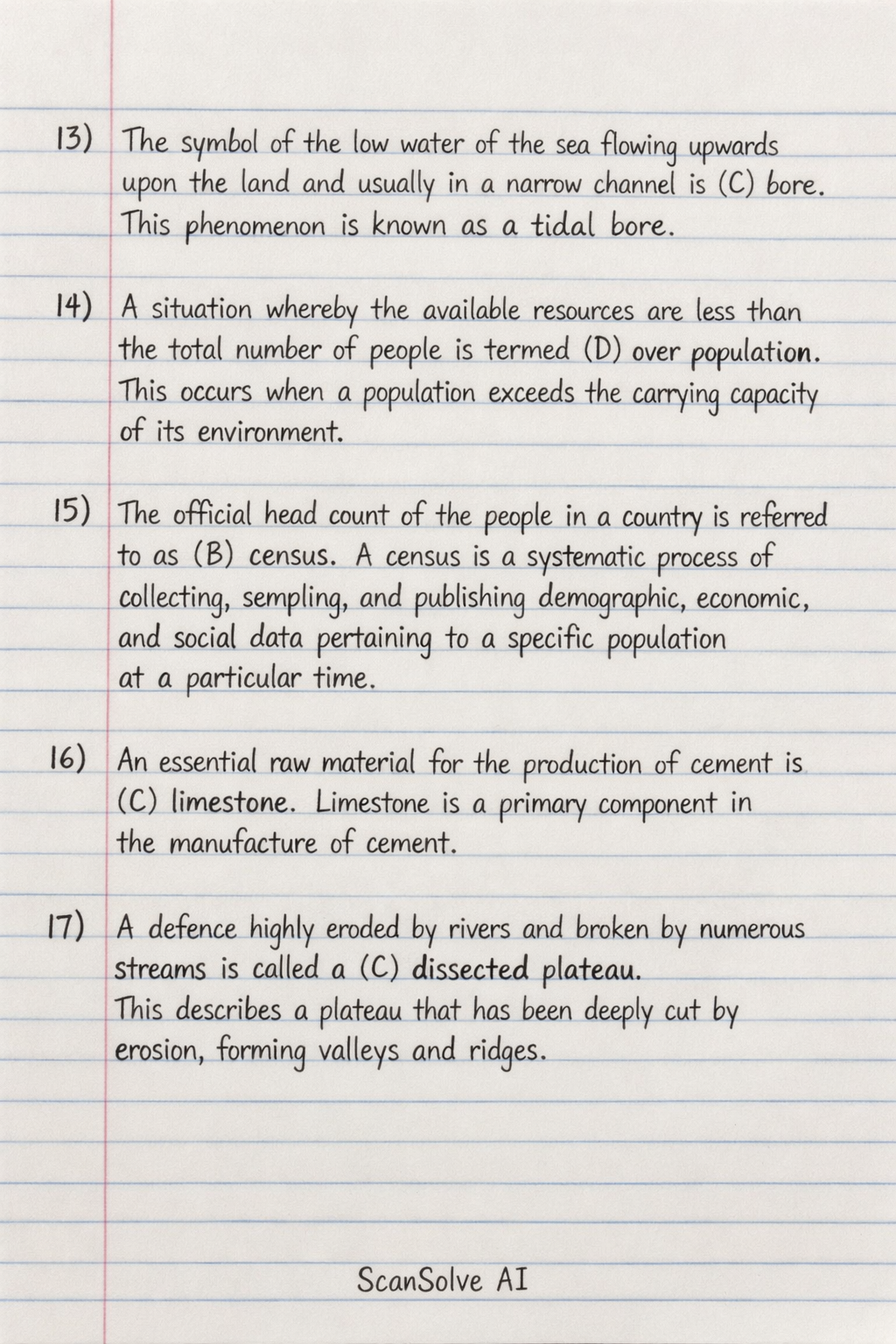
13) The symbol of the low water of the sea flowing upwards upon the land and usually in a narrow channel is (C) bore. This phenomenon is known as a tidal bore.
14) A situation whereby the available resources are less than the total number of people is termed (D) over population. This occurs when a population exceeds the carrying capacity of its environment.
15) The official head count of the people in a country is referred to (B) census. A census is a systematic process of collecting, compiling, and publishing demographic, economic, and social data pertaining to a specific population at a particular time.
16) An essential raw material for the production of cement is (C) limestone. Limestone is a primary component in the manufacture of cement.
17) A defence highly eroded by rivers and broken by numerous streams is called (C) dissected plateau. This describes a plateau that has been deeply cut by erosion, forming valleys and ridges.
18) The path taken by the wind into which one has to walk to get to an area is (A) windward side. This is the side of an object or landform that faces the wind.
19) The study of weather and climate is called (A) meteorology. Meteorology is the scientific study of the atmosphere and its phenomena, including weather and climate.
20) The imaginary line that divides the Earth into two equal halves is called (A) equator. The equator is an imaginary line around the middle of a planet or other celestial body, halfway between the North Pole and the South Pole.
21) The process of soil formation is called (C) pedogenesis. Pedogenesis involves the various processes that lead to the formation of soil.
22) Which of the following is NOT a feature of karst topography? (D) moraines. Moraines are accumulations of glacial debris, whereas sinkholes, caves, and stalactites are characteristic features of karst landscapes formed by the dissolution of soluble rocks.
23) The movement of people from one place to another is called (B) migration. Migration refers to the movement of people from one locality to another, often across a significant distance.
24) Which of the following is NOT a type of rock? (D) granite. Igneous, sedimentary, and metamorphic are the three main types of rocks. Granite is a specific example of an igneous rock, not a general type.
25) A broad lowland at the mouth of a river is called (A) delta. A delta is a landform that is formed at the mouth of a river, where the river's current slows and deposits sediment.
26) The outermost layer of the Earth is called (C) crust. The Earth's crust is the thin, outermost layer of the planet.
27) The atmosphere is composed of several gases. Which of the following is the most abundant? (C) nitrogen. Nitrogen makes up approximately 78% of the Earth's atmosphere.
28) Which of the following is NOT a benefit of transportation? (C) encourages rural-urban migration. While transportation can facilitate migration, rural-urban migration is often considered a demographic trend or a consequence, rather than a direct benefit of transportation itself in the same positive sense as the other options.
Still stuck on this one?
Ask a follow-up, and the answer starts from this question.
More Geography Questions
Handwritten Step-by-Step Solution
Get this as a handwritten image on WhatsApp — like a tutor wrote it for you.
Try on WhatsApp