

This geography problem is solved step by step below, with detailed explanations to help you understand the method and arrive at the correct answer.
ScanSolve AI Answer
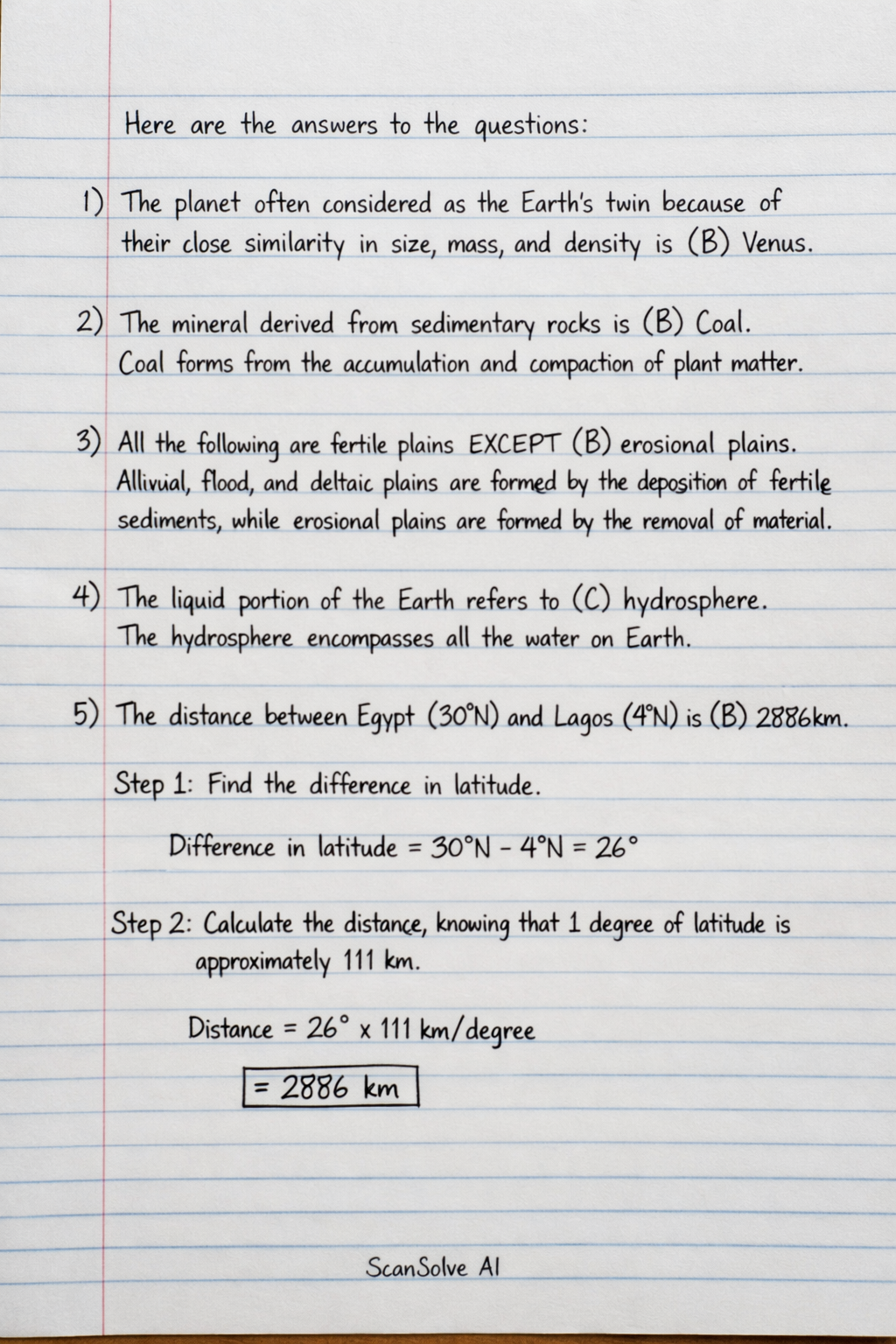
Here are the answers to the questions: 1) The planet often considered as the Earth's twin because of their close similarity in size, mass, and density is (B) Venus. 2) The mineral derived from sedimentary rocks is (B) Coal. Coal forms from the accumulation and compaction of plant matter. 3) All the following are fertile plains EXCEPT (B) erosional plains. Alluvial, flood, and deltaic plains are formed by the deposition of fertile sediments, while erosional plains are formed by the removal of material. 4) The liquid portion of the Earth refers to (C) hydrosphere. The hydrosphere encompasses all the water on Earth. 5) The distance between Egypt (30°N) and Lagos (4°N) is (B) 2886km. Step 1: Find the difference in latitude. Difference in latitude = 30^ N - 4^ N = 26^ Step 2: Calculate the distance, knowing that 1 degree of latitude is approximately 111 km. Distance = 26^ × 111 km/degree = 2886 km 6) The day in which the length of day and night are equal everywhere on Earth is (C) 21st March. This is one of the two equinoxes. 7) An elevated upland with peak surfaces refers to (A) mountain. 8) A plain formed from the deposition of sediments which cover the beds of lakes that have become dry is (B) lacustrine plains. "Lacustrine" refers to lakes. 9) The acronym GIS refers to (C) Geographic Information System. 10) A hygrometer is an instrument used in measuring (D) relative humidity. 11) The largest river in Nigeria is (A) River Niger. 12) The wind responsible for rainfall in Nigeria is called (B) tropical maritime air mass. This air mass brings moisture from the Atlantic Ocean. Send me the next one 📸