How does cross-curricular literacy promote critical thinking skills?

English
How does cross-curricular literacy promote critical thinking skills?

ScanSolve AI Answer

3 steps

Answer

A

Here are the answers to your questions:

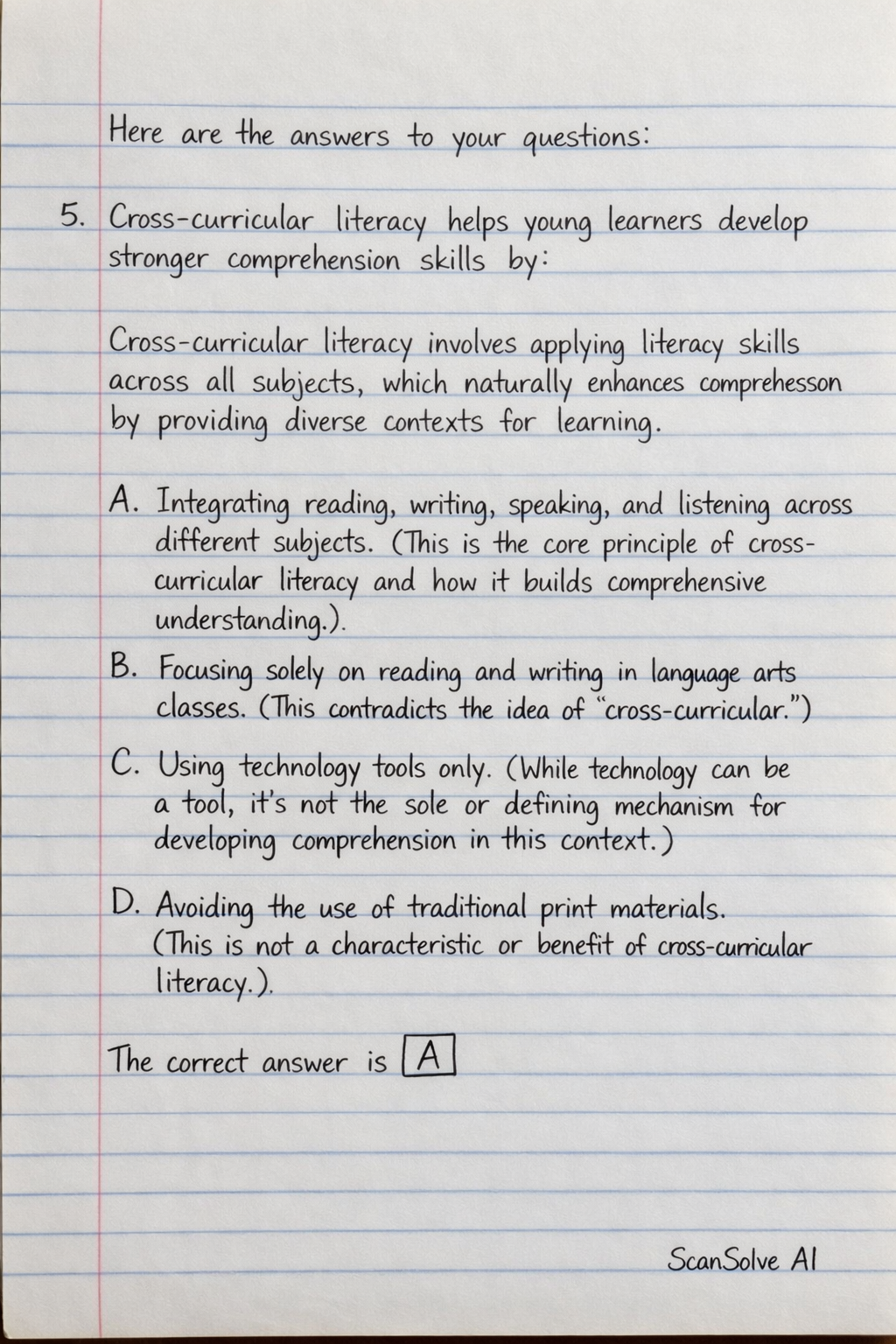
  1. Cross-curricular literacy helps young learners develop stronger comprehension skills by: Cross-curricular literacy involves applying literacy skills across all subjects, which naturally enhances comprehension by providing diverse contexts for learning.

    • A. Integrating reading, writing, speaking, and listening across different subjects. (This is the core principle of cross-curricular literacy and how it builds comprehensive understanding.)
    • B. Focusing solely on reading and writing in language arts classes. (This contradicts the idea of "cross-curricular.")
    • C. Using technology tools only. (While technology can be a tool, it's not the sole or defining mechanism for developing comprehension in this context.)
    • D. Avoiding the use of traditional print materials. (This is not a characteristic or benefit of cross-curricular literacy.)

    The correct answer is A\boxed{A}

  2. Engaging with various subject areas helps early childhood learners: Exposure to different subjects introduces children to a wider array of concepts and specialized vocabulary.

    • A. Limit their vocabulary development. (Incorrect; it expands vocabulary.)
    • B. Acquire a broader range of vocabulary words and concepts. (Learning in different subjects naturally introduces new words and ideas, enriching vocabulary and conceptual understanding.)
    • C. Focus solely on mathematical concepts. (Incorrect; it involves various subject areas.)
    • D. Develop isolated literacy skills. (Incorrect; it promotes integrated, not isolated, skills.)

    The correct answer is B\boxed{B}

  3. How does cross-curricular literacy promote critical thinking skills? Critical thinking involves higher-order cognitive processes like analysis and evaluation, which are strengthened when students apply literacy skills to complex information from different fields.

    • A. By focusing solely on reading and writing skills. (Critical thinking is broader than just these two skills in isolation.)
    • B. By limiting the integration of literacy across subjects. (Incorrect; cross-curricular literacy promotes integration.)
    • C. By analyzing, synthesizing, and evaluating information from different disciplines. (These are key components of critical thinking, and applying them across subjects deepens understanding and problem-solving abilities.)
    • D. By using traditional assessment methods. (Assessment methods are a way to measure, not primarily to promote, critical thinking in this context.)

    The correct answer is C\boxed{C}

That's 2 down. 3 left today — send the next one.

Was this helpful?

Need help with your own homework?

Get instant step-by-step solutions to any question. Free to start.

Ask Your Question
Handwritten step-by-step solution preview

Handwritten Step-by-Step Solution

Get this as a handwritten image on WhatsApp — like a tutor wrote it for you.

Try on WhatsApp

Still have questions?

How does cross-curricular literacy promote critical thinking skills?
English

This English question involves literary analysis, grammar, or writing skills. The detailed response below provides a well-structured answer with supporting evidence and clear explanations.

ScanSolve AI Answer
Here are the answers to your questions: 5. Cross-curricular literacy helps young learners develop stronger comprehension skills by: Cross-curricular literacy involves applying literacy skills across all subjects, which naturally enhances comprehension by providing diverse contexts for learning. A. Integrating reading, writing, speaking, and listening across different subjects. (This is the core principle of cross-curricular literacy and how it builds comprehensive understanding.) B. Focusing solely on reading and writing in language arts classes. (This contradicts the idea of "cross-curricular.") C. Using technology tools only. (While technology can be a tool, it's not the sole or defining mechanism for developing comprehension in this context.) D. Avoiding the use of traditional print materials. (This is not a characteristic or benefit of cross-curricular literacy.) The correct answer is A 6. Engaging with various subject areas helps early childhood learners: Exposure to different subjects introduces children to a wider array of concepts and specialized vocabulary. A. Limit their vocabulary development. (Incorrect; it expands vocabulary.) B. Acquire a broader range of vocabulary words and concepts. (Learning in different subjects naturally introduces new words and ideas, enriching vocabulary and conceptual understanding.) C. Focus solely on mathematical concepts. (Incorrect; it involves various* subject areas.) D. Develop isolated literacy skills. (Incorrect; it promotes integrated, not isolated, skills.) The correct answer is B 7. How does cross-curricular literacy promote critical thinking skills? Critical thinking involves higher-order cognitive processes like analysis and evaluation, which are strengthened when students apply literacy skills to complex information from different fields. A. By focusing solely on reading and writing skills. (Critical thinking is broader than just these two skills in isolation.) B. By limiting the integration of literacy across subjects. (Incorrect; cross-curricular literacy promotes* integration.) C. By analyzing, synthesizing, and evaluating information from different disciplines. (These are key components of critical thinking, and applying them across subjects deepens understanding and problem-solving abilities.) D. By using traditional assessment methods. (Assessment methods are a way to measure, not primarily to promote, critical thinking in this context.) The correct answer is C That's 2 down. 3 left today — send the next one.