
We read your photo as:
Fill in the blanks with the most appropriate word from the options provided. 1. Despite repeated warnings, the chairman remained
ScanSolve AI Answer
Answer
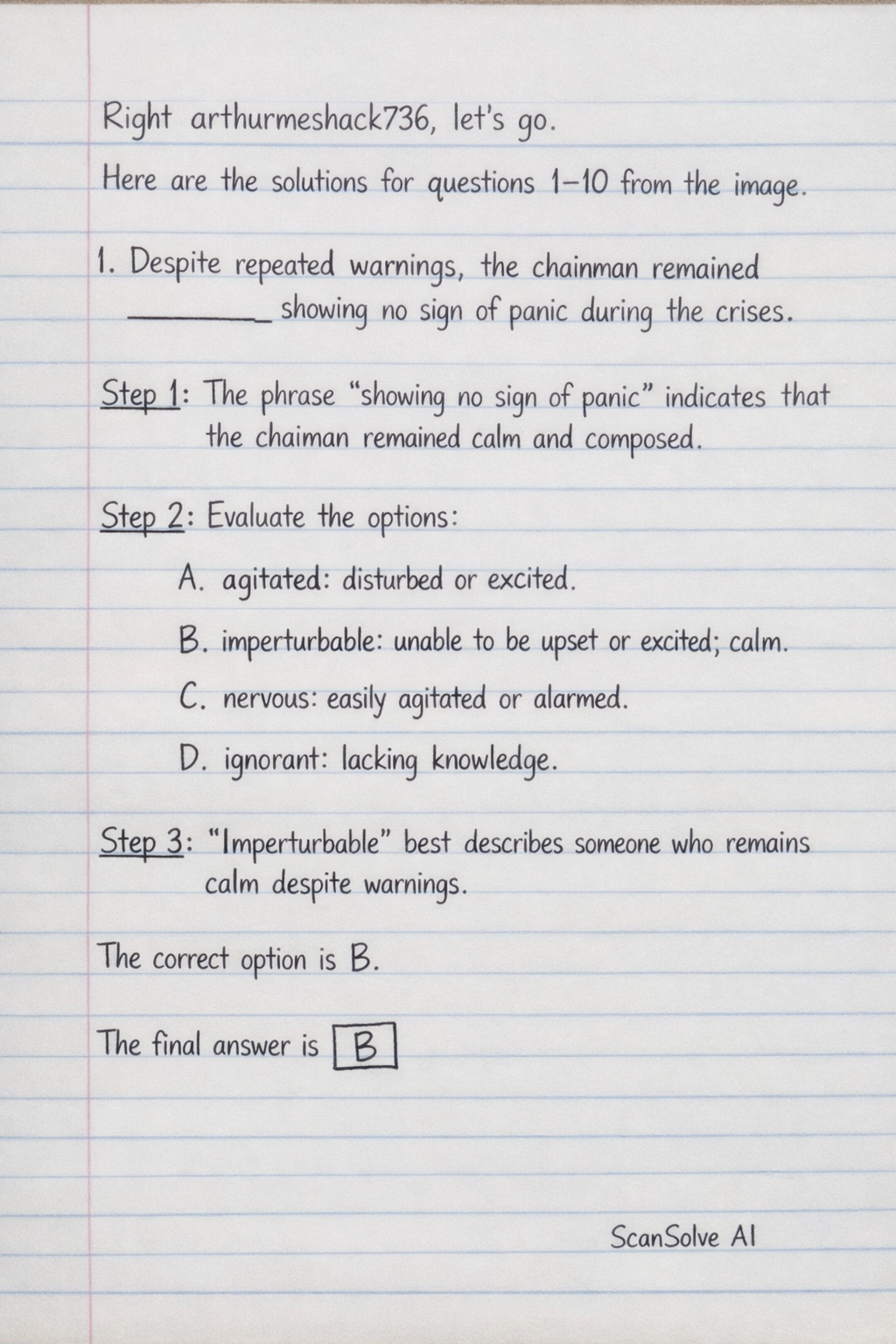
Here are the solutions for questions 1-10 from the image.
1. Despite repeated warnings, the chairman remained ______ showing no sign of panic during the crises.
- Step 1: The phrase "showing no sign of panic" indicates that the chairman remained calm and composed.
- Step 2: Evaluate the options:
- A. agitated: disturbed or excited.
- B. imperturbable: unable to be upset or excited; calm.
- C. nervous: easily agitated or alarmed.
- D. ignorant: lacking knowledge.
- Step 3: "Imperturbable" best describes someone who remains calm despite warnings.
The correct option is B.
The final answer is
2. The scientist's explanation was so ______ that very few in the audience understood the experiment.
- Step 1: If "very few in the audience understood," it means the explanation was difficult to comprehend.
- Step 2: Evaluate the options:
- A. obscure: not discovered or known about; uncertain or difficult to understand.
- B. simple: easily understood.
- C. clear: easy to understand.
- D. obvious: easily perceived or understood.
- Step 3: "Obscure" means difficult to understand, which aligns with the audience's lack of comprehension.
The correct option is A.
The final answer is
3. The student was praised for being ______ always completing assignments on time and with great care.
- Step 1: "Completing assignments on time and with great care" describes a diligent and hard-working person.
- Step 2: Evaluate the options:
- A. lazy: unwilling to work.
- B. industrious: diligent and hard-working.
- C. careless: not paying enough attention.
- D. inattentive: not paying attention.
- Step 3: "Industrious" accurately describes someone who consistently works hard and carefully.
The correct option is B.
The final answer is
4. The historian's account was largely ______, relying on conventional interpretations rather than alternative perspectives.
- Step 1: "Relying on conventional interpretations rather than alternative perspectives" means the account followed established or old ways of thinking.
- Step 2: Evaluate the options:
- A. modern: relating to recent times.
- B. traditional: existing in or as part of a tradition; long-established.
- C. innovative: featuring new methods; advanced and original.
- D. unconventional: not based on what is generally done or believed.
- Step 3: "Traditional" best fits the description of relying on conventional interpretations.
The correct option is B.
The final answer is
5. His ______ behaviour at the formal meeting drew criticism from both colleagues and superiors.
- Step 1: If the behavior drew criticism at a formal meeting, it implies the behavior was inappropriate or out of place for such an setting.
- Step 2: Evaluate the options:
- A. incongruous: not in harmony or keeping with the surroundings or other aspects of something.
- B. appropriate: suitable or proper.
- C. fitting: appropriate or suitable.
- D. suitable: right or appropriate.
- Step 3: "Incongruous" means out of place or inappropriate for the context, which would lead to criticism in a formal setting.
The correct option is A.
The final answer is
6. The diplomat made ______ remarks that was only loosely connected to the main discussion.
- Step 1: "Loosely connected to the main discussion" means the remarks were not central or directly relevant.
- Step 2: Evaluate the options:
- A. tangential: diverging from a previous course or line; only slightly or indirectly related.
- B. relevant: closely connected or appropriate.
- C. central: of greatest importance.
- D. crucial: of great importance.
- Step 3: "Tangential" accurately describes remarks that are only slightly or indirectly related to the main topic.
The correct option is A.
The final answer is
7. The politician's ______ attitude made it impossible for his opponents to forgive past grievances.
- Step 1: If opponents found it impossible to forgive, the politician's attitude must have been one of resentment or a desire for revenge.
- Step 2: Evaluate the options:
- A. vindictive: having or showing a strong or unreasoning desire for revenge.
- B. forgive: (verb) to stop feeling angry or resentful. This is a verb, not an attitude.
- C. conciliatory: intended or likely to placate or pacify.
- D. lenient: permissive or tolerant.
- Step 3: "Vindictive" best describes an attitude that would prevent forgiveness of past grievances.
The correct option is A.
The final answer is
8. The engineer's initial calculations were ______ resulting in serious errors in the design.
- Step 1: "Resulting in serious errors" indicates that the calculations were flawed or incorrect.
- Step 2: Evaluate the options:
- A. fallacious: based on a mistaken belief or unsound reasoning.
- B. correct: free from error.
- C. accurate: correct in all details.
- D. precise: marked by exactness.
- Step 3: "Fallacious" means mistaken or unsound, which directly leads to serious errors.
The correct option is A.
The final answer is
9. The artist was known for his ______ style, which often defied traditional artistic norms.
- Step 1: "Defied traditional artistic norms" means the style was unusual, unconventional, or strange.
- Step 2: Evaluate the options:
- A. eccentric: unconventional and slightly strange.
- B. ordinary: with no special features; normal.
- C. conventional: based on what is generally done or believed.
- D. standard: used or accepted as normal.
- Step 3: "Eccentric" best describes a style that goes against traditional norms.
The correct option is A.
The final answer is
10. In addressing the problem before it escalated, the manager took a ______ approach.
- Step 1: "Addressing the problem before it escalated" means taking action in advance to prevent a negative outcome.
- Step 2: Evaluate the options:
- A. reactive: acting in response to a situation.
- B. proactive: creating or controlling a situation by causing something to happen rather than responding to it after it has happened.
- C. careless: not paying enough attention.
- D. passive: accepting what happens without active response.
- Step 3: "Proactive" describes taking initiative to prevent problems before they worsen.
The correct option is B.
The final answer is
Try one yourself
A new problem that tests the same skill.
Still stuck on this one?
Ask a follow-up, and the answer starts from this question.
More English Questions
Handwritten Step-by-Step Solution
Get this as a handwritten image on WhatsApp — like a tutor wrote it for you.
Try on WhatsApp