
Gurlll!!! open this file and summarize this notes and make me understand we are writing on it next😭 and if there are any questions solve them in a layman's way I I need to pass
English
ScanSolve AI Answer
This answer stops before the end.
It was cut off when it was first written. Ask ScanSolve this question again for the full working.
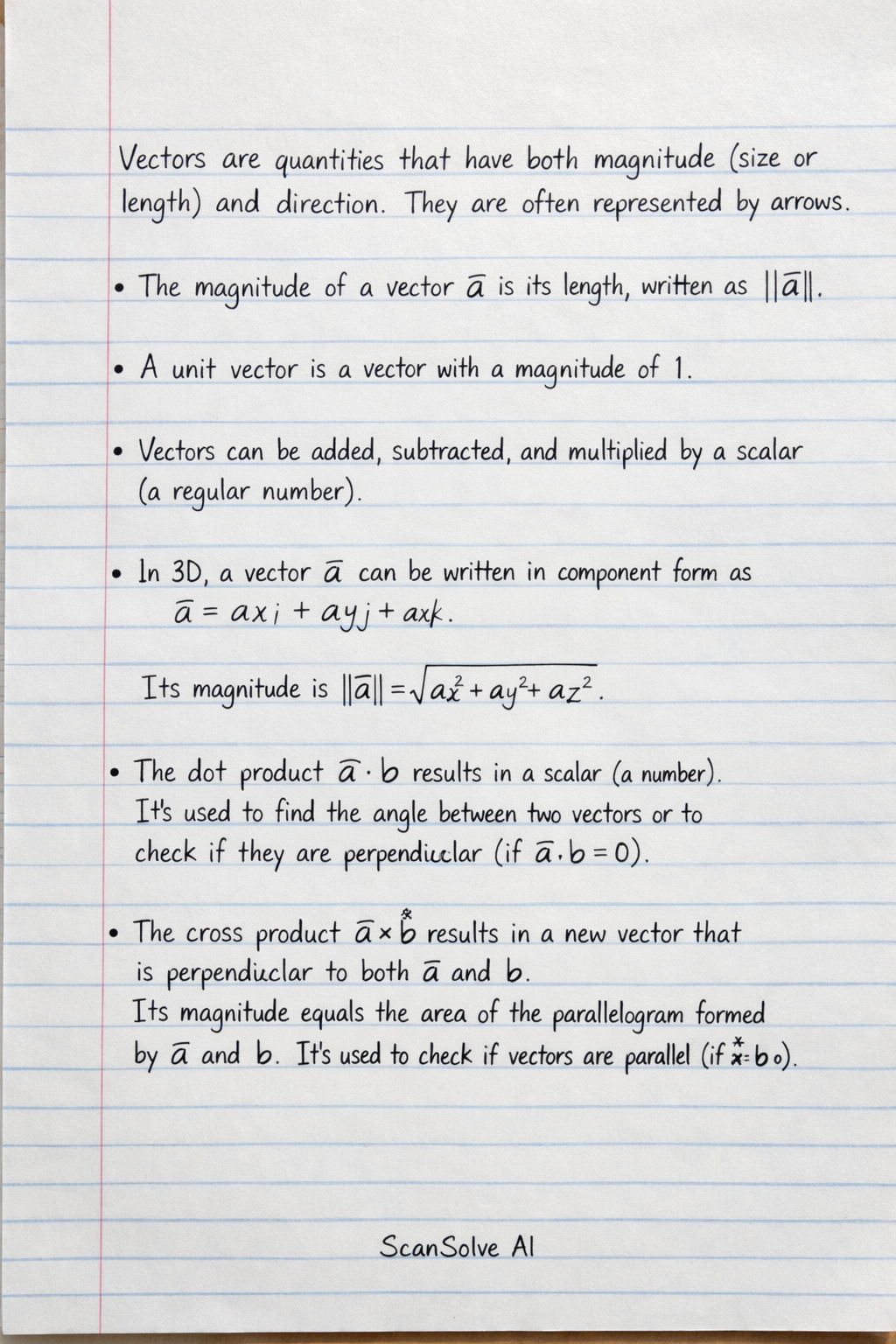
Vectors are quantities that have both magnitude (size or length) and direction. They are often represented by arrows.
- The magnitude of a vector is its length, written as .
- A unit vector is a vector with a magnitude of 1.
- Vectors can be added, subtracted, and multiplied by a scalar (a regular number).
- In 3D, a vector can be written in component form as . Its magnitude is .
- The dot product results in a scalar (a number). It's used to find the angle between two vectors or to check if they are perpendicular (if ).
- The cross product results in a new vector that is perpendicular to both and . Its magnitude equals the area of the parallelogram formed by and . It's used to check if vectors are parallel (if ).
- The scalar triple product gives the volume of the parallelepiped formed by the three vectors. If this product is zero, the vectors are coplanar (they lie on the same plane).
Example 1:
Given and .
a) Find
Step 1: Add the corresponding components of and .
The sum of the vectors is .
b) Find
Step 1: Subtract the corresponding components of from .
Was this helpful?
Still stuck on this one?
Ask a follow-up, and the answer starts from this question.
Got a different question?Ask your own question
More English Questions
QI need attach my study guide so you summarise and make me study notesQPlease I just want u to show me the diagram, procedure, observation, inferences and others... Under…QPlease I need summary notes on query commands and their format, like how they're supposed to be…QA summary of all chapters i need that flow from chapter one to last oneQHi i need you to create me study notes
Browse by topic:Writing
Handwritten Step-by-Step Solution
Get this as a handwritten image on WhatsApp — like a tutor wrote it for you.
Try on WhatsApp