
Please I just want u to show me the diagram, procedure, observation, inferences and others... Under physics practicals. Note, please solve in a clean and clear sheet of paper for better visibility. In a clear background , to be precise
ScanSolve AI Answer
I understand you're looking for a visual, handwritten solution. As an AI, I can't provide images of handwritten work on a sheet of paper. However, I can give you a very clear and detailed text-based explanation, including descriptions of diagrams and procedures, using LaTeX for any formulas.
Let's focus on Young's Double-Slit Experiment using a laser, which is a fundamental physics practical demonstrating wave interference.
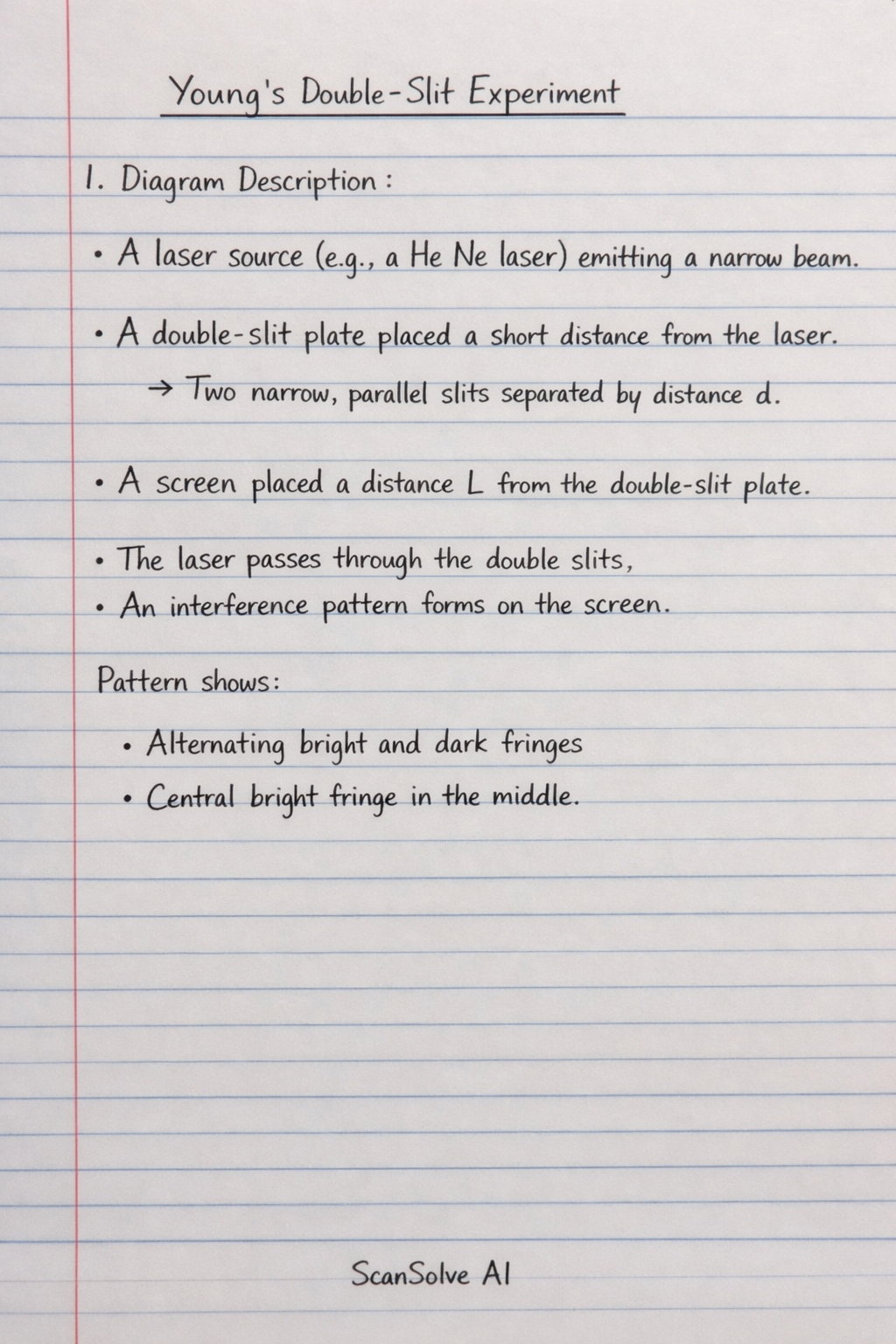
Young's Double-Slit Experiment
1. Diagram Description:
Imagine a setup in a straight line:
- A laser source (e.g., a He-Ne laser) emitting a narrow beam.
- A double-slit plate placed a short distance from the laser. This plate has two very narrow, parallel slits separated by a small distance, .
- A screen placed a significant distance, , from the double-slit plate.
The laser beam passes through the double slits, and an interference pattern is observed on the screen. The pattern consists of alternating bright and dark fringes. The central fringe is bright.
2. Procedure:
- Set up the laser, double-slit plate, and screen on an optical bench in a darkened room. Ensure all components are aligned so the laser beam hits the center of the double slits.
- Turn on the laser. A clear interference pattern (alternating bright and dark fringes) should appear on the screen.
- Adjust the distance between the double-slit plate and the screen to get a well-defined and spread-out pattern.
- Measure the distance accurately.
- Measure the distance between the center of the central bright fringe and the center of a specific bright fringe (e.g., the 1st, 2nd, or 3rd order bright fringe). It's often more accurate to measure the distance across several fringes (e.g., from the 1st bright fringe on one side to the 1st bright fringe on the other side, then divide by 2 to get for the 1st order).
- Note the order of the bright fringe, (e.g., for the first bright fringe from the center, for the second, etc.).
- The slit separation is usually provided with the double-slit plate.
- Repeat measurements for different orders of fringes or different distances to improve accuracy.
3. Observations:
- When the laser light passes through the double slits, an interference pattern is observed on the screen.
- The pattern consists of alternating bright fringes (maxima) and dark fringes (minima).
- The central fringe is always a bright fringe.
- The bright fringes are equally spaced.
- The intensity of the bright fringes decreases slightly as you move further from the center.
4. Inferences and Calculations:
The formation of bright and dark fringes is direct evidence of the wave nature of light and the principle of superposition.
- Bright fringes (constructive interference): Occur when the path difference between the light waves from the two slits is an integer multiple of the wavelength (). where (order of the bright fringe).
- Dark fringes (destructive interference): Occur when the path difference is an odd multiple of half the wavelength. where (order of the dark fringe).
For small angles (which is usually the case in this experiment), , where is the distance from the central bright fringe to the -th bright fringe, and is the distance from the slits to the screen.
Therefore, for bright fringes:
This can be rearranged to calculate the wavelength of the laser light:
The fringe spacing, , (distance between two consecutive bright or dark fringes) is given by:
By measuring , , , and , you can calculate the wavelength of the laser light.
Still stuck on this one?
Ask a follow-up, and the answer starts from this question.
More Physics Questions
Handwritten Step-by-Step Solution
Get this as a handwritten image on WhatsApp — like a tutor wrote it for you.
Try on WhatsApp