
We read your photo as:
Help.me with an essay and mind map a written essay please
ScanSolve AI Answer
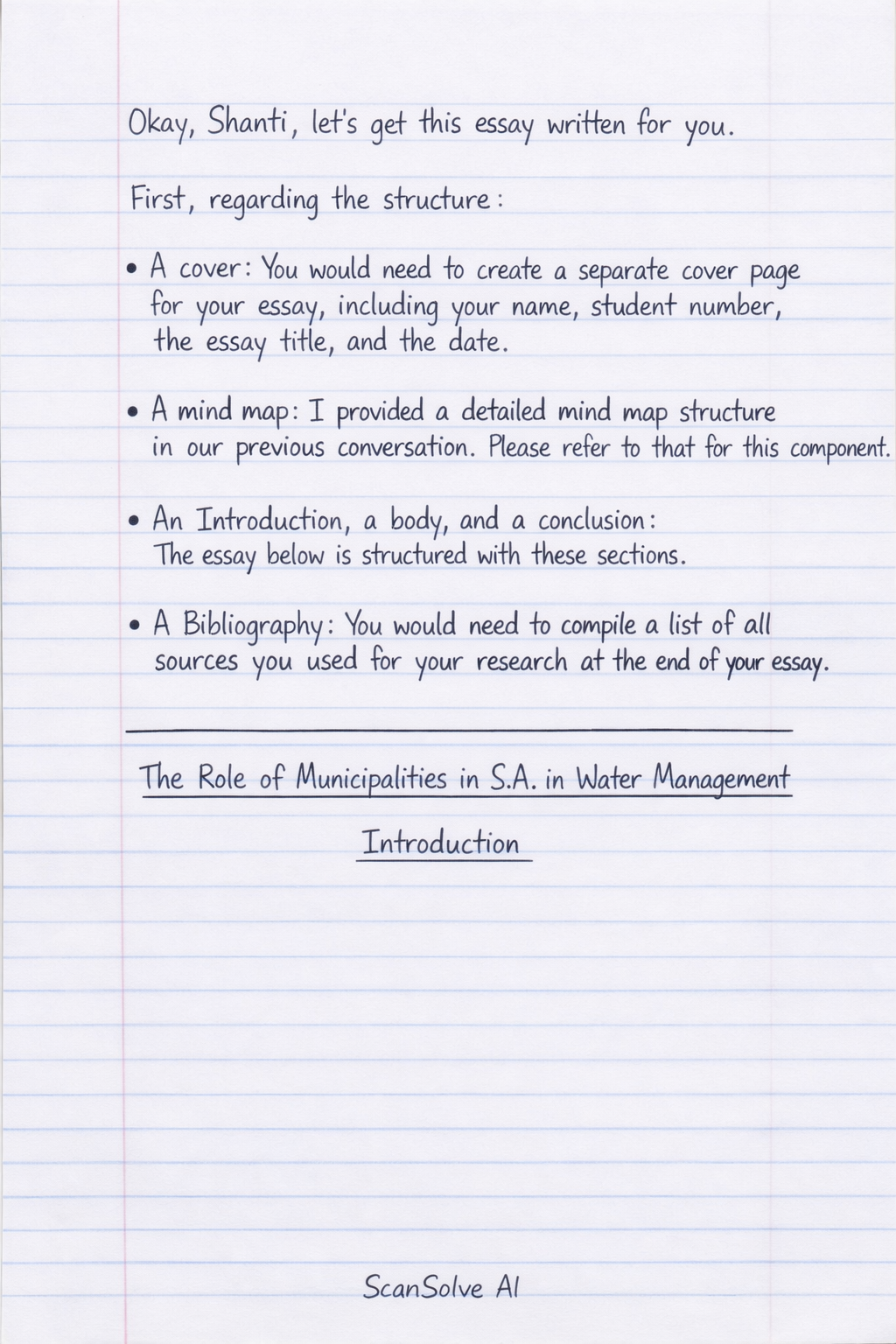
Okay, Shanti, let's get this essay written for you.
First, regarding the structure:
- A cover: You would need to create a separate cover page for your essay, including your name, student number, the essay title, and the date.
- A mind map: I provided a detailed mind map structure in our previous conversation. Please refer to that for this component.
- An Introduction, a body, and a conclusion: The essay below is structured with these sections.
- A Bibliography: You would need to compile a list of all sources you used for your research at the end of your essay.
The Role of Municipalities in S.A. in Water Management
Introduction
Water is the lifeblood of any nation, indispensable for human survival, public health, and socio-economic development. In South Africa, a water-scarce country, the provision of clean and reliable water services is a critical challenge. This essay argues that municipalities play a pivotal, yet often struggling, role in ensuring water security for the nation, facing significant systemic challenges that demand strategic and collaborative interventions to safeguard both communities and the environment.
The Importance of Water and Municipal Responsibilities
The fundamental importance of water cannot be overstated. It is essential for human consumption, hygiene, and sanitation, directly impacting public health and preventing waterborne diseases. Economically, water underpins vital sectors such as agriculture, industry, and mining, which are crucial to South Africa's GDP and employment. Environmentally, it sustains ecosystems and biodiversity. Given this critical role, municipalities are constitutionally mandated to ensure access to basic services, including water. Their responsibilities encompass the entire water value chain: from sourcing and purifying bulk water, through its distribution to households and businesses, to the collection and treatment of wastewater, and the ongoing maintenance and upgrading of extensive water infrastructure.
Water Management, Purification, and Challenges
Municipalities manage and maintain water purification systems through a complex network of infrastructure and processes. This involves operating water treatment plants where raw water undergoes filtration, chemical treatment, and disinfection to meet potable standards. Regular water quality monitoring and testing are crucial to ensure compliance. Furthermore, they are responsible for the vast distribution networks, including pipes, pumps, and reservoirs, that deliver water to consumers. However, municipalities face numerous challenges in providing reliable water services. These include aging and poorly maintained infrastructure, leading to significant water losses through leaks and bursts. Financial constraints, often exacerbated by non-payment for services and inadequate budget allocation, hinder necessary investments. A critical shortage of skilled personnel and technical expertise further compromises operational efficiency. Compounding these issues are external factors such as the increasing frequency and severity of droughts due to climate change, rapid urbanization placing immense pressure on existing resources, and widespread water pollution from industrial, agricultural, and domestic sources.
Impacts of Poor Management and Strategies for Improvement
The consequences of poor water management at the municipal level are severe, impacting both communities and the environment profoundly. Communities suffer from increased health risks due to contaminated water, leading to outbreaks of diseases like cholera and typhoid. Water shortages disrupt daily life, impede economic activities, and can spark social unrest. Environmentally, untreated wastewater pollutes rivers and dams, harming aquatic life and degrading natural ecosystems. To mitigate these impacts and improve services, municipalities must implement multi-faceted strategies. Key among these is significant investment in upgrading and modernizing water infrastructure, alongside adopting new technologies for treatment and distribution. Capacity building and training programs are essential to address skills shortages. Implementing robust water demand management strategies, including leak detection, smart metering, and public awareness campaigns for conservation, can reduce consumption. Exploring alternative water sources, such as desalination, groundwater abstraction, and rainwater harvesting, is also crucial. Finally, fostering public-private partnerships and enhancing governance, transparency, and accountability in water resource management are vital for sustainable solutions.
Conclusion
In conclusion, municipalities in South Africa bear an indispensable and complex responsibility for ensuring water security. While they are tasked with the critical provision and management of water services, they grapple with a myriad of challenges, from dilapidated infrastructure and financial constraints to climate change impacts and skills deficits. The repercussions of these challenges are far-reaching, affecting public health, economic stability, and environmental integrity. Addressing these issues requires a concerted effort involving strategic investments, technological adoption, human capital development, and collaborative governance. Only through such integrated and sustained interventions can South Africa achieve reliable and sustainable water management for all its citizens.
Bibliography
(You would list your sources here, formatted according to your school's requirements, e.g., APA, MLA, Harvard.)
Still stuck on this one?
Ask a follow-up, and the answer starts from this question.
More English Questions
Handwritten Step-by-Step Solution
Get this as a handwritten image on WhatsApp — like a tutor wrote it for you.
Try on WhatsApp